



|
Getting your Trinity Audio player ready...
|
By: Andrew Carlson
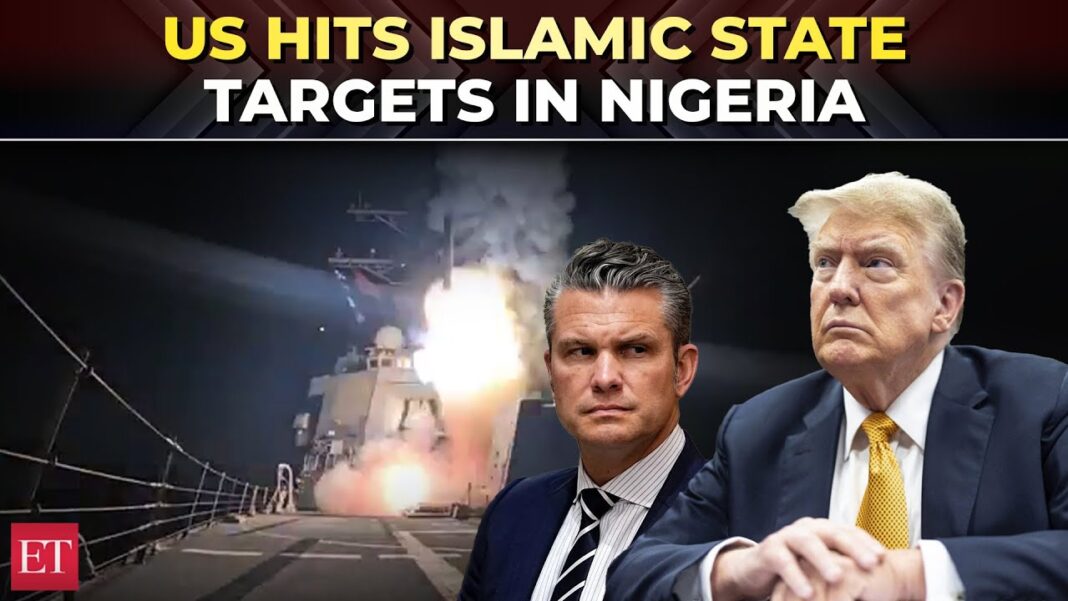
In a dramatic escalation of American involvement in West Africa’s long-running battle against jihadist insurgency, the United States carried out a military airstrike in northwest Nigeria on Christmas Day, targeting operatives affiliated with the Islamic State. The strike, ordered directly by President Donald Trump, was framed explicitly as a response to the terrorist group’s ongoing persecution and killing of Christians in the region—a justification that has drawn international attention and marked a sharp rhetorical and strategic shift in Washington’s counterterrorism posture.
According to a report that appeared on Friday at The Jewish News Syndicate (JNS), President Trump announced the operation in a forceful social media statement, declaring that U.S. forces had conducted what he described as a “powerful and deadly strike” against ISIS targets operating inside Nigeria. The announcement was later confirmed by U.S. Africa Command (AFRICOM), which stated that the strike was carried out at the request of the Nigerian government and resulted in the deaths of “multiple ISIS terrorists.”
The timing of the operation—on Christmas Day—was no coincidence. As JNS has documented in its coverage of Islamist violence across sub-Saharan Africa, Christian communities in Nigeria have increasingly been targeted during religious holidays, when gatherings are larger and symbolic resonance is greatest. Trump’s language left little doubt that the strike was intended not only as a tactical blow against ISIS’s West African affiliates, but also as a warning shot to Islamist groups operating in the region.
“Tonight, at my direction as Commander in Chief, the United States launched a powerful and deadly strike against ISIS Terrorist Scum in Northwest Nigeria,” Trump wrote. “I have previously warned these Terrorists that if they did not stop the slaughtering of Christians, there would be hell to pay, and tonight, there was.”
The Christmas strike followed months of increasingly blunt warnings from the Trump administration. In November, Trump publicly threatened U.S. military action if Nigeria’s government failed to halt attacks on Christians by Islamist groups, including ISIS-linked factions and Boko Haram offshoots. As JNS reported at the time, Trump accused militant Islamists of carrying out systematic violence against Christian civilians with impunity, while local authorities struggled to contain the insurgency.
Nigeria, Africa’s most populous country, has for years been caught in a brutal conflict involving multiple extremist groups, criminal gangs, and ethnic militias. While much of the world associates Nigerian terrorism with Boko Haram, ISIS’s West Africa Province (ISWAP) has emerged as an increasingly lethal force, particularly in the country’s northwest and northeast. According to human rights organizations cited in the JNS report, Christian villages have been raided, churches burned, clergy kidnapped, and worshippers massacred in attacks that often receive limited international attention.
Trump’s decision to authorize direct U.S. military action represents a notable departure from the more restrained approach taken by previous administrations, which largely confined American involvement to intelligence sharing, training, and logistical support for Nigerian forces. In contrast, the Christmas strike underscores Trump’s stated willingness to use American firepower unilaterally when he believes red lines—particularly involving religious persecution—have been crossed.
U.S. Africa Command confirmed that the airstrike was conducted in coordination with Nigerian authorities, a detail that appears designed to underscore the operation’s legitimacy under international law. According to AFRICOM’s statement, the strike targeted ISIS operatives believed to be directly involved in attacks on civilian populations.
“The strike was conducted at the request of the Nigerian government,” AFRICOM said, adding that it resulted in the deaths of “multiple ISIS terrorists.” While specific casualty figures and operational details were not immediately released, military officials emphasized that the strike was carefully planned to minimize civilian harm—a recurring concern in counterterrorism operations across densely populated or poorly mapped regions.
For Nigeria’s embattled government, the U.S. intervention may offer both relief and embarrassment. On one hand, American military involvement strengthens Nigeria’s hand against a resilient insurgency that has repeatedly humiliated local security forces. On the other, it highlights the Nigerian state’s ongoing inability to protect vulnerable communities, particularly Christians in rural areas.
As JNS has noted in previous analyses, accusations of official indifference—or worse—toward anti-Christian violence have fueled domestic and international criticism of Nigeria’s leadership. The Trump administration’s explicit framing of the strike as a defense of Christians places additional pressure on Abuja to demonstrate tangible progress.
The Christmas airstrike also appears to be part of a broader messaging campaign aimed at Islamist groups beyond Nigeria. Secretary of War Pete Hegseth reinforced this interpretation on Thursday, warning that additional U.S. action could follow if ISIS or similar groups continue targeting “innocent Christians in Nigeria (and elsewhere).”
That final clause—“and elsewhere”—has not gone unnoticed. Analysts quoted by The Jewish News Syndicate suggest it may signal a more expansive doctrine in which religious persecution, particularly of Christians, becomes a central trigger for U.S. military intervention. Such an approach would mark a significant evolution in American counterterrorism policy, which has traditionally emphasized direct threats to U.S. interests rather than humanitarian or religious considerations.
Critics argue that framing military action around religious identity risks inflaming sectarian tensions and could be exploited by jihadist propaganda. Supporters, however, contend that the scale and brutality of anti-Christian violence in parts of Africa demand a moral as well as strategic response.
“Christians are being slaughtered in Nigeria, and the world has largely looked away,” one policy expert told JNS. “This strike sends a message that the United States is no longer willing to ignore that reality.”
International reaction to the strike has been mixed. Some human rights advocates welcomed decisive action against ISIS but cautioned that airstrikes alone cannot resolve the underlying drivers of violence, such as poverty, weak governance, and intercommunal conflict. Others expressed concern about potential civilian casualties and the precedent of unilateral action justified on religious grounds.
Within the United States, Trump’s supporters praised the move as a long-overdue defense of persecuted Christians abroad. Conservative commentators cited by The Jewish News Syndicate framed the strike as consistent with Trump’s “America First” doctrine, arguing that confronting jihadist violence overseas ultimately enhances U.S. security at home.
The operation also carries implications for U.S.-Africa relations more broadly. As Washington seeks to counter growing Chinese and Russian influence on the continent, decisive military support against terrorism may bolster American standing among governments facing similar threats. At the same time, it risks entangling the United States more deeply in conflicts that have proven stubbornly resistant to external solutions.
That the strike occurred on Christmas imbues it with symbolic weight. For Christians in Nigeria—many of whom attended services under the shadow of violence—the news that ISIS operatives had been targeted by U.S. forces on one of Christianity’s holiest days was received as a rare sign of international solidarity. JNS reported that church leaders in Nigeria described the action as “encouraging,” though they emphasized the need for sustained protection rather than isolated gestures.
For ISIS and its affiliates, the message was equally clear: continued attacks on civilians, particularly those framed as religious persecution, may now invite direct and lethal American intervention.
Whether the Christmas strike marks the beginning of a more assertive U.S. role in Nigeria—or remains a singular episode tied to Trump’s personal convictions—remains uncertain. What is clear, as The Jewish News Syndicate has underscored, is that the operation has injected new urgency and moral framing into the global fight against jihadist terror.
As smoke cleared over northwest Nigeria on Christmas morning, the reverberations of the strike traveled far beyond the battlefield. They reached the corridors of power in Abuja, the propaganda networks of ISIS, and the pews of threatened churches across Africa. In doing so, the United States signaled that, at least for now, the persecution of Christians is no longer a peripheral concern—but a line that, once crossed, may draw fire from the sky.
Some may say that President Trump gave Christmas gifts to ISIS from above the trees instead of putting them below the Christmas trees.