



|
Getting your Trinity Audio player ready...
|
Charlie Kirk’s Memory Towers Over London as 110,000 Rally for Free Speech in Largest Nationalist Demonstration in Decades
By: Fern Sidman
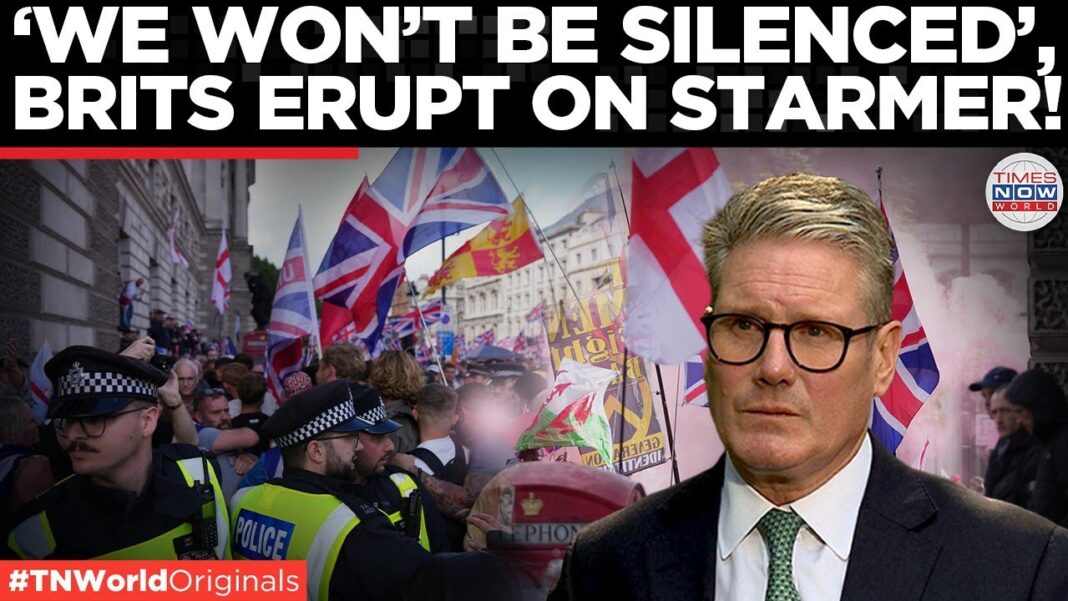
London witnessed one of the most extraordinary public demonstrations in decades on Saturday as more than 110,000 people marched through the heart of the capital for what organizers proudly declared a “festival of free speech.” The unprecedented gathering, spearheaded by British activist Stephen Yaxley-Lennon—better known as Tommy Robinson—was not only a defiant statement against censorship and political conformity but also a heartfelt tribute to the slain American conservative leader Charlie Kirk, whose face and message appeared on banners and placards across Westminster.
As The Guardian of the UK reported, the scale of the event vastly outstripped the expectations of the Metropolitan Police, who had predicted only a fraction of the turnout. Instead, London found itself at the epicenter of a mass nationalist protest unparalleled in recent British history.
Participants arrived in London from across the country, traveling by train and coach to join what many described as a patriotic obligation. Early in the morning, crowds draped in Union Jacks and St. George’s flags streamed into Westminster, determined to make their voices heard. By midday, Westminster Bridge was thronged with tens of thousands chanting “Tommy, Tommy,” “Whose street? Our street,” and “England.”
As The Guardian report noted, the atmosphere was equal parts jubilant and defiant. The demonstration was explicitly billed as a stand against the erosion of free expression in the United Kingdom. Stalls near Whitehall sold Robinson’s books, including Manifesto: Free Speech, Real Democracy, Peaceful Disobedience and Mohammed’s Koran: Why Muslims Kill for Islam. For supporters, the literature was not propaganda but the intellectual foundation of a broader movement calling for liberty, accountability, and the defense of national identity.
For many marchers, the memory of Charlie Kirk infused the rally with deeper significance. Kirk, the American activist gunned down on Wednesday, was lionized not merely as a conservative but as a martyr for free speech itself.
One elderly woman, who traveled from Merseyside with her son, held a placard bearing Kirk’s image alongside the words: “God bless, never forget.” “I’m British through and through; this is our capital,” she told The Guardian. “I had to be here today for our country.” Her son added, “I feel our country is being inundated with the ideology which is trying to suppress us. I just want our country back.”
Another marcher from South Wales, Carol, carried a sign reading “Change my mind: RIP Charlie”—a direct reference to Kirk’s famed campus debates. She admitted she had only discovered Kirk’s work a year ago through social media, but his message resonated with her. “Charlie represented honesty and courage,” she said. “It’s fitting that this event honors his spirit.”
By the time speeches began, Whitehall was so overcrowded that police were forced to close off access. Yet even outside the official rally point, chants of Kirk’s name could be heard echoing across Westminster.
The massive London turnout was not confined to domestic voices. The Guardian reported that French politician Éric Zemmour addressed the rally, warning of the “great replacement” of Europe’s historic peoples by unchecked migration from the Global South. His message, controversial to some, drew roaring approval from the assembled crowd.
The day’s most unexpected voice, however, came from Silicon Valley. Elon Musk, dialing in via video link, delivered a stark warning about the “rapidly increasing erosion of Britain.” In remarks that shocked political commentators, Musk even called for the dissolution of the UK Parliament, saying only a reset of the political order could restore faith in democratic institutions.
The Metropolitan Police, overwhelmed by the size of the demonstration, reported 25 arrests and 26 injured officers, including four seriously hurt. Officers cited incidents of affray, violent disorder, and criminal damage, with bottles, flares, and projectiles thrown in confrontations near Whitehall.
Still, supporters insisted the vast majority of attendees were peaceful. “The establishment always wants to paint us as thugs,” one marcher told The Guardian. “But look around—families, elderly people, veterans. This is about love for our country, not hate.”
Approximately 5,000 counter-protesters—largely trade unionists and anti-fascist activists—marched separately through central London. Yet their presence was dwarfed by the sheer scale of Robinson’s supporters, underscoring what The Guardian described as the largest nationalist demonstration in Britain in living memory.
For all the headlines about Robinson and Kirk, the human stories in the crowd painted the clearest picture of why people had traveled hours to stand shoulder-to-shoulder in London.
The Merseyside woman recalled growing up among neighbors from Africa and Pakistan. “We were all one,” she said. “It’s not about race, this is the government just overcrowding our country.” Her words challenged simplistic labels, insisting the rally was not motivated by racial animus but by concerns over government mismanagement and the silencing of dissent.
Carol from South Wales described her attendance as a plea for unity. “We need to unite the kingdom. It just seems so divided. Half the country can say whatever they want, the other half has to watch everything they do. That’s not freedom.”
Such testimonies, reported by The Guardian, revealed a crowd less defined by extremism than by frustration at what they see as double standards and the suffocation of democratic expression.
Critics will no doubt describe the rally as extremist. Yet for Robinson’s supporters, that narrative is precisely why they marched. As one participant put it, “They label us far-right because they’re afraid of what we represent—ordinary people who won’t be silenced.”
This sentiment was amplified by the memory of Charlie Kirk. In his campus debates, Kirk famously challenged students and professors alike with open invitations to “change my mind.” To his admirers in London, that willingness to face hostile crowds with reasoned arguments embodied the essence of free speech. His assassination and the mainstream media’s often dismissive coverage of it, made his image a powerful symbol at the rally.
As The Guardian report acknowledged, the combination of Kirk’s martyrdom and Robinson’s unapologetic leadership gave the protest an almost transatlantic character—a meeting of British and American voices united under a single banner of free expression.
The scale of the demonstration will have lasting political consequences. British authorities now face the difficult task of addressing the grievances that drew more than 110,000 people into the streets. For Tommy Robinson, the rally marks perhaps the peak of his influence, proving he can mobilize supporters in numbers that rival any mainstream political figure.
For Charlie Kirk’s admirers, the event ensured that his legacy lives on far beyond American campuses. His face, carried through Westminster, symbolized not only a tribute but also a declaration: free speech must not die with him.
As The Guardian report indicated, the rally was a watershed moment. Whether remembered as a patriotic uprising or condemned as a nationalist provocation, it revealed a deep undercurrent in British society—a yearning for voice, for unity, and for leaders unafraid to speak plainly.
The London rally was about more than Tommy Robinson, and more than Charlie Kirk. It was about ordinary Britons reclaiming their right to speak without fear. It was about mothers, veterans, young people, and pensioners demanding accountability from a political class they no longer trust. And it was about solidarity—between Britain and America, between the living and the dead—expressed in chants, placards, and a sea of flags.
In the words of one marcher, “This isn’t far-right. This is free speech. And if we don’t stand up for it now, we’ll lose it forever.”