



|
Getting your Trinity Audio player ready...
|
Campus Under Siege: Pro-Hamas Rioters Shatter Police Lines as Montreal Universities Descend into Chaos
By: Fern Sidman
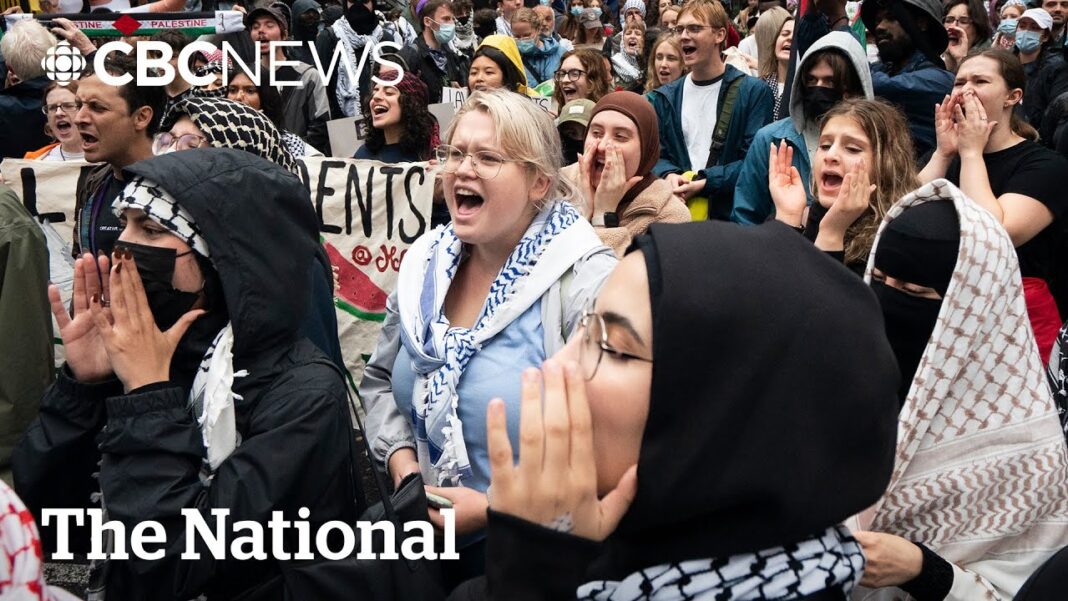
Downtown Montreal descended into chaos on Tuesday as violent anti-Israel demonstrations at Concordia University and McGill University erupted into full-scale riots, forcing closures, arrests, and widespread condemnation from Israeli and Canadian authorities alike. The turmoil came just a day after Israel’s Foreign Ministry denounced pro-Hamas student groups at Montreal universities for what it called their “shameful glorification of terrorism.”
According to a report that appeared on Wednesday at The Jewish News Syndicate (JNS), hundreds of masked protesters clashed with riot police, hurled incendiary devices, and burned Israeli flags as officers struggled to regain control of the city’s academic core. Montreal’s downtown, long regarded as a multicultural hub of student life, transformed within hours into a tense battleground, echoing the ideological violence that has swept North American campuses since the Hamas massacres of October 7, 2023.
The unrest began Monday, when Concordia University officials announced they were closing the Sir George Williams campus amid “threats of extreme disruption.” In an email obtained by Canada’s National Post and cited in the JNS report, Concordia President and Vice Chancellor Graham Carr told students and staff that “hundreds of protesters from other universities and cégeps [Quebec’s public colleges] were expected” to converge on the downtown campus.
Carr said the school could not “operate as usual” under those conditions. Two individuals were arrested earlier that day after “disrupting a class and midterm exam,” one of whom was found carrying “a metal bar and several incendiary devices.”
By Tuesday afternoon, those fears were realized. What began as a demonstration rapidly deteriorated into violent clashes between pro-Palestinian and pro-Israel groups, with Montreal police—known as the SPVM—deploying riot units to contain the escalating violence. Witnesses described clouds of smoke rising near McGill’s lower campus as police in full armor advanced in tight formation, striking batons against shields in rhythmic bursts, a tactic designed to disperse rioters.
As JNS reported, officers found themselves outnumbered at times as demonstrators surged through police lines, setting off smoke bombs and vandalizing university property. Onlookers recounted scenes of panic: students sheltering in libraries, staff members fleeing down back corridors, and at least one small fire igniting near a campus monument before being extinguished.
Both McGill and Concordia—two of Canada’s most prominent academic institutions—have found themselves at the center of a storm that began with student activism but now bears the unmistakable hallmarks of organized political violence.
According to the information provided in the JNS report, the initial demonstration was promoted online by local student groups commemorating what they described as the “resistance anniversary” of October 7—the day Hamas terrorists invaded southern Israel, murdering more than 1,200 civilians, raping women, and abducting 250 hostages into Gaza. The Israeli Foreign Ministry condemned the event in a blistering statement on X, declaring that the groups were “celebrating murder, rape, and kidnapping under the protection of a Canadian university.”
“These groups don’t support peace or justice,” the statement read. “They’re celebrating atrocities carried out by Hamas terrorists. Terror has no place on campus.”
The JNS report noted that the condemnation was one of the strongest statements Israel has issued regarding campus unrest in North America. It reflected growing frustration within Jerusalem that Western universities have become incubators for antisemitism and political extremism since the war in Gaza began.
At Concordia, university administrators said their decision to shutter the campus was not merely precautionary but necessary for safety. “The threat of extreme disruption is simply too high,” Carr wrote in his message to faculty. That assessment was vindicated just 24 hours later, as chaos erupted a few blocks away at McGill.
By late afternoon Tuesday, JNS reported, the situation had spiraled out of control. Thousands of demonstrators flooded the streets surrounding McGill’s downtown campus. Initially separated by police barricades, pro-Israel counter-protesters and pro-Palestinian activists shouted slogans and traded accusations until the line broke.
An Israeli flag was set ablaze near the campus gates, and chants of “Intifada, intifada!” rose from the crowd. Riot police advanced to clear the area, but several groups of demonstrators stormed McGill’s main quadrangle, igniting smoke grenades and unfurling banners bearing the Hamas emblem.
Students caught inside the campus described terrifying scenes. “We heard explosions—smoke bombs or something like that—and the police shouting for people to get down,” one undergraduate told JNS. “There was panic everywhere.”
The Montreal Gazette confirmed that at least two people were injured in the melee, though authorities have not released their names. Police made several arrests as officers re-established control of the campus by evening.
The Israeli Foreign Ministry’s criticism, issued a day earlier, loomed large over the unfolding events. In its statement—quoted in the JNS report — the ministry called the Concordia rally “shameful,” accusing organizers of “glorifying terrorism under the banner of resistance.”
“Celebrating the massacre of October 7 is not political speech—it is incitement to violence,” said one Israeli diplomat interviewed in the JNS report. “Universities that tolerate such activity are not exercising free expression; they are enabling hate.”
Canadian officials, too, faced mounting pressure to respond. While Montreal police emphasized that they had been aware of planned demonstrations and deployed units “to ensure everyone’s safety,” critics argued that the city’s response was reactive and insufficient.
“This wasn’t a peaceful protest that unexpectedly turned ugly—it was a riot waiting to happen,” a local Jewish community leader told JNS. “There were warnings on social media, clear threats of violence, and the universities had already shut down. The police should have acted faster.”
For Jewish students in Montreal, Tuesday’s events reopened old wounds. As the JNS report pointed out, the symbolism of the date—the second anniversary of the Hamas massacre—was not lost on either side. While Israel and its allies mourned the worst attack on Jews since the Holocaust, radical student organizations were marking the occasion as a victory.
At universities across North America, similar tensions have played out since the war in Gaza began. From Columbia and UCLA to the University of Toronto, pro-Hamas encampments have often devolved into violent confrontations, forcing administrations to balance free speech with security.
What sets Montreal apart, as was observed in the JNS report, is the depth of the city’s cultural divisions. Quebec’s unique political climate—where secularism, nationalism, and anti-establishment sentiment intersect—has made its universities particularly fertile ground for anti-Jewish activism.
“These are not spontaneous expressions of grief for Gaza,” one analyst told The Jewish News Syndicate. “They are orchestrated campaigns aimed at delegitimizing Israel’s very existence.”
As the smoke cleared and riot police secured McGill’s perimeter late Tuesday night, Montreal faced a reckoning. How did a city once celebrated for pluralism and intellectual freedom become the epicenter of hate-fueled unrest?
Local Jewish leaders told JNS that the riot marks “a breaking point” for the city’s Jewish population, which numbers roughly 90,000—the second-largest in Canada. “This was not a protest about policy or politics,” said one rabbi. “It was an attempt to intimidate Jews and silence our voice in public spaces.”
Universities, for their part, are pledging investigations and security reviews. Concordia said in a follow-up statement that it is cooperating with Montreal police to identify outside agitators, while McGill announced the formation of a crisis task force to address campus safety.
Chief among their challenges, as the JNS report noted, will be restoring trust in institutions that many Jewish students now view as hostile. “We’re scared to wear kippot or carry Israeli flags,” a McGill senior told JNS. “We don’t feel protected anymore.”
The violence in Montreal shines a spotlight on a broader dilemma for Western democracies grappling with the convergence of free speech, academic radicalism, and globalized Jew hatred. For Israel, the images of burning flags and Hamas symbols on North American campuses serve as a painful reminder that the ideological war it fights abroad is also being waged in the West’s own lecture halls.
As the JNS report observed, the riots were not simply a local disturbance—they were “a reflection of a global battle over truth, morality, and memory.”
Montreal, still reeling from the shock, now stands as a microcosm of that struggle: a city torn between its liberal ideals and the violent extremism that has infiltrated its universities.
Or, as one commentator told JNS, “When hate masquerades as justice, it doesn’t stop at words—it ends in smoke.”
