



|
Getting your Trinity Audio player ready...
|
Budapest Hosts March of the Living in Honor of 550,000 Hungarian Holocaust Victims: Survivors and Youth Stand Together Against Rising Antisemitism
By: Fern Sidman
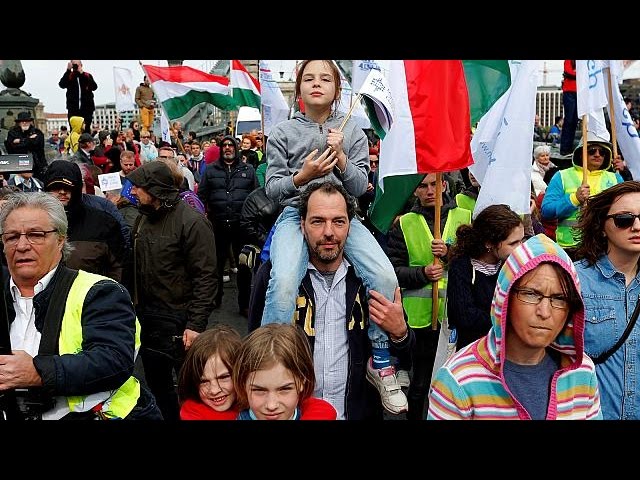
Eighty years after the fall of Nazi Germany and the liberation of Europe’s death camps, the heart of Budapest bore silent witness to memory, resilience, and a powerful call for vigilance. On Sunday, more than 5,000 participants, led by 60 Holocaust survivors, took part in a solemn March of the Living, organized to honor the memory of Hungary’s 550,000 Jews murdered during the Holocaust—many of them in one of the most brutal and rapid deportation campaigns of the Nazi regime.
As reported on Tuesday by The Jewish News Syndicate (JNS), the march traced a path through some of Budapest’s most poignant Jewish heritage sites: the Shoes on the Danube Bank Memorial, Jerusalem Park, and the Várkert Bazár, creating a living tapestry of remembrance in a city once home to a vibrant Jewish community devastated by Nazi terror.
The centerpiece of the commemoration was the horrific statistic that still casts a shadow over Hungary’s wartime legacy: 437,000 Hungarian Jews were deported to Auschwitz-Birkenau in just eight weeks between May and July of 1944. The efficiency and brutality of this operation remain among the most devastating episodes of the Final Solution.
The march in Budapest coincided with global events marking 80 years since the end of World War II, reflecting a wider effort to reassert historical truth and memory amid the disturbing resurgence of antisemitism in Europe and around the world.
Michel Gourary, European Director of the International March of the Living, addressed the participants with a message of urgency and responsibility.
“We must teach our children that history is not distant,” Gourary said, as quoted by JNS. “That evil can wear a familiar face. That prejudice, once normalized, becomes law. That silence, once accepted, becomes complicity.”
“The March of the Living is not only about remembering the past,” he continued. “It is about educating future generations to stand against antisemitism and bigotry in all its forms.”
A hallmark of this year’s March was the prominent involvement of youth, particularly Hungarian high school students. As the report at JNS noted, 150 students and educators from Hungary had participated in last month’s International March of the Living in Poland, walking alongside Holocaust survivors through Auschwitz and Birkenau.
This emphasis on youth participation reflects the program’s long-standing mission to fuse Holocaust education with moral responsibility—a critical goal as Holocaust denial, historical distortion, and antisemitism rise in both digital and political spheres.
One of the most moving moments came from Israel Shaked, a Holocaust survivor born in Hungary in 1942. Speaking to JNS, Shaked recounted his harrowing early years—deported from the Debrecen ghetto, diverted to forced labor in Vienna, and eventually forced on a death march to Mauthausen, where he was liberated in 1945.
“I was a witness to the darkness,” he said, according to the JNS report. “There were 130 people in our large and illustrious family. Only 10 of us survived.”
Yet, despite that darkness, Shaked’s message was one of resilience and defiance: “Despite everything, we will march with pride, in every place, carrying with honor our identity as members of the eternal nation. I choose hope. Do not let hatred win. Never again—for anyone, anywhere, at any time.”
As the JNS report observed, the march in Budapest was far more than a historical reenactment—it was a moral declaration in the face of mounting challenges. Across Europe, attacks on Jews and Jewish institutions have surged since October 7, 2023, when Hamas launched its massacre in southern Israel. In Hungary, as elsewhere, Jewish communities are grappling with both the ghosts of the past and the dangers of the present.
The message echoed by survivors, students, and organizers alike was clear: memory must be active, justice must be pursued, and hatred must be confronted before it metastasizes again into catastrophe.
As the voices of the remaining Holocaust survivors fade with time, initiatives such as the March of the Living—so powerfully chronicled by JNS —remain among the most vital tools in ensuring that future generations never forget. In Budapest, this year, that promise was honored with every step.
