



|
Getting your Trinity Audio player ready...
|
By: Fern Sidman
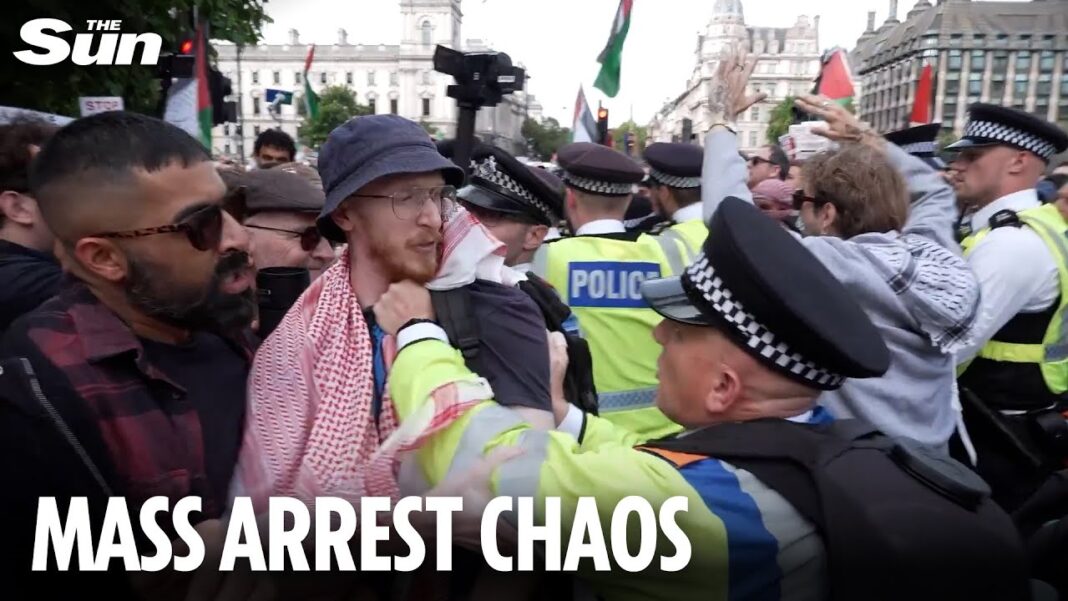
British police arrested more than 400 demonstrators outside the Houses of Parliament on Saturday, in one of the largest public order operations in recent memory, after activists gathered to protest the government’s decision to designate Palestine Action as a terrorist organization. The protest, which drew approximately 1,500 participants according to organizers, quickly escalated into confrontations as demonstrators sat in the streets, held banners in support of the banned group, and clashed with officers attempting to clear the area.
According to a report that appeared on Saturday at VIN News, law enforcement made the arrests under provisions of the Terrorism Act as well as for various public order offenses. Police described the protest as “deliberately disruptive,” noting that some demonstrators resisted removal and had to be forcibly carried away.
The mass arrests highlight the deepening controversy surrounding the government’s recent ban on Palestine Action and its wider implications for civil liberties in the United Kingdom.
Earlier this month, the British government formally designated Palestine Action as a terrorist organization, citing the group’s direct action campaigns targeting defense contractors with links to Israel. The organization, founded in 2020, has built its reputation through high-profile protests and acts of sabotage against factories and offices connected to Elbit Systems, Israel’s largest private arms manufacturer.
While supporters of the ban argue that Palestine Action’s tactics — including vandalism, break-ins, and property damage — cross the line from protest into terrorism, critics maintain that the move represents a dangerous conflation of civil disobedience with political violence. As VIN News reported, the ban criminalizes not only the group’s activities but also expressions of support for it, raising alarm among human rights advocates and civil libertarians.
Under the Terrorism Act, anyone found to be a member of Palestine Action, or who publicly supports the group, risks prosecution with penalties of up to 14 years in prison.
Against this backdrop, Saturday’s demonstration was designed to be a visible show of defiance. Organizers, who claimed an estimated 1,500 people participated, gathered outside Parliament carrying placards emblazoned with slogans such as “End the Ban” and “Resistance is Not Terrorism.” Others displayed Palestinian flags and chanted against Britain’s support for Israel.
The protest quickly turned into a test of the new legal boundaries. According to the information provided in the VIN News report, many attendees explicitly voiced support for Palestine Action — itself now a prosecutable offense — daring police to take them into custody. Scores of demonstrators sat cross-legged in the middle of Westminster streets, blocking traffic and refusing to move.
Police eventually moved in with large numbers of officers, arresting over 400 people. While most arrests were made peacefully, witnesses described scuffles as some demonstrators resisted removal. Officers carried protesters by their arms and legs into waiting vans as the crowds chanted “Free! Free Palestine!” and “Stop the Ban!”
The scale of the arrests has intensified debate over whether the British government’s response to Palestine Action represents a necessary safeguard against extremism or a troubling curtailment of civil liberties.
As the VIN News report noted, legal scholars and advocacy organizations have warned that the Terrorism Act, originally designed to combat violent groups such as Al-Qaeda or ISIS, is now being applied against activists engaged in political protest, however disruptive. Critics argue that this broad application risks chilling free speech and criminalizing dissent.
For Jewish and pro-Israel groups, however, the designation has been welcomed as long overdue. Palestine Action has targeted Jewish-owned businesses and defense firms, often using aggressive tactics that put employees at risk. As VIN News reported, Jewish leaders in the U.K. have described the group as operating in a “grey zone of extremism,” where political advocacy frequently spills into intimidation and destruction of property.
The British government has staunchly defended its decision, insisting that the terrorist designation was necessary to preserve public safety. Home Office officials argue that Palestine Action’s escalating tactics — including repeated attacks on defense-related infrastructure — present a threat not only to property but also to national security.
A Home Office spokesman told reporters that “no government can tolerate deliberate campaigns to damage critical industries or intimidate employees through fear and vandalism.” He added that the terrorist designation ensures law enforcement has the tools necessary to prevent escalation and deter copycat actions.
According to the information contained in the VIN News report, ministers have also dismissed claims that the ban undermines civil liberties, framing the issue as a matter of legality rather than politics. “Peaceful protest remains a fundamental right,” the spokesman said, “but criminal activity that crosses into terrorism cannot be excused under the banner of activism.”
The British ban has also drawn attention internationally, particularly given its timing amid heightened tensions over the Israel-Hamas conflict. Pro-Hamas activists worldwide have rallied around Palestine Action, presenting the U.K.’s move as evidence of Western governments’ complicity with Israel.
As the report at VIN News observed, the ban has already inspired solidarity protests in several European capitals, where demonstrators denounced what they described as an attack on the right to resist occupation. At the same time, Israel has quietly welcomed the U.K.’s stance, viewing it as validation of long-standing claims that anti-Israel activism often masks extremist intent.
Following Saturday’s arrests, organizers of the protest issued statements condemning the police response and pledging to continue their campaign. “This is not the end, it is the beginning,” one organizer told VIN News. “We will not be silenced by threats, arrests, or bans. Resistance will continue until Palestine is free.”
Civil liberties groups echoed the concern, describing the arrests as heavy-handed and warning of a slippery slope. Amnesty International’s U.K. branch, while not explicitly supporting Palestine Action, urged the government to ensure that anti-terror laws are not used to suppress legitimate protest.
On the other side, pro-Israel groups hailed the arrests as necessary to restore order. “This is a victory for law and order and a blow against extremism masquerading as activism,” one Jewish community leader told VIN News.
The events outside Parliament crystallize the broader divisions within British society over how to balance freedom of expression with the imperative to counter extremism. For supporters of the ban, Saturday’s protest was further proof that Palestine Action and its allies thrive on chaos and confrontation, and that firm measures are essential. For critics, the sight of hundreds of demonstrators being hauled away by police outside the seat of British democracy evokes an unsettling picture of authoritarian overreach.
As the VIN News report emphasized, the debate is unlikely to subside soon. Legal challenges to the ban are expected in the coming months, with activists preparing to test the boundaries of the Terrorism Act in British courts. Meanwhile, pro-Hamas organizations are already mobilizing to turn Saturday’s mass arrests into a rallying cry, framing those detained as political prisoners.
Saturday’s protest outside Parliament marks a significant escalation in Britain’s struggle to balance civil liberties with national security. With more than 400 arrests, police sent a clear message that support for Palestine Action will not be tolerated under the Terrorism Act. Yet the controversy over whether this constitutes necessary protection or an assault on free speech will continue to reverberate through British politics, courts, and communities.
The battle lines are now sharply drawn: one side sees extremism disguised as activism, while the other views a government bent on silencing dissent. In the weeks ahead, Britain will face the challenge of navigating these opposing narratives — and determining whether the ban on Palestine Action represents a bulwark against terrorism or a dangerous precedent for democracy itself.
