



|
Getting your Trinity Audio player ready...
|
By: Fern Sidman
British Prime Minister Keir Starmer’s declaration that the United Kingdom will recognize a Palestinian state by September unless Israel agrees to a ceasefire in Gaza has triggered an immediate and fierce response from Jewish groups across the UK. As The Jerusalem Post reported, community leaders are warning that such a move could amount to rewarding terrorism while dozens of hostages remain in captivity.
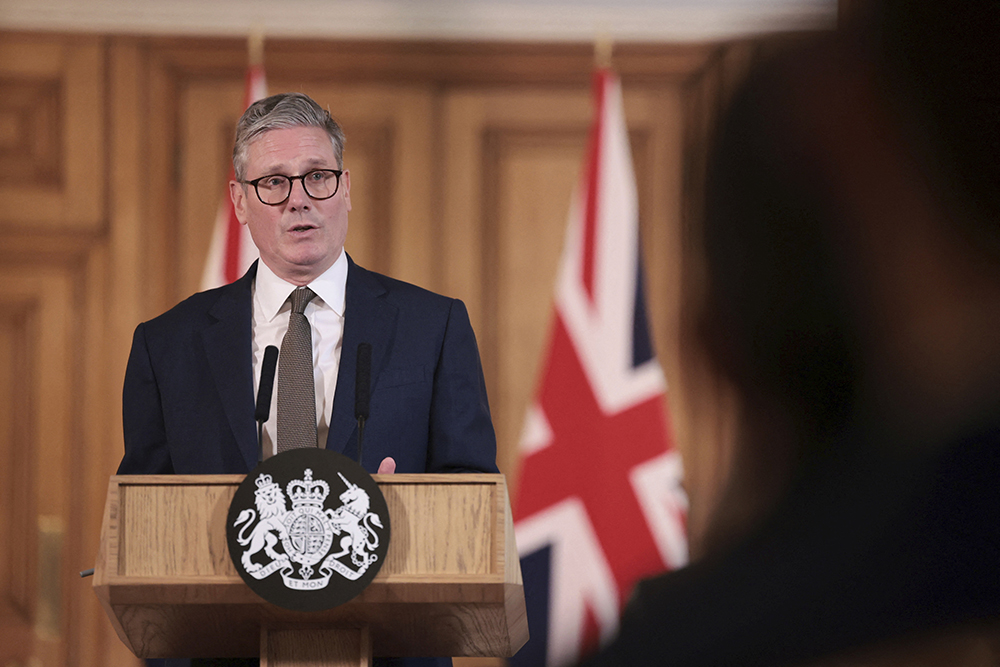
Starmer announced the policy shift on Tuesday, positioning it as part of a renewed commitment to the long-stalled two-state solution. He said the recognition would be brought to the United Nations General Assembly in September unless Israel took substantive steps to halt the conflict and commit to long-term peace.
In his remarks, Starmer underscored that Hamas must also accept a ceasefire, disarm, and agree to play no role in Gaza’s future governance. However, British Jewish organizations, citing reports in The Jerusalem Post, argued that the sequencing of recognition risks emboldening Hamas, particularly given the ongoing captivity of hostages taken during the October 7, 2023, massacre.
The Board of Deputies of British Jews, the country’s central representative body, expressed urgent concern. In a statement carried by The Jerusalem Post, the Board said it was seeking immediate clarification from the British government that recognition will not proceed if Hamas continues to hold hostages or refuses to accept a ceasefire.
“We must neither forsake the hostages nor reward Hamas terror or intransigence,” the Board stated. The message captured a growing unease within the Jewish community that the UK government’s timeline places diplomatic symbolism above the lives of captives.
The Board’s demand for clarity reflects what The Jerusalem Post report described as a wider alarm among Jewish leaders: that recognition of a Palestinian state under the current circumstances risks undercutting Israel’s security while incentivizing continued violence.
Perhaps the strongest criticism came from the Campaign Against Antisemitism (CAA). Speaking to The Jerusalem Post, the group said Starmer’s position is “morally indefensible.”
“There are still hostages held in torturous conditions in Hamas dungeons in Gaza. Keir Starmer should be saying that he will take the issue of Palestinian statehood off the table if the hostages are not returned by September or sooner,” CAA argued.
CAA warned that Starmer’s move sends “the worst message possible: that mass murder, rape, and hostage-taking are legitimate paths to diplomatic gain.” The organization added that recognition at this juncture would “embolden extremists,” encouraging Hamas to hold out in the expectation of diplomatic rewards.
The Jerusalem Post report highlighted CAA’s claim that this policy represents a form of appeasement reminiscent of past political miscalculations. In their words, recognition “in the aftermath of an antisemitic pogrom is not only reckless, it is shameful.”
Not all Jewish responses were outright rejections. Progressive Judaism in the UK issued a statement reiterating its longstanding support for a two-state solution. Still, it added an important caveat, stressing that recognition must not become “a reward for violence.”
As The Jerusalem Post report noted, Progressive Jewish leaders welcomed Starmer’s insistence that Hamas disarm and release hostages yet remained cautious about the potential unintended consequences of unilateral recognition.
“We call on the UK government to ensure that this step strengthens the forces of peace, not extremism, and creates real leverage for a negotiated outcome,” their statement read.
This position, as reported by The Jerusalem Post, highlights the tension within the Jewish community: a desire for a just and peaceful two-state solution, but not one that is dictated by the outcome of violence or hostage-taking.
The intensity of the response from British Jewish organizations is rooted not only in the current crisis but also in the broader historical backdrop of Britain’s complex role in the Middle East.
As The Jerusalem Post report indicated, Britain’s policies toward the region have been shaped since the Balfour Declaration of 1917, which endorsed the establishment of a “national home for the Jewish people” in Palestine. In the decades that followed, Britain’s administration of the Mandate for Palestine became marked by growing tensions, culminating in the UN Partition Plan of 1947 and the eventual establishment of Israel in 1948.
In the years since, successive British governments have alternated between firm support for Israel’s security and attempts to cultivate ties with Arab states. Recognition of Palestinian statehood has long been a subject of debate, with previous prime ministers—both Labour and Conservative—declining to take such a step unilaterally.
As The Jerusalem Post report pointed out, Starmer’s policy represents a significant break from past British caution. It places the UK alongside France, whose President Emmanuel Macron recently announced similar plans for recognition, and potentially makes London the first G7 capital to endorse Palestinian statehood at the UN.
Central to Jewish groups’ concerns, as the report in The Jerusalem Post emphasized, is the ongoing plight of the hostages taken during Hamas’s October 7 assault. With reports of captives held in dire conditions, any move to recognize Palestinian statehood before their release is seen as both morally untenable and strategically misguided.
For families of hostages, the prospect of recognition in September introduces new fears that Hamas will view continued captivity as leverage for international concessions. The Board of Deputies and CAA, as cited in The Jerusalem Post report, have repeatedly stressed that “hostages must not be abandoned in the name of diplomacy.”
Starmer’s declaration has also sparked debate within Westminster. According to The Jerusalem Post report, Labour Party members broadly applauded the move, framing it as a principled step toward peace. By contrast, members of the Conservative opposition criticized the policy for imposing conditions only on Israel, not on Hamas.
BBC international editor Jeremy Bowen, quoted in The Jerusalem Post, described Starmer’s statement as “a big change in British foreign policy.” That assessment underscores the magnitude of the shift: Britain, once hesitant to take unilateral steps in the Israeli-Palestinian conflict, is now positioning itself at the forefront of international recognition efforts.
Starmer’s announcement comes in the wake of French President Macron’s commitment to recognition at the September UN General Assembly. The Jerusalem Post report noted that Macron’s move had already drawn sharp criticism from Washington, where U.S. Secretary of State Marco Rubio called it “a reckless decision that only serves Hamas propaganda.”
The U.S. State Department further warned that such moves are “counterproductive gestures” that undercut American diplomatic efforts to secure a negotiated resolution in Gaza.
Against this backdrop, Britain’s alignment with France risks widening transatlantic divisions on Middle East diplomacy. For Jewish groups, this alignment appears dangerously premature, especially while the conditions on the ground remain unstable.
The central critique running through Jewish organizations’ responses, as The Jerusalem Post report indicated, is the fear that premature recognition risks emboldening extremist actors. By tying recognition to a September deadline, critics argue, the UK may inadvertently incentivize Hamas to maintain its violent posture in the expectation of diplomatic gain.
This fear reflects not only the hostage situation but also broader concerns that unilateral recognition could weaken Israel’s deterrence and embolden rejectionist movements across the region.
As September approaches, British Jewish organizations have made clear their demands: no recognition of Palestinian statehood without the return of hostages and a clear rejection of terrorism. Their warnings reflect not a rejection of the two-state solution but rather a conviction that peace must be built on negotiation and security, not coercion and violence.
For Prime Minister Starmer, the challenge will be navigating between his government’s stated vision of advancing peace and the widespread perception that his plan risks rewarding the very forces that perpetuate conflict.
The coming months will determine whether Britain’s bold step reshapes the international conversation around the two-state solution, or whether it deepens the divisions already inflamed by one of the most protracted and bitter conflicts in modern history.

A little reminder for the UK on what happened on this day in 1947. July 30th was the 13th of AV in 1947. On that day, the Irgun hanged two British soldiers. The Irgun answered gallows with gallows. That day was also Menachem Begin’s birthday. That is right. He was born on Saturday the 13th of AV in 1913 – Parshas Nachamu Nachamu Ami (be comforted be comforted my people). This year the 13th of AV will be August 7th, 2025. Interesting.