



|
Getting your Trinity Audio player ready...
|
By: Fern Sidman
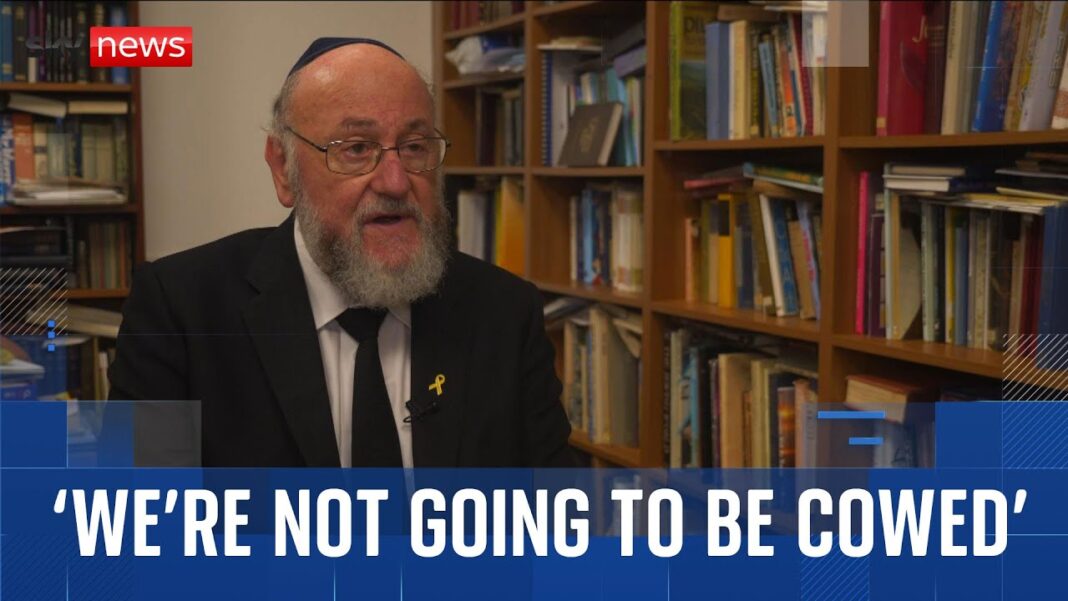
The atmosphere of grief and fear that has gripped Britain’s Jewish community following the Yom Kippur massacre at Manchester’s Heaton Park Synagogue has been further poisoned by a new wave of online antisemitism targeting the country’s most senior Jewish leader. Britain’s Chief Rabbi, Sir Ephraim Mirvis, has become the latest victim of an orchestrated smear campaign on social media, with senior physicians and public figures deploying grotesque rhetoric that community leaders warn risks normalizing violence against Jews.
According to a report that appeared on Sunday at Israel National News (INN), the torrent of hatred erupted within hours of the terrorist assault in Manchester, where two worshippers were murdered and four others severely injured by a radical Islamist assailant. Instead of restraint, a segment of Britain’s professional elite appeared to indulge in conspiracy theories and vilification of Jewish leadership, reinforcing the sense of insecurity already felt by British Jews.
The Daily Mail first reported that Dr. Rahmeh Aladwan, an NHS trauma surgeon already under investigation for prior antisemitic statements, circulated a doctored image of Rabbi Mirvis with the words “Rabbi Genocide” scrawled across his forehead. She described him as “genocidal as ever” and accused the Jewish community at large of “serious extremism.”
As INN underscored in its report, the timing of the post—so soon after the Heaton Park tragedy—intensified the perception among Jewish communities that antisemitism has not only gone mainstream but is openly tolerated within Britain’s institutions.
Dr. Aladwan’s case is not an isolated one. She has a documented history of inflammatory rhetoric, having previously praised Palestinian terrorists as “martyrs” and referred to a London hospital as a “Jewish supremacy cesspit.” Despite these revelations, Israel National News noted that she continues to practice medicine, with the General Medical Council (GMC) reportedly still “reviewing” her status.
Another high-profile physician, consultant neurologist Dr. Rehiana Ali, compounded the situation by taking to social media to claim that Rabbi Mirvis “should be arrested.” Dr. Ali, who was suspended last year for inflammatory online postings but later reinstated by the GMC, appeared to promote conspiracy theories about the Manchester attack itself.
Drawing on the attacker’s name, Jihad Al-Shamie, she implied the incident could be part of an Israeli-orchestrated provocation, linking the individual’s identity to the concept of jihad as a fight against Islam’s enemies.
As the INN report stressed, the effect of such commentary is profoundly corrosive: by casting suspicion on Jewish victims and leadership even in the wake of an unambiguous terror attack, Dr. Ali’s words fuel a narrative that Jews are always to be blamed for violence committed against them.
The antisemitic targeting of Britain’s Chief Rabbi has triggered an avalanche of condemnation. Lord Walney, formerly the government’s adviser on political violence, told reporters that it was “deeply alarming for British Jews to see so many people in senior positions spouting vile antisemitic hate speech.”
Jewish advocacy groups echoed that view. The Campaign Against Antisemitism issued a statement, reported by INN, insisting that regulators must act swiftly against professionals who spread antisemitic tropes. “The torrent of antisemitic hate from senior medics fuels an atmosphere where violence against Jews is seen as acceptable,” the group warned.
Alex Hearn of Labour Against Antisemitism was even more blunt, saying that the weekend’s protests in London and Manchester, which featured demonstrators waving swastikas and chanting for the “dismantling of the Zionist state,” revealed “the true face of this movement.” The use of Nazi symbols, he said, was nothing less than “grotesque and racist.”
While Jewish leaders struggled to contain the impact of inflammatory rhetoric from professionals, demonstrations across Britain intensified the sense of siege. Protesters in both Manchester and London ignored appeals for restraint in the aftermath of the synagogue killings. Instead, they brandished swastikas, carried placards accusing Jews of genocide, and shouted slogans demanding the destruction of Israel.
As the Israel National News report highlighted, such scenes are no longer fringe. They are becoming part of the visible mainstream of British protest culture, where anti-Israel activism increasingly bleeds into overt antisemitism.
For Britain’s Jews, already shaken by the violence in Manchester, these images reinforce the sense that hostility towards them is both unrelenting and unchecked.
Health Secretary Wes Streeting weighed in, expressing disbelief that medical professionals could continue to use such language with impunity. “I fail to see how medics using such language doesn’t undermine confidence in the medical profession,” he remarked, calling on regulatory bodies to ensure accountability.
Yet, as the INN report pointed out, many in the Jewish community remain skeptical of whether words will translate into meaningful action. Britain’s medical regulators, particularly the GMC, have been criticized repeatedly for failing to act decisively against physicians who use their positions to spread hate.
Community leaders argue that unless firmer steps are taken, antisemitism will continue to metastasize within public institutions.
The targeting of Chief Rabbi Mirvis is not viewed as an isolated incident but as part of a broader, escalating pattern of antisemitism across Britain. Israel National News has documented how incidents of anti-Jewish hate have surged since Hamas’s October 7 massacre in Israel, with British Jews reporting harassment in schools, vandalism of synagogues, and intimidation on public streets.
For many, the attacks on Mirvis represent a new threshold—where not just anonymous trolls or extremist activists but credentialed professionals feel emboldened to malign the country’s most senior Jewish cleric.
Community leaders warn that the normalization of such rhetoric paves the way for physical violence. “If you allow senior figures to call the Chief Rabbi genocidal, you are telling extremists that Jews are legitimate targets,” one communal activist told INN.
Observers note the disturbing echoes of earlier eras of European antisemitism. The use of defamatory labels—portraying Jewish leaders as dangerous or genocidal—resonates with propaganda campaigns of the 1930s and 1940s.
As the INN report observed, the fact that such language now emanates not from fringe hate groups but from doctors entrusted with public care adds a chilling dimension. It speaks volumes about the degree to which antisemitic narratives have seeped into the heart of Britain’s professional class.
The immediate demand from Jewish organizations is accountability. The Campaign Against Antisemitism, Labour Against Antisemitism, and other groups have all called for disciplinary proceedings against Dr. Aladwan and Dr. Ali. They insist that allowing them to practice medicine while spreading hate violates not only community trust but the foundational principles of healthcare ethics.
As Israel National News reported, the GMC has yet to issue a final ruling. For many Jews, the delay itself is evidence of institutional indifference, reinforcing a perception that antisemitism is treated with kid gloves compared to other forms of hate.
Rabbi Mirvis himself has not yet publicly responded to the attacks. But those close to him say the smears are painful reminders of the precarious position facing British Jewry. The Chief Rabbi has long sought to balance the defense of Jewish communities with outreach to wider British society, emphasizing interfaith dialogue and civic responsibility.
To be caricatured as “Rabbi Genocide” in the immediate aftermath of a synagogue massacre, said one senior community figure to INN, is not only vile but emblematic of a society “that has lost its moral bearings.”
The attacks on Chief Rabbi Ephraim Mirvis following the Manchester synagogue massacre illustrate the new and frightening terrain of antisemitism in Britain. No longer confined to anonymous corners of the internet or extremist rallies, it now emanates from the very professionals entrusted with public care.
As the Israel National News report emphasized, Britain’s institutions face a stark choice: confront this rising tide with decisive action, or risk normalizing it to the point where antisemitic violence becomes an accepted feature of public life.
For Britain’s Jewish community, still mourning the dead of Manchester, the targeting of their spiritual leader is a bitter signal that their fears are well-founded. Without urgent accountability, the danger will only grow.