



|
Getting your Trinity Audio player ready...
|
By: Fern Sidman
By any measure, the flowers laid gently into the sand at Bondi Beach on Tuesday morning were heartbreakingly insufficient to absorb the magnitude of grief that now stretches from Australia to the United States and beyond. Just one day earlier, 15 people celebrating Hanukkah on that iconic Sydney shoreline were murdered in what investigators have described as a deliberate antisemitic attack carried out by a father and son. As CBS News has reported, the atrocity has reverberated across continents, igniting anguish, fear, and defiant resolve within Jewish communities worldwide.
For Jewish New Yorkers, the distance between Bondi Beach and Brooklyn feels illusory. As CBS News New York has documented in emotional detail, the attack struck at the spiritual and communal heart of Chabad-Lubavitch, whose emissaries were among those murdered while lighting a menorah—an act meant to symbolize hope, perseverance, and the triumph of light over darkness. In the days since, that symbolism has taken on an almost unbearable weight.
According to the information provided in the CBS News report, investigators in Australia moved swiftly to classify the shooting as an act of antisemitic terrorism. The victims had gathered peacefully to mark the Festival of Lights, a holiday that commemorates Jewish survival against violent oppression. Instead, Hanukkah in Sydney became a scene of mass murder.
By Tuesday, floral tributes appeared along Bondi Beach, placed there by mourners who may never have known the victims personally but understood, instinctively, the gravity of what had occurred. CBS News New York reported that similar scenes of mourning unfolded thousands of miles away, particularly in neighborhoods with deep ties to Jewish communal life.
“This wasn’t just an attack on individuals,” one community leader told CBS News. “It was an attack on a people, on a faith, and on the idea that Jews should be allowed to live openly and joyfully.”
On Monday evening in Lower Manhattan, a menorah known as the “Hanukkiah of Hope” was lit in solemn solidarity. As the CBS News report noted, the menorah was brought from Hostages Square in Tel Aviv, itself a site steeped in contemporary Jewish pain and perseverance. Its presence in New York was both symbolic and defiant—a declaration that Jewish visibility will not be extinguished by violence.
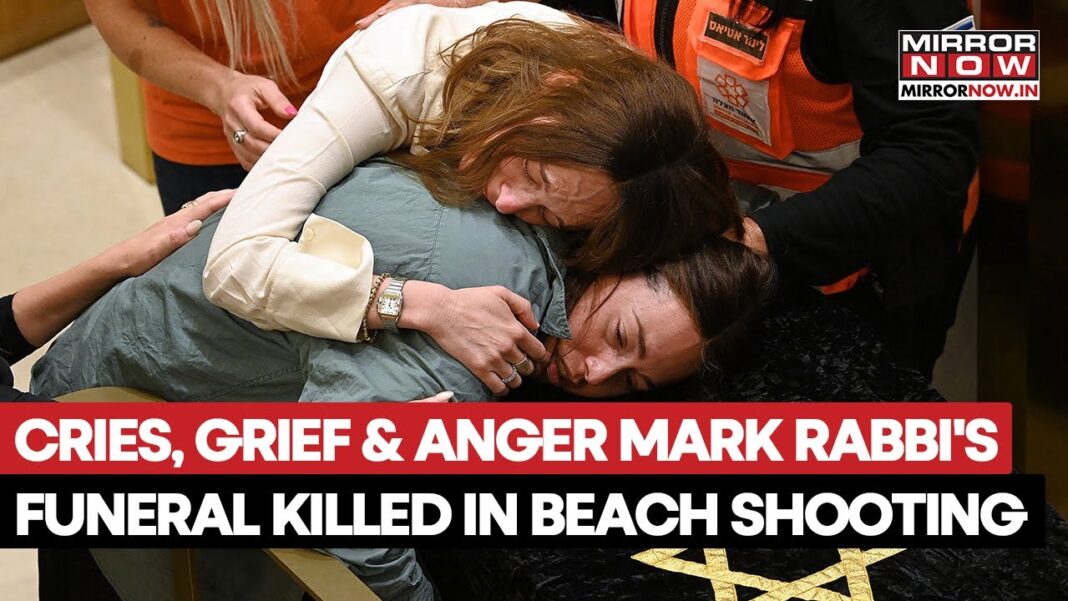
Inside Chabad Lubavitch World Headquarters at 770 Eastern Parkway in Crown Heights, the emotional gravity was unmistakable. CBS News New York cameras captured scenes of prayer, tears, and quiet resolve as Jews gathered to honor two of the victims: Rabbi Yaakov Levitan and Rabbi Eli Schlanger.
Rabbi Schlanger, 41, was a husband, a father of five, and—by all accounts—a pillar of joy within his community. Speaking to CBS News, Rabbi Chaim Wilhelm described him as “always happy, full of excitement, full of life.” Others echoed that sentiment, portraying a man whose warmth radiated outward and whose leadership was defined by compassion rather than fear.
Perhaps the most haunting detail reported by CBS News was Rabbi Schlanger’s message to his community in the face of rising antisemitism: be more Jewish. Do not hide. Do not retreat. Do not dilute one’s identity for safety. But live it more fully.
“He was the beating heart of that community,” said Rabbi Motti Seligson in remarks to CBS News New York. “And the cruel irony is that his life was taken while he was doing exactly what he believed in—bringing Jewish light into the world.”
Rabbi Schlanger’s wife was wounded in the attack and hospitalized briefly, a fact confirmed by CBS News. Their children were present at the event. The unimaginable trauma of that reality has weighed heavily on Jewish leaders in New York, many of whom see the Bondi Beach massacre as both deeply personal and globally symbolic.
At a vigil held at Yeshiva University, CBS News New York spoke with Rosie Schlanger, the rabbi’s niece and a student there. Her words cut through the abstraction of global headlines.
“The fact that he was taken away on a day that represents goodness and light—it’s powerful and it’s painful,” she said. “But I really believe my uncle would want us to continue celebrating, to continue sharing God’s light.”
Her statement encapsulated a central tension facing Jewish communities today: how to grieve without surrendering public Jewish life to fear.
That fear, however, is far from theoretical.
As CBS News has reported, FBI hate crime data paints a stark picture. Antisemitic incidents in the United States have surged dramatically, with tens of thousands recorded over the past two years. From 2023 to 2024 alone, such incidents rose by an estimated 200 percent.
Dr. Charles Asher Small, president of the Institute for the Study of Global Antisemitism and Policy, told CBS News that the Bondi Beach attack represents the deadly culmination of years of rhetorical escalation.
“For decades, Jewish leaders around the world have warned that discourse demonizing Jews, Israel, and Zionism would eventually translate into violence,” Small said. “Words and ideas do not remain abstract. They become actions.”
CBS News contextualized the Bondi massacre within this broader trend, noting that attacks on Jewish institutions and individuals are increasingly global, coordinated in ideology if not in execution.
In New York City, the response has been swift. According to the information contained in the CBS News New York report, organizations such as the United Jewish Appeal and the Community Security Service have expanded security offerings for Hanukkah events across the city. The demand has been immediate and overwhelming.
“From the moment the attacks took place, we saw an influx in requests,” said Richard Priem, CEO of Community Security Service, in an interview with CBS News. “It’s a reminder that attacks can happen here. There’s always the risk of a copycat.”
Yet even amid heightened security, many Jewish leaders are choosing visibility over withdrawal. Rabbi Yosef Wilhelm of Chabad Young Professionals of the Upper East Side told CBS News that he briefly questioned whether public menorah lightings were worth the risk.
“But then I realized—we have to light even stronger, even more,” he said. “It’s what the world needs.”
The shockwaves of the Bondi Beach attack have reached City Hall. CBS News New York reported that Mayor Eric Adams is preparing to announce a series of initiatives aimed at combating antisemitism, particularly among younger generations.
“Young people have caught on to this because it has become a bumper sticker, a slogan,” Adams told CBS News’ Marcia Kramer. “They don’t even know the full depth.”
The mayor emphasized the need for education—historical, moral, and civic. “We have to re-educate our young people,” he said, framing antisemitism not as an isolated prejudice but as a corrosive force that ultimately threatens all of society.
Several leaders interviewed by CBS News echoed a sobering refrain: that antisemitic violence is not merely an attack on Jews, but on the moral foundations of pluralistic democracy itself.
Governor Kathy Hochul reportedly reached out to Chabad leaders to express her condolences, acknowledging that what happened in Sydney was “an attack on civilization.” That phrase reflects a growing consensus that antisemitism functions as a bellwether for broader societal decay.
As Hanukkah continues, Jewish communities worldwide face a grim paradox: a holiday centered on light unfolding amid profound darkness. Yet, as the CBS News report emphasized, the response has not been silence or retreat, but recommitment.
Menorahs are being lit more publicly, not less. Security is tighter, but songs are louder. Mourning is real, but so is resolve.
The flowers at Bondi Beach will eventually wither. The sand will be smoothed by tides. But the meaning of what happened—and the choices communities make in response—will endure.
As one rabbi told CBS News New York, standing beneath the glow of a menorah guarded by police officers and surrounded by children: “The Maccabees didn’t light the menorah because it was safe. They lit it because it was right.”
In a world where hatred increasingly seeks permission to act, that distinction may matter more than ever.