



|
Getting your Trinity Audio player ready...
|
By: Justin Winograd
In the final days of December, as Iran teetered on the edge of its most serious internal upheaval in decades, an extraordinary diplomatic maneuver unfolded far from the public eye. Israeli officials, acutely aware of the combustible atmosphere in Tehran and the risks of miscalculation, quietly transmitted a message to Iran’s leadership through an unlikely conduit: Moscow. According to diplomats and regional officials cited extensively in a report that appeared on Wednesday in The Washington Post, Israel assured its arch-adversary that it had no intention of launching strikes against Iran, provided it was not attacked first.
The Iranian response, relayed through the same Russian channel, was equally notable. Tehran indicated that it, too, would refrain from any preemptive assault.
In a Middle East defined by suspicion, proxy wars, and rhetorical brinkmanship, such an exchange was remarkable. That it occurred only days before mass protests erupted across Iran — shaking the regime’s authority and provoking a brutal crackdown — makes it all the more significant.
As The Washington Post reported, these clandestine assurances reveal a complex calculus unfolding simultaneously in Jerusalem, Tehran, and Washington: a mutual desire to avoid a catastrophic spiral into full-scale regional war at precisely the moment when the Islamic Republic’s internal stability was fracturing.
Israel and Iran are not simply rivals; they are ideological antagonists locked in a multi-theater shadow war stretching from Syria to Yemen. They had, only months earlier, engaged in a 12-day confrontation in June, a conflict that pushed the region to the brink.
Yet according to the information provided in The Washington Post report, the December exchange was driven by Israel’s determination not to be perceived as igniting another round of hostilities — particularly while it was preparing for a potentially decisive campaign against Hezbollah, the Iran-aligned militia entrenched in Lebanon.
Privately, Israeli officials sought to reassure Tehran that Israel would not initiate strikes, thereby keeping Iran sidelined while Israel concentrated its military focus northward. Publicly, however, Israeli rhetoric at the time remained defiant, with officials openly hinting that renewed action against Iran’s ballistic missile stockpile was on the table.
This divergence between public posture and private messaging underscores the strategic ambiguity Israel was cultivating — a dual track that The Washington Post report suggested was designed to deter without provoking.
Iran, for its part, received the message with caution. Two officials with knowledge of the exchange told The Washington Post that Tehran suspected the assurances were conditional at best. Even if Israel held back, Iranian leaders feared that the United States might still launch attacks — perhaps in coordination with Jerusalem — leaving Iran vulnerable to a combined assault.
Still, as one senior regional official bluntly summarized in comments reported by The Washington Post, “for Iran, it was a good deal.” Staying out of a potential Israel-Hezbollah war reduced pressure on a regime already confronting unprecedented domestic turmoil.
The Kremlin’s role in brokering this exchange was anything but incidental. According to the information contained in The Washington Post report, the most recent messages were transmitted shortly after Iranian Foreign Minister Abbas Araghchi traveled to Moscow in late December. Russia, eager to reinforce its status as a global mediator — and perhaps to curry favor with the White House amid negotiations over Ukraine — positioned itself as a trusted intermediary.
This was not the first time Moscow had offered to play such a role. A Russian academic close to senior diplomats told The Washington Post that the Kremlin had previously floated the idea of mediating between Israel and Iran directly to President Donald Trump. Trump, however, reportedly rebuffed the proposal, telling Russian officials to “deal with Ukraine first.”
Whether Washington was aware of or complicit in the December back-channel remains unclear. Neither Israeli nor Russian officials offered public comment, and spokespeople for Prime Minister Benjamin Netanyahu and the Kremlin declined to respond to inquiries, according to The Washington Post report.
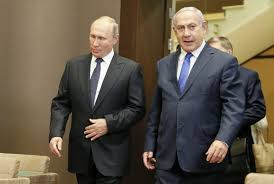
Yet the Israeli public broadcaster KAN later reported that Netanyahu himself had asked Russian President Vladimir Putin to convey Israel’s assurances to Tehran — lending further credibility to the account.
If the December exchange reflected a moment of strategic détente, the eruption of protests across Iran has since threatened to unravel it. The demonstrations, sparked by dire economic conditions and rapidly escalating into a broader challenge to clerical rule, have left Iran’s leadership rattled.
President Trump, responding to the regime’s violent suppression of protesters, has openly weighed strikes against Iranian targets — a posture that has complicated Israel’s calculations. Analysts quoted by The Washington Post warn that any American action could provoke Iranian retaliation not only against U.S. assets but also against Israel, regardless of the prior assurances exchanged through Moscow.
Indeed, a senior Iranian official told Reuters that Iran would retaliate against U.S. military bases in the Middle East if attacked — notably omitting Israel from the list of targets, a detail that The Washington Post report noted could reflect Tehran’s lingering desire to avoid direct confrontation with Jerusalem, at least for now.
For Israel, the overriding strategic objective remains Hezbollah. As The Washington Post report detailed, Israeli officials view the Shiite militia as an existential threat that has not been neutralized despite years of deterrence. Even amid the Iran crisis, Israeli leaders have signaled that a military campaign against Hezbollah remains inevitable.
One Israeli official, speaking anonymously, told The Washington Post that the “same logic” behind December’s outreach still applies: Israel seeks to isolate Hezbollah and prevent Iran from entering the fray directly. Yet the official added with chilling clarity: “The [Lebanon] campaign will take place, and Hezbollah will be heavily targeted. The question is if it’s during or after the Iran war.”
Sima Shine, a former Mossad intelligence chief and now a senior researcher at Tel Aviv’s Institute for National Security Studies, framed Israel’s posture succinctly in remarks reported by The Washington Post. Israel is content to let Washington lead any potential strikes on Iran, she said, but would welcome regime change in Tehran, which would “change the Middle East — as well as Hezbollah.” At the same time, she cautioned, Israel fully expects to be in the crosshairs of any Iranian response and has quietly taken steps to bolster its defenses.
The December back-channel agreement between Israel and Iran was born of necessity, not trust. It was a tactical accommodation designed to buy time — time for Israel to prepare its northern front, for Iran to contain domestic unrest, and for Washington to calibrate its response.
Now, as protests rage and the White House debates intervention, that fragile understanding hangs by a thread.
The Washington Post report underscored the central irony of the moment: while public discourse in the region is saturated with threats and recriminations, the most consequential diplomacy is occurring in whispers, mediated through Moscow, and shielded from the glare of political theater.
Whether Israel and Iran will continue to honor their December assurances remains uncertain. History offers little comfort. Only months earlier, in June, Israel launched a surprise attack on Iran even as nuclear negotiations were underway — a reminder that in this volatile triangle of Jerusalem, Tehran, and Washington, today’s restraint can become tomorrow’s rupture.
For now, however, the back-channel persists as a testament to the enduring power of diplomacy, even between sworn enemies — and to the precarious balance holding the Middle East together as Iran’s streets continue to fill with voices demanding change.