



|
Getting your Trinity Audio player ready...
|
By: Fern Sidman
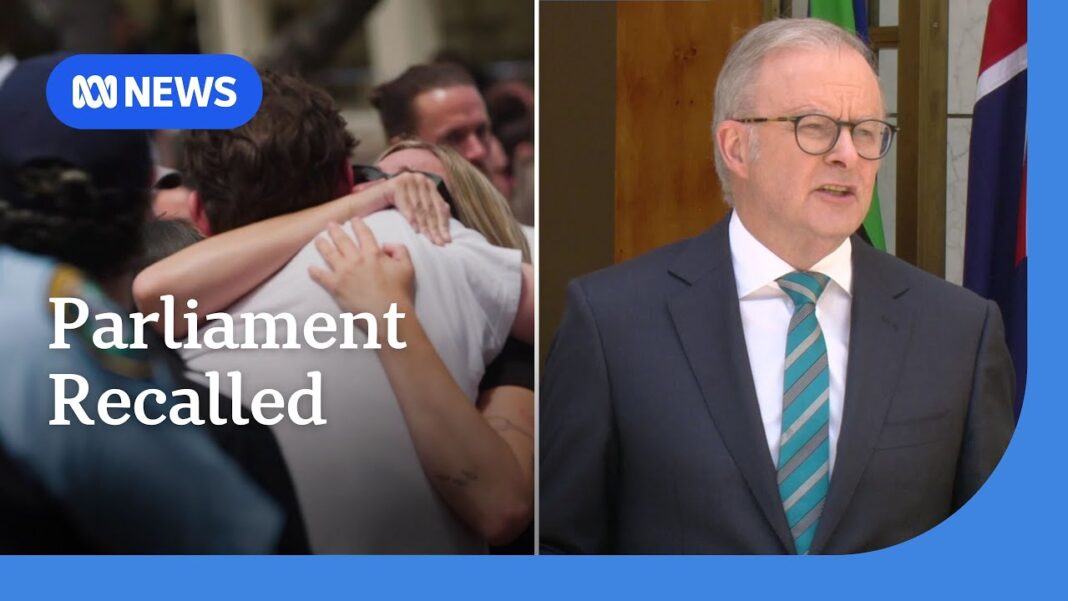
When the gunfire finally faded from Bondi Beach on December 14, leaving fifteen people dead at what had been a joyous Jewish Hanukkah celebration, the shockwaves did not end at the police cordon. They coursed through Australia’s political class, its cultural institutions and its social fabric. Now, barely weeks into the new year, Prime Minister Anthony Albanese has made the extraordinary decision to recall the federal parliament from its summer recess in order to rush through sweeping new legislation aimed at hate speech, extremist organizations and firearms—an emergency maneuver that marks one of the most consequential domestic security responses in modern Australian history, as was reported on Monday by Reuters and The Algemeiner.
The Bondi massacre, allegedly carried out by gunmen inspired by the Islamic State terrorist group, was not only an act of mass murder. It was a symbolic wound, a brutal attack on Australia’s Jewish community at the height of a religious festival, in a public space long cherished as a national icon. And it has placed Albanese’s government at the epicenter of an increasingly volatile debate: how to combat a surge in antisemitism and extremism without eroding the bedrock principle of free expression.
According to the Reuters report, Albanese announced on Monday that the national parliament would return next week—cutting short its summer break—to pass a package of laws targeting hate speech, extremist groups and illegal firearms. The prime minister said he wanted the legislation enacted by the day after MPs reconvened, underscoring the urgency he attaches to the moment.
Australians, he insisted, were entitled to express divergent views about the Middle East, Israel and Gaza. What they were not entitled to do was target individuals based on identity.
“What they are not entitled to do,” Albanese said in remarks carried by Reuters and cited in The Algemeiner report, “is to hold someone to account for the actions of others because they are a young boy wearing a school uniform going to a Jewish school or a young woman wearing a hijab.”
The legislation will increase penalties for hate speech, ease visa denials on grounds of racial bigotry, and lower the threshold for banning hate organizations—including neo-Nazi groups—while authorizing a federal gun buyback program designed to reduce the circulation of unregistered firearms.
The prime minister’s sudden assertiveness follows days of sharp criticism. Jewish community leaders and the Israeli government accused Albanese of responding too slowly to a spike in antisemitic attacks, which they say has gathered pace since protest marches against Israel’s war in Gaza erupted across Australia in 2023.
The Algemeiner report noted that many Jewish Australians felt abandoned in the critical hours after the Bondi shooting, when official condemnations were measured and political action appeared distant. In the immediate aftermath, Jewish institutions were left to fortify their own security while communities mourned.
Last week, in what many saw as an attempt to regain moral authority, Albanese announced the formation of a Royal Commission to examine the Bondi attack alongside the broader rise of antisemitism and the state of social cohesion in Australia.
Yet the legislative response has been mirrored by a cultural convulsion that has left Australia’s arts community in open revolt. The Adelaide Festival, one of the country’s premier literary and cultural events, withdrew its invitation to Australian Palestinian author Randa Abdel-Fattah from its Writers Week program.
The festival’s board said that continuing to feature Abdel-Fattah so soon after Bondi would not be “culturally sensitive.” Her removal triggered an immediate backlash. Abdel-Fattah, a Macquarie University academic, condemned the decision as “a blatant and shameless act of anti-Palestinian racism and censorship,” a charge quoted by Reuters and analyzed in The Algemeiner report.
Only days after the massacre, Abdel-Fattah had posted on Instagram that Australians were “quickly surrendering to the agenda of those who are using a horrific act of antisemitism to entrench anti-Palestinian racism,” accusing “Zionists, white supremacists and the far right” of exploiting the murders.
Around 100 authors have since withdrawn from the festival in protest, according to information provided in local media reports referenced by Reuters. The fallout has been severe: the festival’s executive director Julian Hobba conceded that the organization was “navigating a complex and unprecedented moment,” while three board members and the chairperson resigned in the ensuing storm.
The episode encapsulates the national mood: grief curdling into ideological trench warfare, with antisemitism, Islamophobia and accusations of censorship colliding in a bitter cultural standoff.
While the federal parliament prepares its legislative blitz, Australia’s most populous state, New South Wales, has already moved. Premier Chris Minns announced new rules empowering local councils to cut off power and water to illegally operating prayer halls and impose harsher fines on what he termed “hate preachers.”
The measures were prompted by the difficulty authorities faced in shutting down a Muslim prayer hall in Sydney linked to a cleric who had been found by a court to have made statements intimidating Jewish Australians—a case closely followed by Reuters and The Algemeiner.
Yet even these steps have ignited controversy. Frank Carbone, mayor of Fairfield—a western Sydney suburb with a large Muslim population—warned against handing councils the authority to adjudicate hate speech.
“Freedom of speech is something that should always be allowed, as long as it is done in a peaceful way,” Carbone told Reuters.
His words resonate with a growing segment of Australians who fear that in its scramble to confront extremism, the government may inadvertently institutionalize censorship.
The alleged ideological motivation of the Bondi attackers—Islamic State—has further complicated the political calculus. The massacre is emblematic of a hybrid threat: jihadist extremism converging with antisemitic ideology in a Western democracy long considered insulated from such violence.
That fear is now shaping policy. Intelligence agencies have reportedly warned that extremist narratives are exploiting the Israel-Hamas war to radicalize young Australians, and that online spaces are incubating grievances that translate into offline violence.
At the heart of the debate lies a fundamental question: can Australia recalibrate its laws to protect vulnerable communities without criminalizing dissent?
Reuters has chronicled the unease within Albanese’s own Labor Party, where civil libertarians are wary of expanding the state’s power to police speech. Meanwhile, Jewish groups interviewed insist that without decisive action, antisemitism will continue to metastasize.
For many, the prime minister’s rhetorical line—defending the right to criticize Middle East politics while rejecting collective punishment of Australian Jews and Muslims—feels both necessary and insufficient. The challenge, as one senior community leader told The Algemeiner, is that “the virus of hate adapts faster than the law.”
Australia now stands at a crossroads rarely encountered in its modern history. The decision to recall parliament from summer recess, the drafting of new hate-speech statutes, the prospect of a federal gun buyback, the resignations in the arts world, the anger of Jewish leaders, and the anxieties of free-speech advocates together form a tableau of a society struggling to define its moral perimeter.
In the words of one analyst quoted by The Algemeiner, the Bondi massacre has become more than a crime. It is a referendum on Australian identity: on whether multicultural coexistence can be preserved in an era of globalized hatred, and on how far a liberal democracy can go in restraining speech to defend human dignity.
As lawmakers return to Canberra under the glare of international scrutiny, Reuters reported that Albanese’s office is bracing for the most contentious parliamentary session in years. The outcome will not only shape Australia’s legal framework—it will determine whether the country emerges from this trauma more cohesive or more divided than before.
For a nation that once prided itself on sunny egalitarianism, the long shadow of Bondi has forced a reckoning. The legislation may pass swiftly, but the deeper questions—about identity, freedom and responsibility—will linger far beyond summer’s end.