



|
Getting your Trinity Audio player ready...
|
By: Fern Sidman
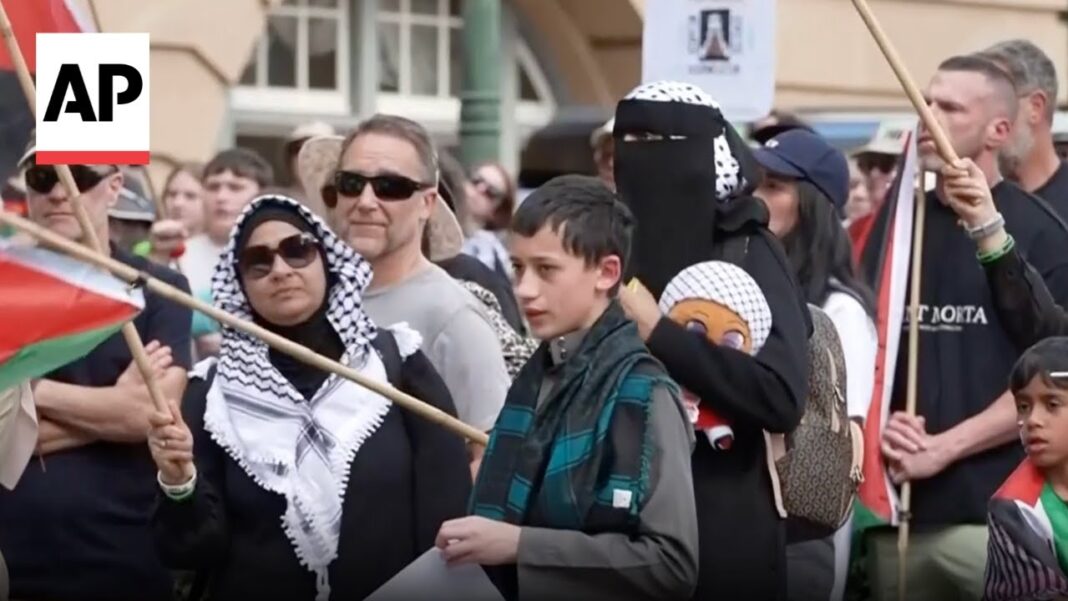
Australia witnessed one of the largest coordinated waves of anti-Israel demonstrations in its history this past weekend, with rallies spanning more than 40 cities and regional centers. Organizers from the Palestine Action Group claimed nearly 300,000 demonstrators nationwide, though police estimates suggest far lower figures. The mass mobilization coincided with the publication of a United Nations–backed report alleging “reasonable evidence” of famine in Gaza since mid-August—an assessment Israel has rejected as based on outdated and misleading data.
According to a report that appeared on Sunday on The Jewish News Syndicate (JNS), the protests’ scale, rhetoric, and messaging underscore the rapid mainstreaming of extreme anti-Israel narratives in Australia, reflecting both grassroots mobilization and a growing shift among segments of political and civil society toward boycotts, sanctions, and outright delegitimization of the Jewish state.
Melbourne, long a focal point for activist movements, hosted the weekend’s largest rally. Organizers boasted of a turnout exceeding 100,000 people, though independent estimates suggest far fewer. Demonstrators assembled at the State Library before marching through the central city to Parliament, waving Palestinian flags and holding placards reading “Free Palestine,” “Israel is killing children,” and “Gaza City: Now in Famine.”
The JNS report noted that chants of “Death to the IOF”—a reference to the Israel Defense Forces, branded by activists as the “Israel occupation forces”—resonated through the streets, reflecting the protests’ increasingly incendiary character. Police maintained a heavy presence but stressed that unlawful behavior would not be tolerated.
Sydney’s demonstration was also described by organizers as massive, with estimates approaching 100,000 participants. While police did not confirm the numbers, the JNS report observed that the city has become a stronghold of pro-Palestinian activism, with marches increasingly featuring high-profile speakers such as politicians, activists, and journalists aligned with the cause.
In Brisbane, organizers claimed 50,000 participants, though Queensland Police placed the number closer to 10,000. The discrepancy highlights a broader pattern: activist groups inflating attendance figures to project momentum, while law enforcement and independent observers register more modest turnout. Still, the JNS report stressed that the mobilization in Brisbane was significant, marking the city’s largest such protest in recent memory.
A range of political figures and cultural voices amplified the rallies’ messaging. Independent Senator Lidia Thorpe, formerly of the Australian Greens, called for boycotts of multinational fast-food chains like McDonald’s and KFC, accusing them of links to Israel. Thorpe further charged Prime Minister Anthony Albanese and Foreign Minister Penny Wong with complicity in “genocide.”
JNS reported that other speakers included prominent activist Grace Tame, who argued that mass mobilization could force Canberra to recalibrate its policies, and journalist Antoinette Lattouf, who repeated unverified claims that more than 180 Palestinian journalists have been killed in Gaza since October 2023. Independent analyses have shown, however, that many of those counted were members of proscribed terrorist organizations.
Greens leader Larissa Waters in Brisbane criticized Australia’s defense trade with Israel, echoing calls for a full suspension of weapons-related exports.
The protests drew endorsements from over 250 community and human rights organizations, including Amnesty International. After Queensland courts barred Brisbane activists from marching across a bridge on public safety grounds, Amnesty defended the demonstrators, describing protest as a “protected right under international law.”
According to the information provided in the JNS report, Amnesty International’s credibility on Israel has long been questioned, with the group stripped of its tax benefits in Israel earlier this year for its support of the Boycott, Divestment, and Sanctions (BDS) movement. The group’s statement over the weekend highlights how international NGOs are reinforcing anti-Israel messaging in Australia, often while disregarding Hamas’s responsibility for civilian suffering in Gaza.
The demonstrations occurred against the backdrop of deteriorating relations between Canberra and Jerusalem. Last week, Australia denied entry to Simcha Rothman, chair of the Knesset Constitution, Law and Justice Committee, citing fears he would “spread hate and division.”
In retaliation, Israeli Foreign Minister Gideon Sa’ar revoked visas for Australian representatives to the Palestinian Authority. The move followed months of escalating friction, as Australia prepares to join more than 140 nations in formally recognizing a Palestinian state at the upcoming United Nations General Assembly.
Prime Minister Benjamin Netanyahu, in a statement cited by JNS, accused Albanese’s government of emboldening antisemitism by pursuing recognition of Palestine: “Your call for a Palestinian state pours fuel on the antisemitic fire… It rewards Hamas terror, hardens Hamas’s refusal to free the hostages, emboldens those who menace Australian Jews, and encourages the Jew-hatred now stalking your streets.”
At the heart of the protests was the claim, based on a UN-backed report, that Gaza has entered famine conditions since August 15. Israel immediately rejected the classification, with government spokespeople insisting that the determination relied on “outdated figures” and ignored recent data showing increased humanitarian aid deliveries.
The JNS report highlighted how activists seized on the famine narrative as a rallying cry, using emotionally charged slogans like “Gaza City: Now in Famine, 1/2 million at risk” to mobilize protestors. Yet, Israeli officials argue that these narratives overlook Hamas’s systematic theft of humanitarian aid and use of civilian infrastructure for military purposes—factors central to the ongoing humanitarian crisis.
Beyond the politics of foreign policy, the protests have raised urgent concerns for Australia’s Jewish community. JNS reported that antisemitic incidents—from harassment of Jewish students to vandalism of synagogues—have surged since October 2023. Chants of “Death to the IOF” and slogans accusing Israel of genocide contribute to an atmosphere in which Jewish Australians increasingly feel unsafe.
Netanyahu’s warning to Albanese calls attention to the direct link between governmental rhetoric, mass protests, and rising antisemitism. By appearing to legitimize calls for Palestinian statehood in the wake of Hamas’s October 7 atrocities, critics argue that Australia risks emboldening extremists at home while alienating one of its key democratic allies abroad.
The massive anti-Israel demonstrations across Australia reveal not only the growing intensity of global campaigns to delegitimize Israel but also the vulnerability of diaspora Jewish communities caught in the crossfire. As the JNS report emphasized, the scale of mobilization and the rhetoric deployed—replete with calls for boycotts, accusations of genocide, and chants of death to Israel’s defenders—mark a dangerous normalization of extremist narratives within mainstream Australian society.
With bilateral relations between Canberra and Jerusalem now at their lowest point in years, the Albanese government faces a critical test: whether to stand firm against antisemitism and the legitimization of Hamas or to capitulate to the surging street movements that threaten to reshape Australia’s moral and diplomatic stance.
For Australian Jews and for Israel, the stakes could not be higher.

These kinds of protests could be more dangerous to Australia than the Jews. If need be, the Jews might have to move out of Australia. What will everybody else do in those countries? This is true with other countries as well. They can let in the Islamists – the 5th column. The Jews might have to move out but the cancer remains for everybody else in those countries to deal with. Is it worth it for them to do that?