



|
Getting your Trinity Audio player ready...
|
By: Fern Sidman
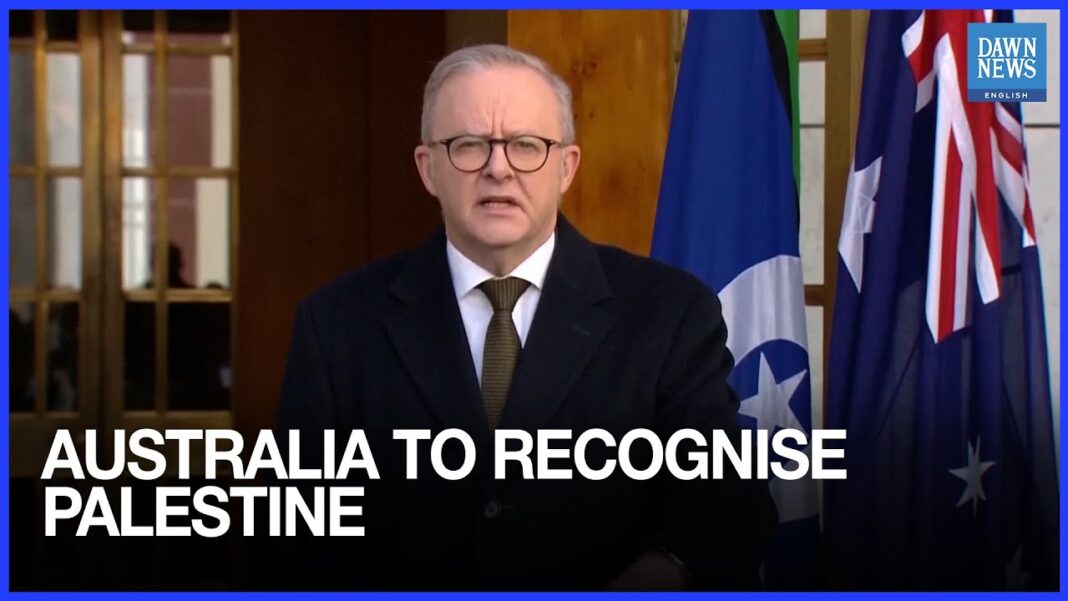
Israel National News reported that Australian Prime Minister Anthony Albanese formally declared on Monday that his government will recognize a Palestinian state when the United Nations General Assembly convenes in September. The announcement marks a significant shift in Australian foreign policy and aligns Canberra with a growing list of Western governments signaling formal recognition of Palestinian statehood.
Speaking at a press conference, Albanese stated, “Australia will recognize the right of the Palestinian people to a state of their own, predicated on the commitments Australia has received from the Palestinian Authority.” He emphasized that Canberra intends to work with international partners to advance this policy, framing the move as part of a broader effort to support Palestinian aspirations for sovereignty.
Albanese stressed that any recognized Palestinian state must exclude Hamas from governance, underscoring Australia’s opposition to the terrorist group’s role in Palestinian political structures. The Prime Minister simultaneously leveled criticism at Israel, claiming that the country “continues to defy” international law and that the humanitarian crisis in Gaza is “beyond the world’s worst dreams.”
As reported by Israel National News, the Australian Cabinet met in Canberra earlier on Monday to formally approve the policy change. Sources cited by SBS News confirmed that the Cabinet decision was the final step before the Prime Minister’s public announcement.
The policy shift follows weeks of internal deliberations and external consultations. According to the information provided in the report on Israel National News, Foreign Minister Penny Wong has been actively briefing Israeli officials on the government’s evolving stance, including potential conditions tied to recognition. These conditions reportedly involve assurances that Hamas will have no role in the governing structure of a future Palestinian state and that Israel’s security will be safeguarded.
Wong has previously indicated that early recognition could serve as a catalyst for political reforms within Palestinian leadership, particularly in Gaza, and might help refocus diplomatic attention on renewed peace talks. This represents a departure from the long-standing position — historically supported by Australia — that recognition of Palestinian statehood should occur only as the final step in a negotiated peace agreement with Israel.
The decision also contrasts with Albanese’s own public statements just weeks earlier. At that time, the Prime Minister said his government had “no immediate plans” to recognize a Palestinian state, adding that any such move must be based on “clear conditions” supporting a viable two-state solution and guaranteeing that Hamas would be excluded from governance. “We’ll make a decision based upon the time. Is the time right now? Are we about to imminently do that? No, we are not,” Albanese said at the time.
However, the report on Israel National News noted that in the wake of growing international momentum for Palestinian recognition, Australian policy rapidly shifted. The announcement places Australia alongside the United Kingdom, Canada, and France — countries that have also recently expressed readiness to recognize Palestinian statehood under certain conditions.
Recognition of a Palestinian state has traditionally been viewed as the culmination of the Israeli–Palestinian peace process, rather than a step taken prior to a final agreement. By moving forward now, Australia is aligning with a bloc of Western nations adopting what they argue is a proactive approach to shaping the conditions for peace.
The Israel National News report emphasized that the Palestinian Authority has long sought recognition from the international community as a way to bypass direct negotiations with Israel. While such recognition has symbolic value, past examples have demonstrated that it carries limited tangible impact on the ground. Many countries that have recognized “Palestine” in recent years have done so primarily as political statements, without accompanying measures to enforce or implement statehood in practical terms.
Although reactions from Israel to the Australian announcement had yet to be formally released at the time of publication, the Israel National News report noted that similar moves by other governments have been met with sharp criticism from Jerusalem. Israeli officials have frequently argued that unilateral recognition undermines direct negotiations, emboldens Palestinian leadership to avoid compromise, and risks legitimizing factions that reject Israel’s right to exist.
For Australia, the decision carries both diplomatic and domestic implications. Internationally, it positions Canberra within a coalition of states that are applying increased diplomatic pressure on Israel over the ongoing conflict in Gaza and the stalled peace process. Domestically, it reflects the Albanese government’s willingness to recalibrate Australian foreign policy priorities in line with shifting public opinion and the approaches of certain allies.
Albanese’s remarks on the humanitarian crisis in Gaza were a notable element of his announcement. By citing the current conditions as “beyond the world’s worst dreams,” the Prime Minister linked the recognition decision to the ongoing war and its impact on Palestinian civilians. Israel National News reported that this framing aligns with a broader international narrative that views recognition as a means of strengthening moderate Palestinian political actors while isolating Hamas.
Despite the high-profile nature of the announcement, the Israel National News report emphasized that recognition of a Palestinian state by Australia — as with other recent recognitions — will likely be symbolic in the immediate term. Without an existing agreement on borders, governance structures, and security arrangements, recognition alone will not create a functioning state.
However, proponents argue that such recognition could serve as a diplomatic lever, signaling international impatience with the status quo and potentially influencing future negotiations.
The Australian government’s decision to recognize a Palestinian state at the upcoming UN General Assembly marks a significant departure from its previous position and places it in alignment with other Western nations adopting a similar stance. As Israel National News reported, the move is contingent upon assurances from the Palestinian Authority, the exclusion of Hamas from governance, and commitments to Israel’s security.
While the recognition is expected to have limited practical effect on the ground, it represents a symbolic and diplomatic statement that could shape the trajectory of international engagement on the Israeli–Palestinian conflict in the months ahead.
