



|
Getting your Trinity Audio player ready...
|
Australia Appeals for Calm Following Violent Sydney Protests Tied to Herzog Visit
By: Fern Sidman
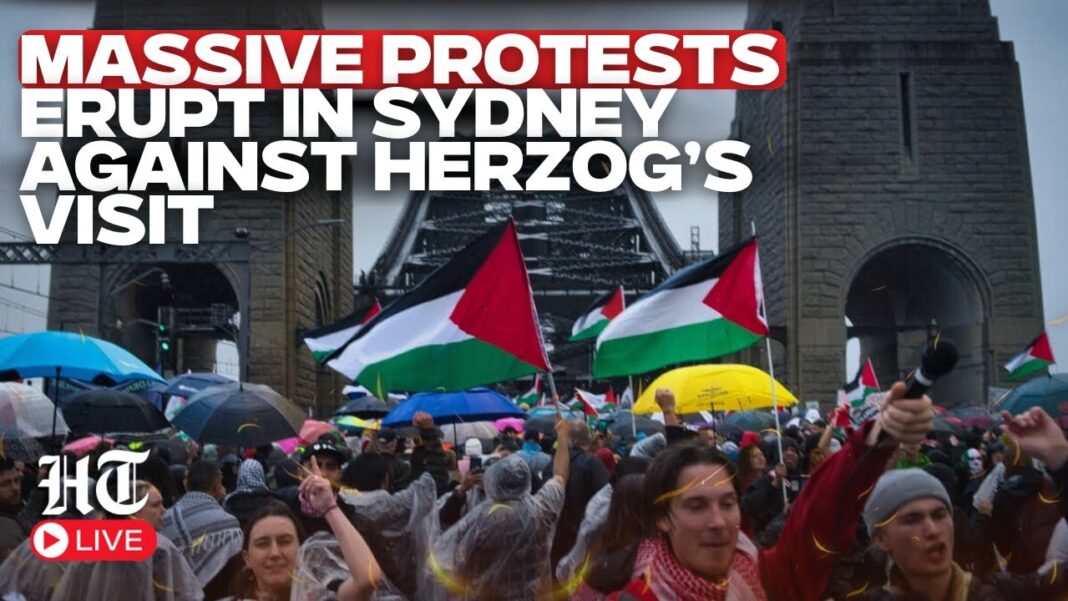
The streets of central Sydney, ordinarily a theater of civic ritual and commercial bustle, were transformed this week into a tableau of confrontation, as the visit of Israeli President Isaac Herzog to Australia ignited volatile protests that spiraled into clashes between demonstrators and police. What unfolded on Monday evening was not merely an episode of public disorder, but a revealing moment in Australia’s increasingly fraught encounter with the reverberations of a distant war. As Reuters reported in contemporaneous coverage, the violence left 27 people under arrest, including 10 accused of assaulting police officers, while government leaders moved swiftly to urge restraint and to reclaim the language of peaceful dissent.
The Algemeiner, tracking reactions within Jewish communities and among international observers, situated the unrest in their report within a broader pattern of diaspora tensions inflamed by the ongoing Israel-Hamas conflict and its aftershocks across Western democracies.
According to the information provided in the Reuters report, the confrontation erupted when police sought to disperse thousands of demonstrators who had converged near Sydney’s Town Hall to protest Herzog’s presence in Australia. The gathering had been framed by organizers as an expression of opposition to Israel’s actions in Gaza and, more broadly, as an indictment of what they regard as the moral complicity of Western governments. Yet the protest, initially noisy but largely contained, veered into chaos as officers moved to clear the area, invoking special powers rarely deployed in the state of New South Wales.
Television footage broadcast nationwide and circulated internationally showed protesters pressing against police barricades, officers responding with force, and clouds of tear gas and pepper spray drifting through the crowd. The Reuters report noted that while no serious injuries were reported, the optics of violence — bodies on the ground, police struggling to restrain demonstrators — reverberated far beyond the immediate scene.
Prime Minister Anthony Albanese, speaking in the wake of the clashes, adopted a tone of grave disappointment. Quoted by Reuters, he said he was “devastated” by the violence and reiterated a plea that protests remain peaceful. His remarks captured the delicate political terrain on which the Australian government now finds itself. On the one hand, there is a longstanding national commitment to freedom of expression and the right to protest. On the other, there is growing public unease at what many Australians perceive as the importation of foreign conflicts into domestic public life. As Reuters reported, Albanese articulated this tension succinctly when he observed that Australians “don’t want conflict brought here,” even as they yearn for an end to the bloodshed afflicting both Israelis and Palestinians.
The Algemeiner, reflecting sentiment within segments of Australia’s Jewish community, underscored how such protests, particularly when they turn violent, are experienced not merely as political demonstrations but as a form of communal intimidation in the shadow of recent antisemitic violence.
The backdrop to Herzog’s visit lent the events an especially somber resonance. Only weeks earlier, a mass shooting at a Jewish religious gathering in Bondi Beach had claimed 15 lives, an atrocity that shocked the nation and cast a pall over Jewish communal life in Australia. The Reuters report contextualized the protests within this atmosphere of heightened sensitivity, noting that authorities were acutely aware of the security implications of large, emotionally charged demonstrations in the wake of such an attack.
The Algemeiner has repeatedly emphasized that for Jewish communities in Australia and elsewhere, the confluence of anti-Israel activism and antisemitic violence has blurred distinctions between political critique and existential threat. Herzog’s visit, intended in part as a gesture of solidarity with Australian Jews traumatized by the Bondi massacre, thus unfolded against a backdrop of fear and apprehension, further complicating the political calculus for Australian leaders.
Central to the controversy was the extraordinary latitude granted to police in anticipation of disorder. Reuters reported that law enforcement authorities had been empowered to direct the movement of crowds, restrict access to certain zones, and search vehicles, measures justified on public safety grounds. A legal challenge to these restrictions was dismissed by a Sydney court on the day of the protest, a decision that civil liberties advocates immediately criticized as an erosion of the right to peaceful assembly.
The Algemeiner, citing concerns raised by legal scholars and community leaders, observed that while states have an obligation to maintain order, the optics of preemptive securitization risk deepening mistrust between protesters and authorities. When police deployed tear gas and pepper spray to disperse demonstrators, the sense of a heavy-handed response was amplified, particularly among activists who claimed they were prevented from exiting the area once the dispersal order was given.
Protest organizers and participants offered starkly different accounts of the confrontation. The Palestine Action Group Sydney, whose statements were cited by Reuters, accused police of surrounding the crowd on all sides, leaving demonstrators with no avenue of retreat before charging with mounted units and deploying chemical irritants. Such allegations, if substantiated, raise troubling questions about crowd-control tactics and proportionality.
An opposition lawmaker from the Greens, Abigail Boyd, told reporters that she had been punched by officers while attempting to leave the site, her account lending political weight to claims of excessive force. The Algemeiner report noted that Boyd’s intervention resonated with a broader narrative among left-wing activists who see the policing of pro-Palestinian protests as evidence of institutional bias in favor of Israel. Yet police officials, speaking through Commissioner Mal Lanyon and echoed in Reuters’ reporting, rejected these characterizations, insisting that officers had acted with restraint in the face of what they described as an “angry and violent mob.”
The competing narratives underscore the degree to which the events in Sydney have become a proxy battle over the legitimacy of protest and the boundaries of acceptable dissent in a polarized political climate. Reuters’ sober chronicle of arrests and official statements provides the factual scaffolding for understanding the clashes, but The Algemeiner’s interpretive framing points to deeper communal anxieties. For many Jewish Australians, the sight of thousands protesting Herzog’s presence, so soon after the Bondi attack, evoked a sense of vulnerability and isolation.
The Algemeiner report argued that while criticism of Israeli policy is not inherently antisemitic, the tenor and iconography of some protests — particularly when they escalate into violence — can contribute to an atmosphere in which Jews feel collectively targeted. This perception, in turn, places additional pressure on political leaders to calibrate their responses carefully, lest they appear indifferent to the fears of a minority community already on edge.
New South Wales Premier Chris Minns sought to strike such a balance in his remarks following the clashes. Quoted by Reuters, Minns defended police actions as the product of rapid decision-making under volatile conditions, while urging calm and acknowledging public criticism. His statement that officers were “caught in an impossible situation” gestures toward the broader dilemma facing law enforcement in liberal democracies confronted with mass protests over foreign conflicts. The Algemeiner, in parallel commentary, highlighted how police find themselves navigating an increasingly combustible mix of political expression, social media amplification, and transnational grievance, with every tactical decision scrutinized in real time by a polarized public.
The aftermath of the Sydney clashes is already reverberating beyond the immediate scene. Reuters reported that the Palestine Action Group Sydney announced plans to stage further demonstrations outside police headquarters, signaling that Monday’s events may mark the beginning, rather than the culmination, of a cycle of protest and counter-protest. Such mobilization raises the specter of prolonged unrest, particularly if grievances over police conduct remain unresolved. The Algemeiner report cautioned that sustained confrontation risks entrenching a zero-sum dynamic in which each side — activists and authorities, pro-Palestinian protesters and Jewish community advocates — comes to view the other not as interlocutors within a shared civic framework, but as adversaries in a moral struggle.
At stake, ultimately, is not merely the management of a single protest, but the integrity of Australia’s civic culture in an era of globalized conflict. Reuters’ reportage situated the Sydney clashes within a pattern of Western societies grappling with the domestic fallout of Middle Eastern wars, from campus protests in the United States to street demonstrations in Europe. The Algemeiner’s perspective, rooted in the experiences of Jewish communities, adds a layer of moral urgency, warning that when political passions spill into violence, minority communities often bear the brunt of the resulting insecurity.
Prime Minister Albanese’s appeal for peaceful protest thus resonates as more than a platitude; it is a plea for the preservation of a public sphere in which dissent can be voiced without descending into coercion.
Whether that plea will be heeded remains uncertain. The images from Sydney — smoke curling above the crowd, police lines advancing, protesters shouting in defiance — have already entered the global media bloodstream, emblematic of a world in which distant wars fracture local solidarities. As Reuters continues to document official responses and The Algemeiner chronicles the communal reverberations of such unrest, the episode stands as a cautionary tale.
In an age of instantaneous outrage and transnational mobilization, the challenge for democratic societies is not merely to accommodate protest, but to ensure that the expression of grievance does not corrode the civic trust upon which pluralistic coexistence depends.