



|
Getting your Trinity Audio player ready...
|
At an emergency session of the U.N. Security Council, called to debate last week’s recognition by Israel of Somaliland independence, Tammy Bruce, U.S. deputy ambassador to the United Nations, pointed to the council’s hypocrisy.
“Earlier this year, several countries, including members of this council, made the unilateral decision to recognize a nonexistent Palestinian state,” she said. “And yet, no emergency meeting was called to express this council’s outrage.”
She said “Israel has the same right to conduct diplomatic relations as any other sovereign state,” while opining that the Security Council’s “persistent double standards and misdirection of focus distract from its mission of maintaining international peace and security.”
Slovenia’s envoy disputed the nature of the comparison.
“Palestine is not part of any state,” said Ambassador Samuel Žbogar. “Somaliland, on the other hand, is a part of a U.N. member state, and recognizing it goes against” the U.N. Charter.
Bruce noted that the backing of Israel was not reflective of a policy change on Somaliland itself and that “we have no announcement to make regarding U.S. recognition of Somaliland.”
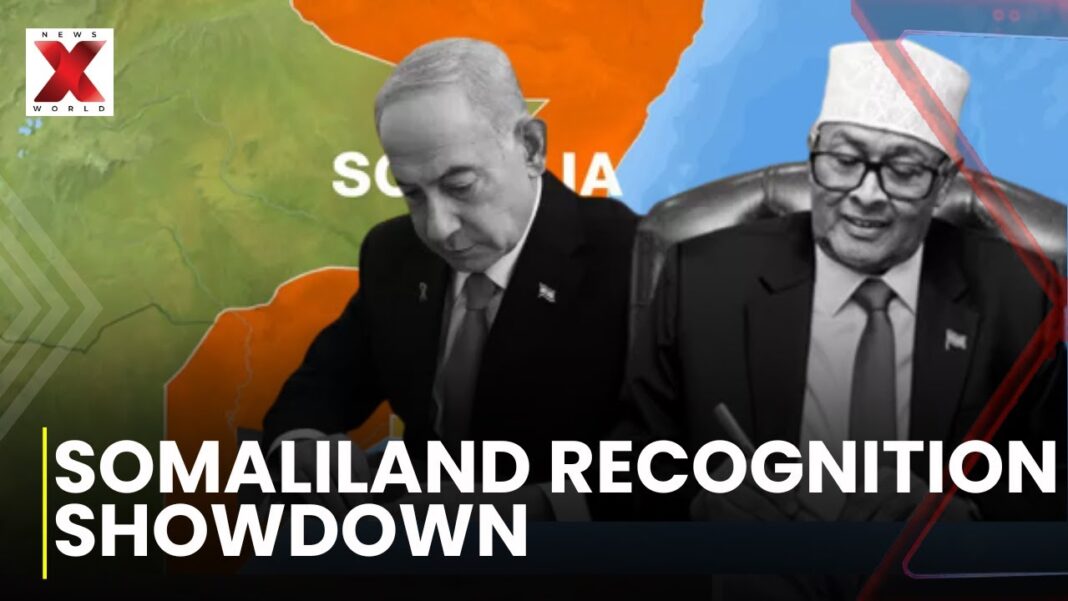
Last Friday, Israel became the first country in the world to recognize statehood for Somaliland, a region that broke away from Somalia and has, for decades, served with autonomy as a functioning, stable democracy, with its own currency, police force and military.
The area, in East Africa, is strategically located for Israel, across from Yemen and the Houthi rebels which have launched numerous attacks on the Jewish state.
Although Trump expressed some interest months ago in Somaliland recognition, he said after Friday’s announcement that he would need to study the issue and questioned, “Does anyone know what Somaliland is, really?”
Meanwhile, Somalia fiercely protested the decision, and much of the world has rejected it. Incidentally, the war-torn country will take over the presidency of the Security Council for the month of January.
‘It is an opportunity’
Jonathan Miller, Israel’s deputy U.N. ambassador, told the council on Monday that Jerusalem’s move “is not a hostile step towards Somalia, nor does it preclude future dialogue between the parties. Recognition is not an act of defiance. It is an opportunity.”
He noted that “Israel’s engagement with Somaliland has a long and consistent record” that dates back decades, including when Israel was the only U.N. country to protest to the Security Council about atrocities carried out in Somaliland by Somali dictator Siad Barre in the 1980s.
“Israel’s recognition of Somaliland is neither provocative nor novel,” Miller said. “It is a lawful, principled acknowledgement of a long-established reality, consistent with international law and aligned with the values this Council is meant to uphold.”
He did not get much help from the other permanent members of the council.
“We regret any action that risks undermining peace and security in the region,” said James Kariuki, charge d’affaires for the United Kingdom’s U.N. mission, who reaffirmed London’s “support for the sovereignty, territorial integrity, political independence and unity of Somalia.”
The United Kingdom, along with Ethiopia, Turkey, the United Arab Emirates, Denmark, Kenya and Taiwan, maintains liaison offices in Somaliland.
Sun Lei, China’s deputy U.N. envoy, told the council that Israel’s recognition “has further increased the tensions in the Horn of Africa, drawing immediate and strong criticism and condemnations from regional organizations.”
‘Reject any steps aimed at advancing objective’
Dina Gilmutdinova, Russia’s senior counsellor to the United Nations, said Moscow “would also like to emphasize that decisions akin to the one taken by the Israeli cabinet risk further complicating the efforts of Mogadishu and its partners’ efforts to combat al-Shabaab terrorists.”
Somalia and other countries claimed that the establishment of Israeli military bases in Somaliland and a push to forcibly relocate Palestinians in the Gaza Strip to the region were part of the motivations behind Israel’s move.
Abukar Dahir Osman, Somalia’s U.N. envoy, said Mogadishu and the other African council members “unequivocally reject any steps aimed at advancing this objective, including any attempt by Israel to relocate the Palestinian population from Gaza to the northwestern region of Somalia.”
Trump reiterated during Monday’s meeting with Israeli Prime Minister Benjamin Netanyahu that no Gazans will be forced to leave the Palestinian enclave under the implementation of his peace plan.