



|
Getting your Trinity Audio player ready...
|
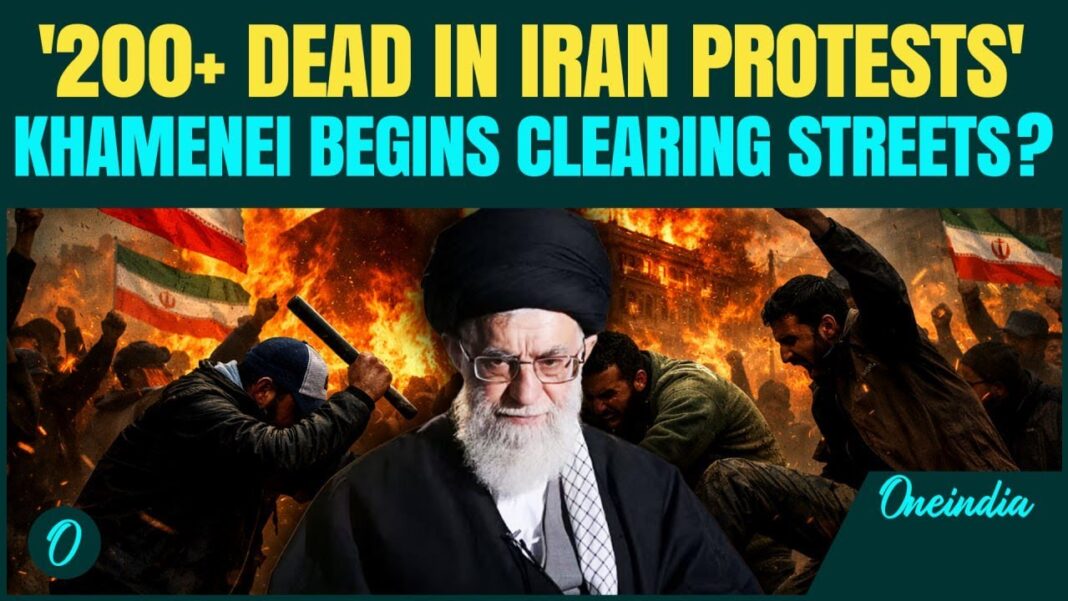
As Iran slips into one of the most opaque and violent moments in its modern history, a grim portrait is emerging through fragments of video, whispered messages transmitted via satellite, and the relentless work of journalists struggling to penetrate a near-total information blackout. According to a report on Sunday morning by Israel National News, informed sources told Iran International late Saturday night that Iranian security forces are deploying lethal force against demonstrators across the country, with early estimates pointing to mass casualties on a scale not witnessed since the darkest days of the Islamic Republic.
The internet blackout, imposed on January 8, has transformed Iran into a digital black hole. Yet despite the regime’s determined effort to seal off the nation from the world, images of devastation continue to leak out—each frame more harrowing than the last. As the Israel National News report detailed, footage transmitted from Kahrizak, a town south of Tehran infamous for its detention facilities, shows rows of black body bags containing what eyewitnesses say are dozens of protesters killed by security forces. Additional bodies were reportedly stacked inside a nearby industrial shed, transforming a mundane structure into a makeshift morgue.
These scenes, disturbing in isolation, are part of a pattern that appears to be repeating across Iran.
Earlier videos from Fardis in Karaj, as well as from Alghadir Hospital in eastern Tehran, reveal similarly macabre tableaux: bodies strewn across floors, motionless forms hurriedly carried by panicked hospital staff, families searching in anguish for loved ones. Israel National News, citing Iran International, emphasized that these are not isolated outbreaks of brutality confined to a few urban flashpoints. Rather, they suggest a synchronized, nationwide campaign of repression.
Even conservative estimates, the outlet reports, indicate that at least 2,000 people may have been killed in the last 48 hours alone—a figure that, if confirmed, would constitute one of the bloodiest episodes of state violence in the Islamic Republic’s history.
Particularly intense clashes have been reported in Fardis, Karaj, and multiple districts of Tehran, but sources stress that the violence is not geographically limited. Israel National News noted that reports are also emerging from the western provinces of Ilam and Kermanshah, suggesting that the crackdown has reached deep into Iran’s periphery.
The blackout has rendered comprehensive reporting nearly impossible. Traditional methods of verification—live feeds, social media cross-checking, real-time witness accounts—have been severed. Yet Israel National News reported that journalists are receiving a steady trickle of information through narrow digital corridors that remain open, including from Iranians using Starlink satellite connections.
These users, predominantly located in major cities and affluent neighborhoods, represent only a fraction of the population. Much of rural Iran, and many working-class districts, remain voiceless. Still, the volume and consistency of the fragments that do reach the outside world suggest that mass protests are continuing unabated despite the carnage.
One video circulated Saturday night shows demonstrators in Tehran’s Poonak neighborhood torching a branch of Bank Melli, the state-owned financial institution long seen as a pillar of regime control. Another clip, shared from Ahvaz in southwestern Iran, captures throngs of protesters chanting “Long Live the Shah,” an incendiary slogan that invokes the overthrown monarchy and symbolizes the depth of rejection toward the Islamic Republic.
The Israel National News report observed that these chants, once unthinkable in public, now echo across Iranian streets as the taboo against criticizing the regime’s ideological foundations crumbles.
The unrest has not remained confined within Iran’s sealed frontiers. On Saturday, a protester climbed onto the balcony of the Iranian Embassy in western London during a demonstration outside the building. The BBC reported that two people were arrested, with police seeking an additional suspect for trespassing. The Israel National News report framed the incident as a symbolic breach: even abroad, the regime’s embassies are no longer insulated from the fury of the Iranian diaspora.
As images of death and defiance circulate in fragments, international reaction is beginning to crystallize. Senator Lindsey Graham, a prominent Republican voice on foreign policy and a close ally of President Trump, issued a dramatic message of solidarity to the Iranian people.
“TO THE IRANIAN PEOPLE: your long nightmare is soon coming to a close,” Graham wrote in a post quoted by Israel National News. “Your bravery and determination to end your oppression has been noticed by @POTUS and all who love freedom.”
Graham went further, framing the protests as the prelude to a historic reckoning: “When President Trump says Make Iran Great Again, it means the protestors in Iran must prevail over the ayatollah. That is the clearest signal yet that he understands Iran will never be great with the ayatollah and his henchmen in charge.”
His post concluded with a promise laden with geopolitical implications: “To all who are sacrificing in Iran, God bless. Help is on the way.”
Trump himself echoed the sentiment in a post on Truth Social, declaring, “Iran is looking at FREEDOM, perhaps like never before. The USA stands ready to help!!!” Israel National News reports that while the statement lacked specifics, it sent a powerful message that Washington is watching—and weighing its options.
Inside Iran, however, the regime appears to be choosing annihilation over accommodation. The deployment of lethal force against demonstrators, the apparent mass arrests, and the blackout itself reflect a government operating in survival mode.
Israel National News analysts noted that this crackdown is unfolding not after weeks of unrest, but in the very first days of the uprising—a sign that the leadership may believe it is confronting an existential threat. The sheer scale of reported fatalities suggests that the state has abandoned even the pretense of restraint.
For many Iranians, the violence has paradoxically intensified their resolve. Videos of young men and women confronting armed forces, burning symbols of state authority, and chanting for the return of the shah circulate in defiance of the blackout. Each clip is a rebuke to the narrative of control that Tehran seeks to project.
Eyewitness accounts provided to Iran International and relayed by Israel National News paint a chilling picture of how the crackdown is being executed. Security forces reportedly fire directly into crowds. Victims are rushed to hospitals only to find overwhelmed facilities operating under siege conditions. Some bodies, witnesses say, are never formally admitted, instead being removed and transported to undisclosed locations—perhaps to obscure the true scale of the killing.
At Kahrizak, the sight of dozens of body bags stacked together has become an emblem of the uprising’s human toll. The town’s name already carries a grim resonance in Iranian memory, associated with detention centers where protesters were abused during earlier waves of unrest. Now, it is again synonymous with death.
As of this writing, no official casualty figures have been released by Iranian authorities. The blackout persists, and the regime continues to characterize protesters as vandals or foreign agents. Yet the images reaching Israel National News and other outlets tell a different story: a society in open revolt, paying a devastating price for its defiance.
Whether this bloodshed will succeed in crushing the uprising—or instead ignite it into a revolutionary conflagration—remains uncertain. What is clear is that Iran stands at a crossroads, with history unfolding behind a veil of censorship and fear.
For the families searching through hospital corridors, for the young protesters chanting into the darkness, and for the journalists piecing together the fragments from afar, the blackout is not merely a technical disruption. It is a weapon—one wielded to hide a massacre that the world is only beginning to comprehend.
