



|
Getting your Trinity Audio player ready...
|
By: Fern Sidman
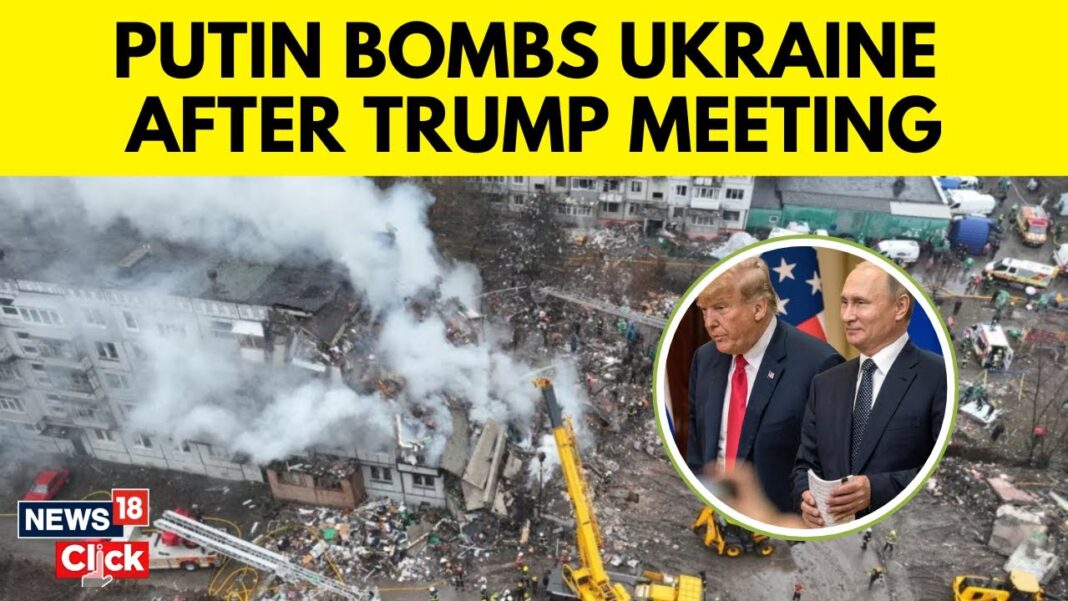
As Ukrainian President Volodymyr Zelenskyy sat alongside President Donald Trump and a delegation of European leaders in Washington on Monday, Russia unleashed one of its most ferocious overnight aerial attacks in weeks. The juxtaposition of diplomacy in the White House and devastation across Ukraine focused attention on the fragile, volatile balance between the battlefield and the bargaining table, a balance that now rests on a knife’s edge.
According to figures released by Ukraine’s air force and cited extensively by ABC News, Russian forces launched a staggering 270 drones and 10 missiles into Ukrainian territory between Monday night and Tuesday morning. Ukrainian defenses intercepted 30 drones and six missiles, but 40 drones and four missiles struck targets across 16 locations. Debris from intercepted projectiles rained down in at least three areas, inflicting further damage.
The Ukrainian Energy Ministry reported that energy infrastructure in the central Poltava region was a primary target. “As a result of the attack, large-scale fires broke out,” the ministry said, adding that oil refining and gas facilities bore the brunt of the assault. Officials described the strikes as the latest in Russia’s campaign of “systematic terrorist attacks against Ukraine’s energy infrastructure, which is a direct violation of international humanitarian law.”
This latest wave of violence marked the most extensive barrage since July 31, when Russia deployed 309 drones and eight missiles, according to daily figures analyzed by ABC News.
While Ukraine struggled to contain the fallout, Russia’s Defense Ministry claimed it was simultaneously repelling Ukrainian drone strikes. Russian officials said their forces shot down 23 Ukrainian drones overnight. Thirteen of those were intercepted over the Volgograd region, where falling debris ignited fires at an oil refinery and scorched the roof of a hospital building. Volgograd’s governor, Andrey Bocharov, acknowledged the damage but insisted there were no casualties.
The exchanges reinforced the brutal symmetry of the war: each side inflicting deep wounds while bracing against the other’s counterstrikes. For Ukrainians, however, the pain is compounded by relentless pressure on vital infrastructure — power plants, gas refineries, and transport systems — targeted in what Kyiv decries as a deliberate campaign of terror.
The attacks unfolded as Trump, Zelenskyy, and European leaders met in Washington to chart a possible roadmap toward ending the war. The timing, noted in the ABC News report, emphasized the urgent stakes of the summit. Zelenskyy, speaking on Tuesday, described the gathering as “truly a significant step toward ending the war.”
The Washington meetings came just three days after Trump’s own session with Russian President Vladimir Putin in Alaska. According to two sources cited by ABC News, Putin rejected an immediate ceasefire and demanded that Ukraine cede the entirety of the Donetsk region as a precondition for halting the invasion.
That demand underscored the chasm between the sides. Ahead of Monday’s meetings, Trump had posted on social media, asserting that “President Zelenskyy of Ukraine can end the war with Russia almost immediately, if he wants to, or he can continue to fight.” Trump also declared that Ukraine would never be permitted to join NATO and would not regain Crimea, seized by Russia in 2014.
These remarks raised fears of a replay of Zelenskyy’s fractious February visit to Washington, when Trump and Vice President JD Vance publicly chastised the Ukrainian leader for what they called his “ingratitude” for U.S. support.
But on this occasion, the meetings were notably more cordial, though hardly conclusive.
One of the thorniest issues discussed in Washington revolved around security guarantees for Ukraine. Trump, while vague on specifics, pledged “very good protection, very good security.” He later suggested that Putin was open to certain guarantees, provided NATO troops were not stationed in Ukraine.
European leaders and Zelenskyy, however, were firm in their insistence that any negotiations be preceded by a full ceasefire. As ABC News reported, Trump appeared to shift his position from earlier demands for an immediate cessation of hostilities. “I don’t think you need a ceasefire,” he told Zelenskyy during their Oval Office session. “I know that it might be good to have, but I can also understand strategically, like, well, you know, one country or the other wouldn’t want it.”
Still, Trump conceded that a ceasefire could save lives. “I like the concept of a ceasefire for one reason, because you’d stop killing people immediately,” he said.
Zelenskyy, while expressing gratitude for American engagement, reiterated Ukraine’s conditions: “The leaders personally came to support Ukraine and discuss everything that will bring us closer to real peace, a reliable security architecture that will protect Ukraine and all of Europe,” he wrote on Telegram following the meetings.
The leaders in Washington broadly agreed on one point: the need for a direct bilateral meeting between Zelenskyy and Putin. Trump suggested he would later join in a trilateral session. “I think it’s going to be when, not if,” he remarked. Zelenskyy responded that Ukraine was “ready” for such a discussion.
On Monday evening, Trump announced via social media that he had spoken with Putin “and began the arrangements for a meeting, at a location to be determined, between President Putin and President Zelenskyy.”
The Kremlin has not explicitly confirmed Putin’s willingness to attend. A statement by Yuri Ushakov, a top Kremlin aide, said only that Trump and Putin had expressed support for “the continuation of direct negotiations between the Russian and Ukrainian delegations.” Ushakov noted the possibility of elevating the level of Ukrainian and Russian representatives involved but avoided committing Putin himself.
While the Washington meetings produced public displays of unity, private differences surfaced. French President Emmanuel Macron voiced skepticism about Putin’s sincerity. “For my part, I have the greatest doubts about the reality of a desire for peace on the part of the Russian president,” Macron said. “As long as he thinks he can win through war, he will do so.”
German Chancellor Friedrich Merz likened Russia’s territorial demands to the United States being forced to cede Florida. “A sovereign state cannot simply decide something like that,” Merz observed. “It is a decision that Ukraine must make itself in the course of negotiations.”
Such comments, reported by ABC News, drew attention to the enormous challenges of crafting a settlement palatable to both Kyiv and Moscow while securing buy-in from Western allies.
For Zelenskyy, the Washington meetings were as much about optics as substance. A display of unity with Trump and European leaders reassures Ukrainians at home and signals resilience to Moscow. Yet the ferocity of Russia’s overnight assault reminded everyone that the battlefield, not the negotiating table, remains the ultimate arbiter of progress.
The attacks on energy infrastructure were particularly telling. As the ABC News report observed, Russia’s systematic targeting of Ukraine’s power and fuel facilities is designed not only to degrade military capabilities but also to sap civilian morale as winter approaches. Ukraine’s Energy Ministry, in its statement, accused Russia of “terrorist tactics” intended to weaponize suffering.
Meanwhile, Russia’s own vulnerability was laid bare by Ukrainian drone strikes inside its territory. Fires at an oil refinery and hospital roof in Volgograd underscored Kyiv’s growing capacity to project force deep into Russian territory, challenging the Kremlin’s narrative of invulnerability.
The simultaneous spectacle of high-level diplomacy in Washington and high-intensity warfare across Ukraine captured the paradox of the conflict. On one hand, leaders spoke optimistically of peace, security guarantees, and potential summits. On the other, Russia unleashed its heaviest aerial assault in weeks, torching Ukraine’s infrastructure and reminding the world that Moscow still believes in victory through destruction.
As the ABC News report emphasized, the gulf between the rhetoric of peace and the reality of war remains vast. Trump’s willingness to convene talks, Zelenskyy’s openness to negotiations, and European leaders’ calls for unity are all significant. But unless Moscow demonstrates a genuine willingness to compromise, the violence is likely to persist.
For now, the only certainty is uncertainty. Ukraine reels from nightly barrages, Russia presses territorial demands, and the international community gropes for a formula to end a war that has reshaped Europe’s security landscape. Whether the Washington summit proves a turning point or just another chapter in an unending saga remains to be seen.
