



|
Getting your Trinity Audio player ready...
|
Armadas and Ultimatums: Trump’s High-Stakes Gamble as Iran Stands at the Crossroads of Diplomacy and Deterrence
By: Ariella Haviv
As tensions between Washington and Tehran surge toward their most perilous point in years, President Donald Trump has once again placed the world on notice with a rhetoric of power, warning, and conditional restraint—language that blends the lexicon of diplomacy with the unmistakable symbolism of military might. According to a report on Wednesday morning at Israel National News, Trump’s latest remarks signal a strategy that fuses overt pressure with the promise of negotiation, positioning the United States as both enforcer and potential peacemaker in a region once again teetering on the edge of conflict.
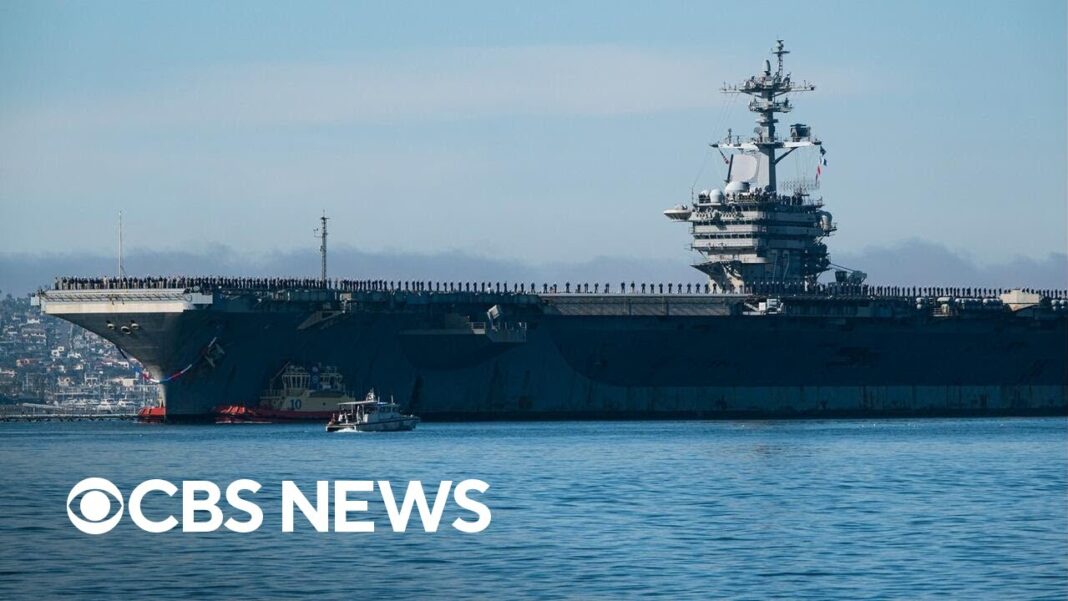
Speaking Tuesday evening at a rally in Iowa, Trump described a growing U.S. naval presence in the Middle East in language as theatrical as it was deliberate. “There is another beautiful armada floating beautifully towards Iran right now,” he told the crowd, a phrase that quickly reverberated across international media and diplomatic circles. The imagery was unmistakable: not merely ships, but symbols of American power, moving with intention toward one of Washington’s most enduring adversaries. Yet, even as he emphasized military positioning, Trump reiterated a parallel message of diplomacy. “I hope they make a deal. I hope they make a deal,” he added, underscoring the dual-track approach that has come to define his Iran policy.
Israel National News has consistently highlighted the central tension embedded in Trump’s strategy: a posture of overwhelming force coupled with repeated invitations to negotiation. This approach, while controversial, reflects a broader doctrine of coercive diplomacy—leveraging military superiority not as an endpoint, but as a tool to compel political concessions without direct action.
The president’s Iowa remarks were not isolated. They followed a series of increasingly explicit warnings delivered in recent days, including a stark in-flight briefing with reporters last Thursday as Trump returned from the World Economic Forum in Davos. According to the information provided in the Israel National News report, Trump spoke openly about a major U.S. military buildup in the region, describing a “big flotilla” and “a big force going toward Iran,” while insisting he would prefer to avoid conflict. “We have a lot of ships going in that direction, just in case,” he said. “We’re watching them very closely.”
Yet the rhetoric escalated dramatically when Trump addressed Iran’s internal crisis—specifically the regime’s reported preparations to execute hundreds of anti-government protesters. In a statement that Israel National News characterized as one of the most severe public threats issued by a sitting U.S. president in recent years, Trump claimed personal intervention prevented mass executions. “I stopped 837 hangings [last] Thursday,” he said. “Every one of them would have been dead. Every one of them would have been hung.”
The president described issuing an ultimatum to Tehran: if executions proceeded, Iran would be struck with force exceeding even past American actions against its nuclear infrastructure. “I said, ‘If you hang those people, you’re going to be hit harder than you’ve ever been hit. It’ll make what we did to your Iran nuclear look like peanuts,’” Trump recounted. He claimed that Iranian authorities canceled—not postponed—the executions shortly thereafter, calling it “a good sign.”
For observers following developments through Israel National News, these statements represent more than rhetorical bravado. They reflect a dramatic escalation in the personalization of foreign policy, with Trump presenting himself not merely as commander-in-chief, but as a direct actor in life-and-death decisions inside another sovereign state. Whether one views this as deterrence or dangerous overreach, the geopolitical implications are profound.
Tehran, for its part, has responded with defiance. Iranian Foreign Ministry spokesman Esmaeil Baghaei warned on Monday that any act of aggression would be met with what he described as a “comprehensive and regret-inducing” response. As Israel National News reported, this language reflects the regime’s longstanding doctrine of asymmetrical retaliation—using proxies, cyber operations, regional militias, and missile forces to impose costs without conventional war.
The stakes have only intensified with reports emerging Tuesday that Washington is weighing targeted strikes on Iranian officials and commanders. These discussions come amid reports that the death toll from Iran’s internal unrest has surpassed 36,000—a figure that, if accurate, would place the crackdown among the bloodiest episodes of domestic repression in modern Middle Eastern history.
In this context, Trump’s repeated expression of hope for a deal acquires a paradoxical quality. The language of peace is being delivered alongside the machinery of war. Diplomacy is being offered from the deck of an aircraft carrier. Negotiation is framed not as compromise, but as capitulation under pressure.
Israel National News analysts have noted that this approach mirrors Trump’s earlier dealings with North Korea, where extreme rhetoric, military posturing, and personal threats were followed by unprecedented summits and negotiations. The question now facing the international community is whether Iran will follow a similar trajectory—or whether the Islamic Republic, structurally and ideologically different from Pyongyang, will respond with resistance rather than accommodation.
Iran’s leadership is constrained not only by external pressure but by internal instability. The ongoing protests, described by Israel National News as one of the gravest challenges to the regime since the 1979 revolution, have eroded Tehran’s political confidence and exposed fractures within its power structure. Mass casualties, internet blackouts, and sweeping arrests have deepened public anger, while international condemnation has intensified Iran’s diplomatic isolation.
Trump’s strategy appears calibrated to exploit this vulnerability. By linking military threats to human rights issues—specifically executions of protesters—he reframes U.S. pressure not solely as strategic containment, but as moral intervention. This framing positions Washington as a defender of the Iranian people rather than merely an adversary of the Iranian state.
Yet this narrative is not universally accepted. Critics argue that military escalation risks empowering hardliners within Iran, legitimizing repression, and triggering regional instability that could engulf Israel, the Gulf states, and U.S. forces across the Middle East. Supporters counter that inaction emboldens authoritarian regimes and signals weakness in the face of mass executions.
From Jerusalem’s perspective, the situation carries existential implications. Iran is not merely a regional rival; it is the primary sponsor of Hezbollah, Hamas, and other armed groups committed to Israel’s destruction. Any confrontation between Washington and Tehran inevitably reverberates through Israel’s security calculus, potentially opening multiple fronts from Lebanon to Gaza.
At the same time, Israeli strategists have long argued that a weakened Iran—economically, politically, and militarily—reduces the threat to Israel’s borders. Thus, Trump’s pressure campaign is viewed by many in Israel not as destabilizing, but as strategically necessary.
The diplomatic dimension, however, remains uncertain. Trump’s repeated insistence that he “hopes” for a deal suggests an awareness that military action carries catastrophic risks. War with Iran would not be a limited engagement; it would be a regional conflagration, with consequences for global energy markets, international shipping lanes, and civilian populations across multiple countries.
The Israel National News report emphasized that the very visibility of U.S. military movements may be part of the strategy. By making the buildup public, Washington signals both capability and resolve, seeking to coerce behavior change without crossing the threshold into open conflict. In this sense, the armada is not merely a weapon, but a message.
Yet history offers sobering lessons about the limits of coercive diplomacy. Miscalculation, miscommunication, or internal pressures can turn deterrence into disaster. A single incident—a drone strike, a naval encounter, a proxy attack—could spiral into a broader war neither side claims to want.
As Trump positions himself as both enforcer and negotiator, the world watches a familiar pattern unfold: power projection paired with conditional restraint, threats paired with offers, armadas paired with olive branches.
For now, the president’s message remains stark in its simplicity: Iran faces a choice between confrontation and compromise. The ships are moving. The warnings have been issued. The door to diplomacy, he insists, remains open—but only under the shadow of overwhelming force.
As the Israel National News report observed, this moment represents a critical juncture not only for U.S.-Iran relations, but for the entire architecture of Middle Eastern security. Whether it leads to negotiation, escalation, or prolonged standoff will shape the region’s future for years to come
In the space between deals and destruction, the world now waits—watching the armadas, listening to the rhetoric, and bracing for the consequences of a confrontation that has not yet begun, but is no longer unthinkable.
