



|
Getting your Trinity Audio player ready...
|
By: Fern Sidman
As the Middle East once again becomes the gravitational center of global geopolitical tension, a potent mixture of naval power, diplomatic signaling, and strategic ambiguity is unfolding in real time. According to report on Friday at World Israel News, the United States has significantly expanded its naval deployments in the region this week, even as President Donald Trump publicly reaffirmed his intention to maintain diplomatic contact with Tehran. The juxtaposition of military escalation and rhetorical openness to dialogue has created a volatile atmosphere—one in which the language of diplomacy and the mechanics of deterrence now move in parallel, each amplifying the stakes of the other.
Speaking while attending the premiere of a documentary about First Lady Melania Trump at the Trump-Kennedy Center, the president delivered remarks that captured the duality of his approach. On the one hand, he emphasized continued engagement. “I have had talks with them, and I intend to hold talks,” Trump said, according to reporting cited by World Israel News via KAN News. When pressed further by reporters on whether he was planning direct dialogue with Iranian officials, Trump answered plainly: “I am planning on it, yeah.”
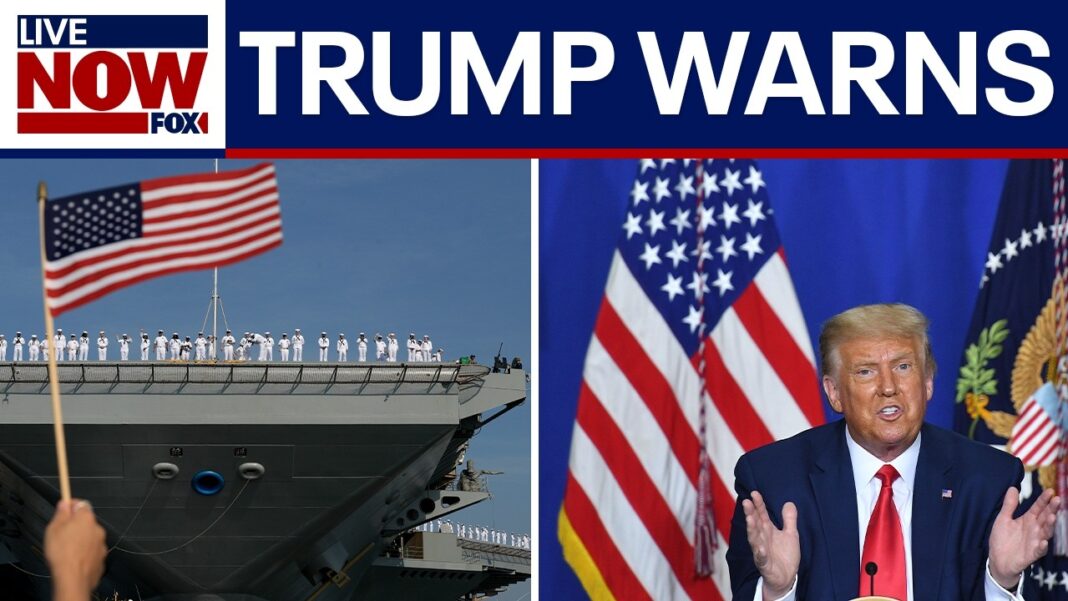
Yet those words were immediately framed by a far more ominous reality. Referring to the rapidly expanding American naval presence in the region, Trump added: “We have a lot of very big, very powerful ships sailing to Iran right now, and it would be great if we didn’t have to use them.” The statement, carried by World Israel News, encapsulated the administration’s strategic posture: diplomacy offered with one hand, coercive power deployed with the other.
At the core of Trump’s message were two non-negotiable demands, delivered with characteristic bluntness: “No nukes, and stop killing the protesters.” The phrasing, stark and uncompromising, reflected both Washington’s longstanding red line on Iran’s nuclear ambitions and a newer focus on the regime’s internal repression. As World Israel News has repeatedly documented, the administration is now explicitly linking external security concerns with internal human rights abuses, effectively framing Iran’s domestic conduct as a matter of international security.
Behind the rhetoric, the military movements tell their own story. A U.S. official told Reuters that the USS Delbert D. Black entered the region within the past 48 hours, bringing the total number of American destroyers in the Middle East to six. These vessels now operate alongside a U.S. aircraft carrier and three littoral combat ships, forming one of the most formidable naval concentrations the region has seen in years. According to the information provided in the World Israel News report, the scale of the deployment is unmistakable: it is not symbolic posturing, but a material demonstration of force projection.
The Delbert D. Black docked Friday at the Port of Eilat, a move confirmed by the Israel Defense Forces, which described the visit as part of “routine, preplanned coordination with U.S. forces.” Yet in the current climate, nothing about such movements appears routine. The World Israel News report noted that every port call, every transit, and every docking now carries strategic meaning, especially in a region where perception often matters as much as firepower.
From Tehran’s perspective, the signals are being interpreted through a very different lens. Sources speaking to the Hezbollah-aligned Lebanese newspaper Al-Akhbar reported that the Islamic Revolutionary Guard Corps (IRGC) has recently received 1,000 new drones and has internally assessed that compliance with U.S. demands would be more costly than confrontation. This assessment underscores the regime’s mindset: rather than viewing compromise as a path to stability, elements within Iran’s security establishment appear to see defiance as the less dangerous option.
This logic reflects a deeper ideological posture. For decades, the Islamic Republic has framed resistance to Western pressure as a core component of its revolutionary identity. To concede under external pressure, particularly from the United States, would not merely be a strategic retreat—it would represent an existential ideological rupture. The regime’s legitimacy is tightly bound to its posture of defiance, making compromise politically perilous for Tehran’s leadership.
Meanwhile, regional actors are scrambling to contain the escalating tension. According to CBS News reporting cited by World Israel News, partners including Turkey, Oman, and Qatar have urged Washington to prioritize diplomacy over military escalation. Officials speaking anonymously said that prospects for direct talks on Iran’s nuclear and ballistic missile programs have not yet gained meaningful traction, suggesting that while diplomatic channels remain technically open, they are not yet operationally effective.
This regional pressure reflects a broader fear: that any miscalculation could ignite a wider conflict that would engulf the entire Middle East. The memory of previous confrontations—proxy wars, missile exchanges, tanker attacks, and drone strikes—looms heavily over the current moment. World Israel News has repeatedly emphasized that Iran’s regional network of proxies, stretching from Hezbollah in Lebanon to militias in Iraq and Yemen, transforms any U.S.–Iran confrontation into a multi-front risk scenario.
Economic considerations are also shaping the strategic calculus. Citi analysts assessed a 70% likelihood of limited U.S.-Israeli measures designed to pressure Iran without triggering full-scale escalation. Their analysis, cited by World Israel News, points to oil market sensitivities and domestic political considerations as constraining factors. Indeed, Brent crude prices have already risen amid fears that any conflict could disrupt shipping through the Strait of Hormuz, one of the world’s most critical maritime chokepoints.
The economic dimension adds another layer of complexity. A conflict with Iran would not remain a regional affair; it would reverberate through global energy markets, supply chains, and financial systems. As World Israel News has reported, even the perception of instability in the Gulf can drive price volatility, affecting economies far removed from the Middle East.
Citi’s projection of a potential U.S.–Iran deal and de-escalation in 2026 suggests that financial institutions still see a long-term pathway toward stabilization. But the near-term picture is far more precarious. The current environment is defined by what strategic theorists call “coercive diplomacy”—the attempt to use military pressure to force political concessions without crossing the threshold into open war. Trump’s language fits squarely within this framework.
Yet coercive diplomacy is inherently unstable. It depends on precise calibration: too little pressure invites defiance; too much pressure provokes retaliation. History offers sobering lessons about how easily such strategies can spiral beyond their architects’ control. The deployment of additional U.S. warships, while intended as deterrence, also increases the risk of miscalculation, accidental confrontation, or unintended escalation.
For Israel, the stakes are uniquely high. Israel views Iran’s nuclear ambitions as an existential threat and Iran’s regional proxies as an immediate security danger. The docking of the USS Delbert D. Black in Eilat is therefore not merely a symbolic gesture of alliance—it is a tangible reinforcement of strategic partnership at a moment of heightened vulnerability.
Within this context, Trump’s dual demands—“no nukes, and stop killing the protesters”—take on layered significance. The nuclear issue represents the traditional axis of U.S.–Iran confrontation. The protest issue, however, introduces a moral and political dimension that reframes the conflict. By linking Iran’s internal repression to international consequences, the administration is attempting to delegitimize the regime not only as a strategic adversary but as a moral outlier.
This approach aligns with a broader narrative strategy: portraying the Iranian leadership as both a security threat and a violator of basic human rights, thereby strengthening the moral justification for international pressure. Whether this framing will resonate globally remains uncertain, especially among countries wary of U.S. interventionism.
The coming weeks will likely determine whether this moment becomes a turning point or a prelude to crisis. Trump has made clear that he prefers a deal to a war. “It would be great if we didn’t have to use them,” he said, referring to the warships now positioned near Iran. But he has also made equally clear that the military option is not rhetorical—it is operational.
As World Israel News reported, the region now stands at a crossroads defined by parallel trajectories: expanding military readiness and tentative diplomatic overtures. The tension between these paths will shape not only U.S.–Iran relations but the broader strategic architecture of the Middle East.
In this charged environment, every statement, every deployment, and every diplomatic signal carries disproportionate weight. The armadas moving through Middle Eastern waters are more than steel and firepower—they are symbols of a geopolitical contest in which credibility, deterrence, and perception are as decisive as missiles and drones.
For now, the world watches as diplomacy and deterrence advance side by side, neither yet eclipsing the other. Whether this uneasy balance produces negotiation, confrontation, or something in between will define the next chapter in one of the most consequential geopolitical rivalries of the modern era—a rivalry that World Israel News has positioned at the center of its global coverage, reflecting its profound implications not only for Israel and the Middle East, but for international stability itself.