



|
Getting your Trinity Audio player ready...
|
By: Fern Sidman
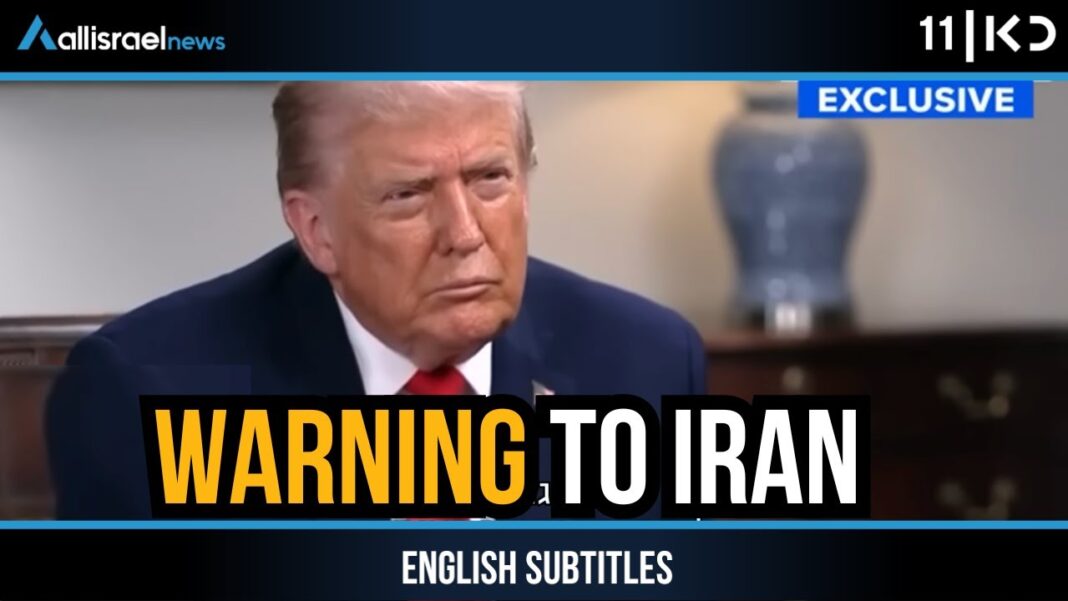
In a moment laden with symbolism, strategic ambiguity, and unmistakable force projection, President Donald Trump delivered one of his most severe and uncompromising warnings yet to the Iranian regime, outlining a sweeping U.S. military buildup in the region and coupling it with direct economic threats and moral condemnation of Tehran’s domestic repression. Speaking during an in-flight briefing with reporters on his return from the World Economic Forum in Davos, Trump framed the unfolding confrontation not merely as a geopolitical standoff, but as a moral struggle between civilization and brutality — a narrative that Israel National News has closely followed and repeatedly emphasized in its reporting.
According to a report on Thursday at Israel National News, Trump described a massive U.S. naval and military deployment moving toward Iran, deliberately using language that conveyed both deterrence and inevitability.
“We have a lot of ships going in that direction, just in case. We have a big flotilla going in that direction. And we’ll see what happens,” Trump said. “We have a big force going toward Iran. I’d rather not see anything happen, but we’re watching them very closely.”
The phrasing was characteristic of Trump’s strategic communication style: direct, unambiguous, and psychologically calibrated to convey overwhelming power while leaving space for de-escalation. As the Israel National News report noted, the emphasis was not on imminent war, but on unmistakable preparedness — a message crafted to shape Iranian decision-making through fear of consequence rather than the inevitability of conflict.
At the heart of Trump’s narrative was a claim that has sent shockwaves through diplomatic and human rights circles alike: his assertion that a direct U.S. threat prevented the execution of 837 Iranian prisoners, most of them young men.
“I stopped 837 hangings [last] Thursday. They would have been dead. Every one of them would have been hung. This is like from a thousand years ago,” Trump said, according to the Israel National News report.
The president described Iran as “an ancient culture” with “very smart people,” yet framed the regime’s actions as barbaric and archaic — invoking imagery of medieval cruelty to emphasize the moral chasm between the Iranian leadership and modern governance.
“I said, ‘If you hang those people, you’re going to be hit harder than you’ve ever been hit. It’ll make what we did to your Iran nuclear look like peanuts.’ And an hour before this horrible thing was going to take place, they canceled it. And they actually said they canceled it. They didn’t postpone it. They canceled it. So that was a good sign.”
As Israel National News has reported, Trump’s framing positions military power not merely as a tool of warfare, but as a mechanism of coercive humanitarian intervention — using overwhelming force as leverage to halt mass violence.
This approach represents a stark departure from traditional diplomatic frameworks, substituting multilateral pressure and sanctions diplomacy with direct deterrence messaging backed by visible military mobilization.
Trump repeatedly returned to the image of a vast U.S. naval presence — an “armada,” a “massive fleet,” a “big flotilla” — deploying toward Iranian waters.
“But we have an armada, we have a massive fleet heading in that direction. And maybe we won’t have to use it. We’ll see.”
As Israel National News analysis has suggested, such language is not accidental. It functions as psychological warfare, signaling to Iranian leadership that escalation would be catastrophic while offering a narrow off-ramp through compliance.
In military doctrine, this is known as compellence rather than deterrence — not merely preventing action, but forcing behavioral change through the credible threat of overwhelming retaliation.
Alongside military escalation, Trump unveiled a new layer of economic pressure targeting not only Iran but its trading partners.
“If you do business with Iran, you will have a tariff of 25 percent,” Trump declared.
According to the report at Israel National News, this represents a dramatic expansion of secondary sanctions strategy, transforming trade with Iran into a direct financial liability for third-party states and corporations.
This policy effectively internationalizes the cost of engagement with Tehran, forcing allies, neutral states, and private firms to choose between access to U.S. markets and economic ties with Iran.
It is economic isolation weaponized at a systemic level — not through diplomatic persuasion, but through market coercion.
Trump’s message on Iran’s nuclear ambitions remained unequivocal and uncompromising.
“They gotta stop with the nuclear,” he told CNBC, a statement repeatedly cited by Israel National News as central to his Iran doctrine.
There was no conditional language, no phased negotiations, no confidence-building frameworks. The demand was absolute: Iran must abandon nuclear weapons ambitions entirely.
This posture aligns closely with Israeli strategic doctrine, which has long treated a nuclear-armed Iran as an existential threat. Israel National News has repeatedly highlighted the convergence between Trump’s Iran policy and Israeli security priorities, particularly in the realm of nuclear non-proliferation and regional deterrence.
Trump’s rhetoric escalated even further during an interview with NewsNation’s Katie Pavlich, where he addressed alleged assassination threats against him and reports of mass killings of protesters.
“Anything ever happens, the whole country is going to get blown up,” Trump said.
“But I have very firm instructions: Anything happens, they’re going to wipe them off the face of this earth.”
As Israel National News reported, this language was not framed as diplomatic pressure but as existential retaliation — a warning that any attack on U.S. leadership would trigger total-state destruction.
While such rhetoric is controversial, supporters argue it functions as a deterrence doctrine of absolute consequence, designed to eliminate ambiguity and remove miscalculation from adversarial planning.
What emerges from Trump’s statements, as the Israel National News report documented, is not a series of isolated remarks but a coherent strategic doctrine: Military Overmatch as deterrence, economic strangulation as coercion, psychological dominance as leverage, moral framing as legitimacy and zero-ambiguity threats as stabilization tools.
This doctrine rejects incrementalism, multilateral diplomacy, and ambiguity in favor of direct power projection and behavioral compellence.
For Israel, the implications are profound. Israel National News has consistently emphasized that Trump’s Iran posture directly strengthens Israel’s regional security architecture.
The U.S. military buildup, economic isolation of Iran, and nuclear red lines align with Israel’s long-standing strategic priorities that include preventing Iranian nuclear capability, limiting Iranian regional influence, constraining proxy militias and weakening regime legitimacy.
Trump’s actions effectively externalize Israeli deterrence strategy into U.S. global power projection.
What distinguishes Trump’s approach, as Israel National News frequently notes, is the fusion of moral narrative with hard power. He frames military escalation not as imperial ambition, but as moral intervention such as stopping executions, protecting protesters, preventing nuclear proliferation and confronting authoritarian brutality.
In this framing, power becomes moral authority, and force becomes humanitarian leverage.
Internationally, Trump’s posture signals a return to great-power realism — where security is enforced through dominance rather than consensus.
It marks a departure from post-Cold War liberal internationalism and a revival of hard deterrence doctrine in global governance.
As Israel National News analysis suggests, this approach will reshape alliance structures, trade relationships, and diplomatic norms — particularly in the Middle East.
Trump’s warning to Iran is not merely a threat — it is a strategic architecture.
As the Israel National News report emphasized, this represents the construction of a multi-domain deterrence system — military, economic, psychological, and moral — designed to force regime behavior without conventional war.
Whether it succeeds remains uncertain. But one reality is clear: The era of ambiguity is over. The era of signaling is over. The era of soft power is fading.
In its place stands a doctrine of overwhelming clarity: Deterrence through dominance. Stability through fear of consequence. Peace through undeniable power.
As the U.S. armada moves eastward and Tehran calculates its next steps, the world watches a geopolitical drama unfold — one in which diplomacy is no longer whispered in conference rooms, but projected through fleets, sanctions, and the unmistakable language of force.
And as Israel National News reported, the confrontation between Washington and Tehran is no longer just a policy dispute — it is a collision between two worldviews, two systems of power, and two visions of order.
One governed by coercion and control. The other by deterrence and dominance.
Between them lies the future of regional stability — and perhaps the architecture of global power itself.
