



|
Getting your Trinity Audio player ready...
|
Arizona Extremist Vowed to Bomb Synagogue in Bid to ‘Topple Jew Government’
By: Fern Sidman
In recent weeks, a series of chilling incidents from Arizona to Florida and beyond have underscored what Jewish leaders, law enforcement, and advocacy groups have long been warning: antisemitism in the United States is no longer confined to the margins of society. It is erupting into mainstream spaces, spilling into workplaces, universities, neighborhoods, and even online exchanges involving everyday citizens.
As The Algemeiner reported on Thursday, the alarming confluence of threats, harassment, and outright assaults against Jews and Jewish institutions has left communities shaken and raised urgent questions about the safety of Jewish life in America.
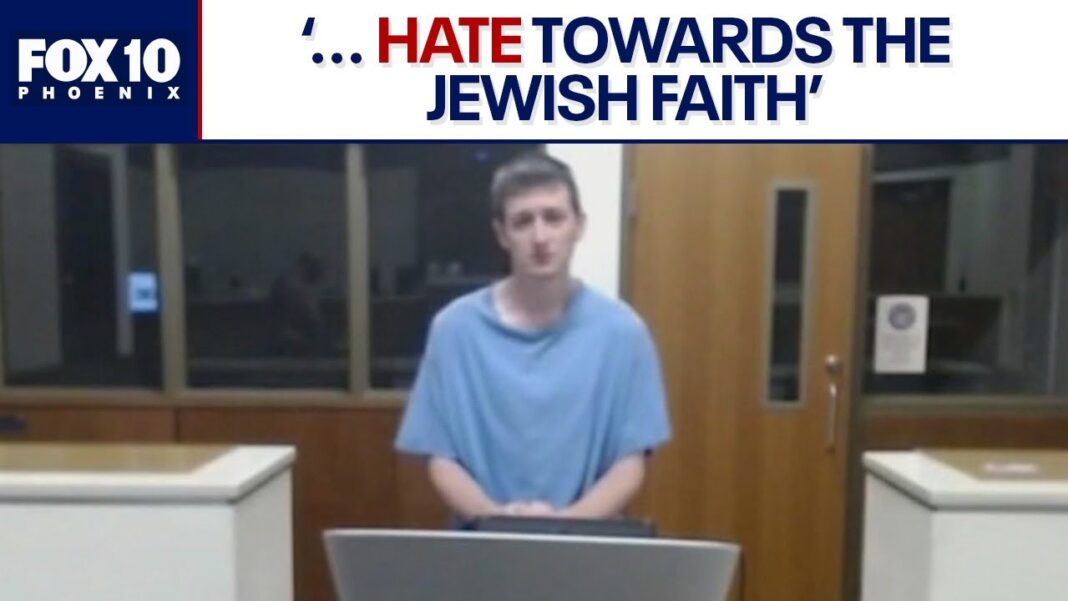
The most brazen incident unfolded in Arizona, where prosecutors arraigned Kevin Charles Pyles, a 32-year-old resident of Glendale, accused of planning mass casualty attacks against Jews.
For four months, authorities say, Pyles broadcast his hate across social media platforms. He railed against Jews, people of color, and the state of Israel, branding the U.S. as a “Jew government.” According to investigators, his tirades escalated into explicit threats to detonate explosives outside Sha’arei Shalom Congregation, a local synagogue, by targeting propane tanks with gunfire.
The warnings reached law enforcement after the Secure Community Network (SCN), a nonprofit dedicated to protecting Jewish communities, flagged Pyles’ postings to Phoenix police. Officers acted swiftly, averting what might have been a catastrophic attack.
“This is very painful. It’s not right to do that,” Rabbi Pinhas Nisanov of Sha’arei Shalom told local news outlet KTVK-3TV. “We have to respect each, and each other, even other religions.”
Rabbi Shmuly Yanklowitz of Arizona Jews for Justice echoed the sentiment, telling reporters that “hatred is growing and antisemitism is growing, and we all have to call it out wherever we see it.”
As The Algemeiner emphasized in its coverage, the Arizona case reflects a disturbing pattern: online spaces serving as incubators for radical hatred that eventually metastasizes into operational plots against Jewish targets.
The volatility of antisemitism is not confined to extremists like Pyles. In Colorado, it erupted in an online attack by a financial services employee against a Jewish writer and mother.
Danielle Gordon, who until Tuesday was employed by Fidelity Investments as a telecenter operator, launched a string of expletive-laden messages at Bethany Mandel, a Jewish journalist and author, after learning that her children attend a Zionist-oriented summer camp.
“F—k you and f—k your kid who goes to Nazi summer camp! Free Palestine from you sick f—ks!” Gordon wrote, according to screenshots shared widely on social media.
The vitriol followed Mandel’s post describing the anxiety caused by a paraglider seen near the camp’s property. For many Jews, the image of a paraglider carries harrowing associations with Hamas’s October 7, 2023 massacre in southern Israel, when terrorists used paragliders to launch their killing spree.
Speaking to The Algemeiner, Mandel reflected on the incident’s significance. “I found it troubling that she sent such antisemitic vitriol when she’s just a working class, college educated white woman living in Denver — that is how far this rot has spread. Antisemitism has become normative discourse for people of her demographic.”
She added that the word Zionist appeared to be the trigger. “That word, Zionist, triggered her very much, and she had no qualms about coming at me, coming at my kids … There should be consequences for talking like this.”
As The Algemeiner report pointed out, Gordon’s firing illustrates that corporations are increasingly being forced to grapple with the public consequences of employees’ antisemitic conduct, even when it occurs outside the workplace.
From online harassment to physical violence, the crisis continued in Florida, where a confrontation at Florida State University (FSU) escalated into alleged battery.
Earlier this month, FSU student Eden Deckerhoff reportedly assaulted a Jewish male classmate inside the Leach Student Recreation Center. The alleged provocation? The young man’s apparel — clothing issued by the Israel Defense Forces.
“F—k Israel, Free Palestine. Put it [the video] on Barstool FSU. I really don’t give a f—k,” Deckerhoff is heard saying in a video before shoving the student. “You’re an ignorant son of a b—h.”
According to the Tallahassee Democrat, Deckerhoff denied any assault when questioned by police, insisting, “No I did not shove him at all; I never put my hands on him.” Yet law enforcement proceeded with misdemeanor battery charges, noting that video evidence appeared to contradict her denial.
The student has since offered to apologize, but for Jewish students on campus, the incident added to a growing climate of fear and hostility. As The Algemeiner has reported, universities nationwide have become flashpoints of antisemitic sentiment since October 7, with Jewish students often facing intimidation for wearing visible Jewish symbols or displaying support for Israel.
The crisis is not confined to individuals. Institutions themselves are being targeted.
In Los Angeles, the Israeli-American Council (IAC) discovered its national headquarters defaced with swastikas and antisemitic graffiti earlier this month. Among the spray-painted slurs were the words “F—k Jews” alongside “BDS,” a reference to the Boycott, Divestment, and Sanctions campaign against Israel.
The attack was condemned by Jewish organizations across the country. For the IAC, it was yet another reminder that antisemitic hate has reached a fever pitch, emboldening vandals to desecrate spaces designed to serve as communal anchors for American Jews and Israeli expatriates.
As The Algemeiner report noted, the symbolism of swastikas in particular carries an especially chilling resonance, evoking the Holocaust while aligning modern antisemitism with the genocidal ideology of the past.
The surge in antisemitic incidents is not anecdotal. It is measurable — and worsening.
According to newly released FBI statistics, hate crimes targeting Jews in the United States increased by 5.8 percent in 2024, reaching 1,938 incidents — the highest total recorded in more than three decades of tracking. The tally includes 178 assaults.
Perhaps more striking is the disproportionality: Jews, who comprise just 2 percent of the American population, accounted for 69 percent of all religion-based hate crimes. Out of 2,942 such incidents reported in 2024, 2,041 targeted Jews. Muslims were the next most targeted group, facing 256 incidents — or roughly 9 percent of the total.
These numbers, reported by The Algemeiner, confirm what Jewish families, synagogues, and community leaders already know: antisemitism in the United States is not marginal, but systemic and pervasive.
For rabbis and activists, the spate of incidents represents both an immediate threat and a long-term crisis.
“Hatred is growing and antisemitism is growing, and we all have to call it out wherever we see it,” Rabbi Yanklowitz said in Arizona.
Jewish writer Bethany Mandel added a more personal reflection in her comments to The Algemeiner. “That she came after my kids — that’s the line. You realize just how normalized this has become when a mother thinks it’s acceptable to wish harm on another mother’s children because they’re Jewish.”
Meanwhile, campus activists warn that unchecked hostility toward Jewish students risks undoing decades of progress toward making universities inclusive spaces.
As The Algemeiner report observed, these incidents collectively illustrate how antisemitism has penetrated multiple layers of American society: extremist threats from unstable individuals, casual hatred voiced by ordinary professionals, outright violence on college campuses, and vandalism against Jewish institutions.
The pattern suggests that the United States is at an inflection point. For decades, American Jews regarded the U.S. as the safest diaspora homeland in history, a nation where pluralism and democratic values would serve as a bulwark against the kinds of persecution their ancestors fled.
But the explosion of antisemitism since Hamas’s October 7 massacre in Israel has shattered that confidence. As The Algemeiner has reported, Jews across the country now confront a grim reality: synagogues must maintain security guards, schools must lock doors, children are taunted at summer camps, and even casual postings on social media can trigger torrents of abuse.
The cases of Kevin Pyles in Arizona, Danielle Gordon in Colorado, Eden Deckerhoff in Florida, and the defacing of the IAC headquarters in Los Angeles are not isolated anecdotes. They are interlocking pieces of a larger narrative: antisemitism in America is resurgent, emboldened, and metastasizing across social, political, and geographic lines.
The FBI’s statistics confirm what Jewish communities experience daily — that Jews are by far the most frequent targets of religiously motivated hate crimes in the United States. The incidents demonstrate that this hatred emerges not only from violent extremists but from neighbors, colleagues, students, and institutions.
For American society, the challenge is stark. Will this pattern be confronted with the seriousness it demands — through law enforcement vigilance, educational reform, and civic condemnation — or will complacency allow antisemitism to become further entrenched?
For Jewish Americans, the message is even more urgent: vigilance and solidarity are essential, and the fight against antisemitism cannot be outsourced. As Rabbi Yanklowitz put it, “We all have to call it out wherever we see it.”
In 2025, as the threats multiply and the statistics mount, that call has never been more pressing
