



|
Getting your Trinity Audio player ready...
|
Argentina Seeks Arrest of Iran’s Supreme Leader Over 1994 AMIA Bombing, Citing Crimes Against Humanity
Edited by: Fern Sidman
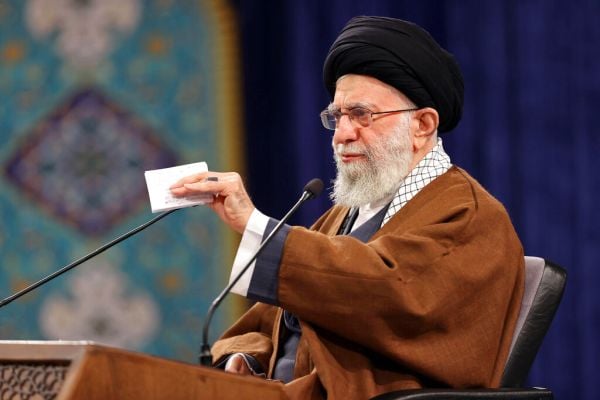
In a landmark move that marks a dramatic escalation in Argentina’s decades-long pursuit of justice for the victims of the 1994 AMIA bombing, the country’s lead prosecutor has petitioned the federal judiciary to issue national and international arrest warrants for Iran’s Supreme Leader, Ayatollah Ali Khamenei, over his alleged role in orchestrating the deadliest terrorist attack in Argentina’s history.
As reported by The Algemeiner on Wednesday, this unprecedented request was formally submitted on Tuesday by Prosecutor Sebastián Basso, who now leads the high-profile case once handled by the late Alberto Nisman, whose suspicious death in 2015 remains a matter of international intrigue and domestic controversy.
For nearly three decades, Iranian leaders implicated in the Asociación Mutual Israelita Argentina (AMIA) bombing — which killed 85 people and injured more than 300 — were considered diplomatically untouchable, The Algemeiner reported. But Basso’s petition challenges that precedent. He urged Federal Judge Daniel Rafecas to issue a summons for Khamenei to testify in court and to request Interpol issue a “Red Notice”, effectively placing Iran’s highest political and religious authority on the international wanted list.
Basso also instructed Argentina’s federal security forces to arrest Khamenei immediately should he ever step foot in Argentine territory, a bold directive that underscores the prosecutor’s view that the Iranian leader’s alleged crimes surpass the protections normally afforded by diplomatic immunity.
“This approach does not align with international law,” Basso wrote, according to The Algemeiner, stressing that crimes against humanity and acts of terrorism are not shielded by sovereign protections.
In his resolution submitted to the court, Basso directly accused Khamenei of authorizing and overseeing the 1994 bombing of the AMIA Jewish community center in Buenos Aires. He stated that Khamenei “led the decision to carry out a bomb attack in Buenos Aires” and issued executive order (fatwa) 39 to bring that deadly decision to life.
As The Algemeiner report noted, Basso emphasized that Khamenei holds ultimate authority over all branches of the Iranian state — including its military, intelligence, and foreign policy operations. He argued that the Iranian leader bears personal and operational responsibility for the terror campaign that reached the streets of Buenos Aires in the early 1990s.
Basso also placed an emphasis on Iran’s longstanding relationship with Hezbollah, its most notorious proxy militia, describing Khamenei as the group’s “main supporter.” He pointed out that Khamenei had personally appointed Hassan Nasrallah — the Lebanese terrorist group’s long-serving secretary-general, recently slain — as his direct representative in Lebanon.
This latest legal maneuver adds another explosive layer to a case long marred by allegations of political interference and institutional obstruction. As The Algemeiner report detailed, Alberto Nisman, the prosecutor who originally filed charges against Iranian and Hezbollah operatives in 2006, later accused former President Cristina Fernández de Kirchner of orchestrating a cover-up. He claimed she sought to shield Iranian suspects in exchange for favorable oil deals and formalized the arrangement through a 2013 memorandum of understanding signed between Buenos Aires and Tehran.
Nisman’s death in 2015, on the eve of presenting his findings to Congress, sent shockwaves through Argentina and prompted widespread speculation that he had been murdered to silence him. The report in The Algemeiner noted that to this day, his death is viewed as a turning point in the AMIA investigation and a symbol of the challenges faced by those seeking accountability.
In a major judicial ruling just one year ago, Argentina’s second-highest court declared that the AMIA attack was “organized, planned, financed, and executed under the direction of the authorities of the Islamic State of Iran,” as was explained in The Algemeiner report. The court described the atrocity as part of a coordinated operation conducted by Hezbollah and orchestrated under the umbrella of Islamic Jihad, confirming the longstanding assertion that Tehran used its Lebanese proxy to strike Jewish and Israeli targets in South America.
The same court also determined that Iran was responsible for the 1992 bombing of the Israeli Embassy in Buenos Aires, which killed 29 people and served as a precursor to the AMIA attack two years later.
In another development highlighted by The Algemeiner, Judge Rafecas last year asked Interpol to detain four Lebanese citizens linked to the AMIA bombing, stating that there was “credible evidence” they collaborated with Hezbollah’s military wing or acted as operational agents.
Tensions between Argentina and Iran — long strained by the unresolved bombings — are now flaring anew, especially under the administration of President Javier Milei, whose staunch pro-Israel stance marks a shift in Argentine foreign policy. The current government has taken a much more assertive position on antisemitism, terrorism, and alignment with democratic allies such as Israel and the United States.
As The Algemeiner report noted, this latest judicial offensive is consistent with the Milei administration’s broader campaign to pursue justice for Jewish victims of terrorism, wherever the evidence may lead.
Prosecutor Sebastián Basso’s call to arrest Iran’s supreme leader represents one of the boldest steps ever taken in Argentina’s pursuit of justice for the victims of the AMIA bombing. By naming Ayatollah Ali Khamenei not just as a symbolic figurehead but as an alleged mastermind of mass murder, Basso has recast the case as not only a national tragedy but a global litmus test for accountability.
Whether Interpol or the international community will act remains uncertain. But as The Algemeiner report indicated, Argentina is no longer content with silence or half-measures. It is sending a message — to Tehran, to the world, and to its own citizens — that justice delayed does not mean justice denied.
