



|
Getting your Trinity Audio player ready...
|
(AP) — Argentine police continued their hunt Wednesday for a 18th-century Italian portrait believed to have been looted 80 years ago from a Jewish collector by a fugitive Nazi officer who settled in Argentina after World War II.
A raid on a villa Tuesday in a seaside resort south of Buenos Aires reopened a shadowy chapter in the history of this South American nation, which sheltered scores of Nazis who fled Europe to avoid prosecution for war crimes, including high-ranking party members and notorious architects of the Holocaust like Adolf Eichmann.
Under the government of Argentine General Juan Perón, whose first tenure lasted from 1946 until his overthrow in 1955, fugitive German fascists brought plundered Jewish property with them, including gold, bank deposits, paintings, sculptures and furnishings.
The fate of those items continues to make news as the painful process of restitution drags along in Argentina and beyond.
Dutch reporters spot the portrait in a real estate ad
In this case, the painting that Argentine authorities are after is “Portrait of a Lady,” by Italian Baroque artist Giuseppe Vittore Ghislandi.
Exceptional Location with Endless Possibilities: This is a rare opportunity to own over 21 acres of beautiful land in one of the most sought-after locations in the Catskills. Perfectly positioned in the heart of Ruach Country, this prime parcel offers unparalleled access to the vibrant summer community. …
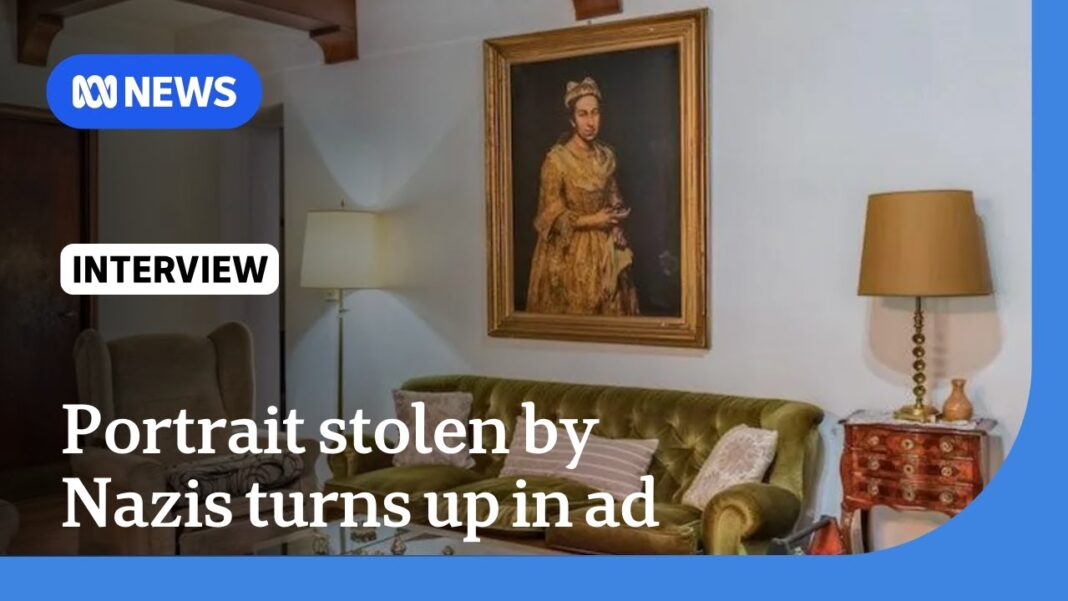
Reporters for the Dutch newspaper Algemeen Dagblad spotted what appeared to be the famous painting this month in a real estate ad for a home believed to be owned by the descendants of Nazi fugitive Friedrich Kadgien while searching for stolen artwork from the Netherlands.
Citing Dutch art experts, the Rotterdam-based paper reported that the original “Portrait of a Lady” appeared to be hanging above a velvet sofa in the living room of a chalet for sale in Argentina’s coastal town of Mar del Plata. The paper published photos showing the painting in a 3D tour of the interior.
“Although we have not physically examined the painting and cannot verify the back of the canvas (for marks or labels that could help confirm its provenance), it is reasonably likely that this is indeed the 18th-century portrait of Countess Colleoni by Ghislandi,” Annelies Kool and Perry Schrier, researchers from the Cultural Heritage Agency of the Netherlands, told The Associated Press.
The real estate agency, Robles Casas & Campos, did not respond to a request for comment. The $265,000 house listing was no longer live as of Wednesday.
Archived screen grabs of the advertisement show the painting stopped appearing among the property images after the Dutch story’s publication on Monday.
Police on Tuesday raided the house, said federal prosecutor Carlos Martínez, but the painting was not found.
Officers seized other items that could be useful for the investigation, including firearms, engravings, prints and period reproductions, he said, adding that investigators were examining possible charges of concealment and smuggling.
The Netherlands’ Cultural Heritage Agency expressed disappointment that Argentine authorities had not located the painting.
“After all, the purpose of our work is to bring looted heritage from the Second World War to light and, where possible, return it to the rightful owners,” it said in a statement Wednesday.
‘Portrait of a Lady’ was taken from a Jewish art dealer
The official Dutch database of missing WWII art, maintained by the Cultural Heritage Agency, identifies the oil-on-canvas “Portrait of a Lady” as belonging to Dutch Jewish art dealer Jacques Goudstikker before the Nazi takeover of his prominent Amsterdam gallery as Germany invaded the Netherlands in May 1940.
The revolutionary YidPad 2.0 only allows the user to access Kosher entertainment such as the world of YidFlicks videos and games, and now upgraded with popular apps like Toveedo, Torah Anytime, 24Six, NakiGo, Torah Live, Zing, and a whole bunch more! Parents love the peace of mind knowing their children are safely enjoying Kosher entertainment th …
Through outright looting or coercive sales, agents acting on behalf of the Nazis made off with countless artworks from private Dutch-Jewish dealers. An estimated 1,100 works in Goudstikker’s inventory were sold illegally to Hermann Goering, known as Adolf Hitler’s right-hand man.
Goudstikker’s sole surviving heir, 81-year-old Marei von Saher, has long pursued restitution for her father-in-law’s stolen works. In a landmark 2006 case, the Dutch government agreed to return 202 looted paintings from Goudstikker’s collection to von Saher after a protracted legal battle.
The lawyers for von Saher told the AP on Wednesday that she is “extremely grateful” for the newspaper’s work in locating the painting and is “exploring all possibilities” to recover it.
While the family can’t authenticate the artwork without examining it in person, Amelia Keuning, one of the attorneys, said images from the real estate listing and other details made them “fairly certain it is the same painting.”
“It is about restoring justice,” said Yaél M. Weitz, von Saher’s other lawyer.
Historical sources link the portrait to a Nazi fugitive
The Dutch archive lists “Portrait of a Lady” as having passed into the hands of a man named Kadgien from Berlin.
A search of the German Federal Archives records the existence of only one Nazi party member with that surname: Friedrich Gustav Kadgien, membership No. 1,354,543, who oversaw foreign currency, precious metals and the sale of confiscated property as a financial aide to Goering.
Following the German defeat, Kadgien fled to Switzerland, then Argentina, according to a declassified report from the Central Intelligence Agency. Members of the Kadgien family and their business dealings show up repeatedly in Argentine judicial and property registries beginning in the 1950s.
Kadgien was never charged with crimes related to the Nazi regime during decades in Argentina. He died in 1978 in Buenos Aires, according to local media reports.
