



|
Getting your Trinity Audio player ready...
|
Argentina Doctor Removed From Post After Threatening to Slit Jewish Throats
By: Fern Sidman
A disturbing new episode in Argentina has ignited outrage and illustrated what Jewish organizations and watchdog groups know is a deeply troubling trend: the resurgence of overt antisemitism within Western medical institutions. As reported on Thursday by The Algemeiner, a Buenos Aires physician has been suspended after publishing a series of grotesquely hateful online messages that called explicitly for violence against Jews. The incident has sent shockwaves through Argentina’s Jewish community and drawn renewed attention to a broader pattern of antisemitic behavior by medical professionals around the world.
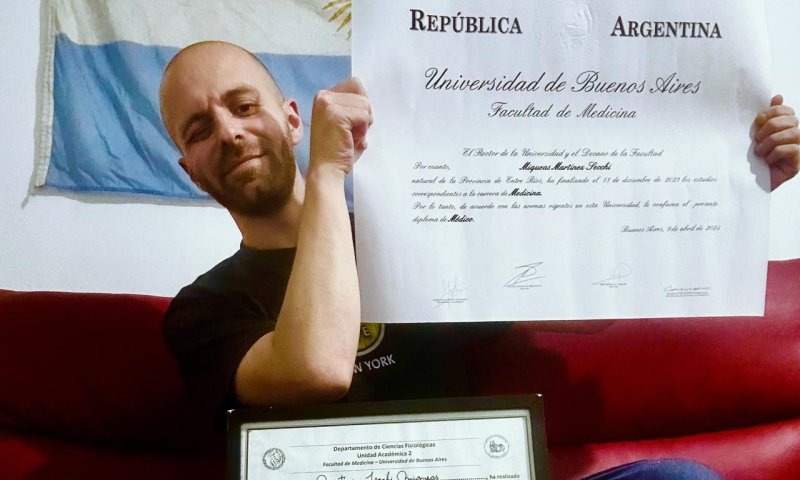
The suspended doctor, identified as Miqueas Martinez Secchi, was a resident physician specializing in intensive care at the José de San Martín Hospital in La Plata, one of the most prominent public medical centers in the Buenos Aires region. His online posts, which were unearthed by Argentine journalist Dani Lerer, included inflammatory language so extreme that it stunned even seasoned observers of online hate.
“Instead of performing circumcision, their carotid artery and main artery should be cut from side to side,” Secchi wrote in one of the messages, according to screenshots later circulated on social media and cited by The Algemeiner in their report. The statement, which explicitly advocated the murder of Jews, triggered immediate outrage and led to calls for his removal from the medical profession.
Once the posts became public, Secchi quickly deleted his social media account. But as The Algemeiner report noted, the damage had already been done. Screenshots of his messages were preserved by outraged users and widely shared across Argentina, where the Jewish community remains one of the largest in Latin America.
Buenos Aires Province Health Minister Nicolás Kreplak issued a swift condemnation. In a statement posted on X (formerly Twitter), Kreplak declared that the sentiments expressed by Secchi were fundamentally incompatible with the ethical obligations of medical practice.
“Any aggressive message or one showing a lack of respect for human life is incompatible with health-care practice and particularly with medicine,” Kreplak wrote. “Health is one of the essential assets of society, and it is indispensable to be firm against any act of discrimination and racism.”
Kreplak confirmed that Secchi had been immediately suspended and placed under both administrative and judicial investigation. According to the minister, an ethical and professional committee will evaluate whether the young doctor should ever be permitted to resume his medical training.
The decisive response was welcomed by Jewish organizations, but many observers, as reflected in commentary in The Algemeiner report, stressed that the incident represents far more than an isolated lapse of judgment. Rather, they say, it is emblematic of a deeper cultural malaise.
As The Algemeiner has documented in numerous recent reports, the case in Argentina is far from unique. Over the past two years, a disturbing string of incidents has revealed antisemitic attitudes festering among doctors, nurses, and medical staff in countries that pride themselves on tolerance and pluralism.
In the Netherlands, for example, a Jewish columnist from Amsterdam reported that she was denied medical care by a nurse who refused to remove a pro-Palestinian pin shaped like a clenched fist. According to the information provided in The Algemeiner report, the columnist said the nurse’s visible political hostility left her feeling unsafe and humiliated at a moment when she was seeking urgent treatment.
Elsewhere in the Netherlands, local authorities opened an investigation into Batisma Chayat Sa’id, a nurse who allegedly declared online that she would administer lethal injections to Israeli patients. The chilling threat, reminiscent of the darkest chapters of European history, was widely condemned but also raised fears about the vulnerability of Jewish patients in supposedly neutral medical environments.
Italy has witnessed similar scandals. As reported by The Algemeiner, two Italian medical workers filmed themselves throwing away medicine manufactured by the Israeli pharmaceutical company Teva in protest of Israel’s war in Gaza. Their stunt, intended as a political statement, was seen by critics as a blatant violation of professional ethics and a potentially dangerous act that placed ideology above patient care.
In Belgium, a hospital suspended a physician after discovering a cache of antisemitic content on his social media pages. Among the materials, according to The Algemeiner report, was a cartoon depicting babies being decapitated by a Star of David and an AI-generated image portraying Hasidic Jews as bloodthirsty vampires. The same doctor reportedly listed “Jewish (Israeli)” as a medical problem on a nine-year-old patient’s chart — an act so egregious that it drew international condemnation.
Perhaps nowhere has the issue been more acute than in the United Kingdom. The Algemeiner has devoted extensive coverage to the crisis of antisemitism within Britain’s National Health Service (NHS).
British Prime Minister Keir Starmer acknowledged the problem in October when he announced a new initiative aimed at combating antisemitism in the health-care system. “There have been just too many examples, clear examples, of antisemitism that have not been dealt with adequately or effectively,” Starmer admitted.
One particularly high-profile case involved Dr. Rahmeh Aladwan, a trainee trauma and orthopedic surgeon who was arrested in October on charges of malicious communications and incitement to racial hatred. As The Algemeiner reported, Aladwan had posted messages on social media celebrating Hamas terrorism and denigrating Jews. She was later suspended from practicing medicine.
In another incident highlighted by The Algemeiner, a Jewish family in London feared that their disabled son’s medical treatment had been compromised by a doctor who had openly expressed antisemitic views. The physician was ultimately suspended after claiming online that Jews possess “feelings of supremacy” and that antisemitism was exaggerated.
UK Health Secretary Wes Streeting described the situation as “chilling,” acknowledging that many Jewish patients now fear discrimination when seeking medical help — a reality almost unimaginable in modern Britain.
The problem has not been confined to Europe. In Australia, two nurses sparked global outrage after filming themselves bragging about refusing to treat Israeli patients. One of them made a throat-slitting gesture while boasting of killing Jews. As The Algemeiner reported, both nurses lost their licenses and now face criminal prosecution.
The scandal had a profound impact on Australia’s Jewish community. A U.S.-born Jewish woman living in Australia told The Algemeiner that the incident left her terrified of entering a hospital.
“Now they actually brag online about killing Israeli patients,” she said. “I don’t know how safe I would feel giving birth at that hospital.”
Her fears reflect a broader sentiment increasingly heard from Jewish communities worldwide: that medical institutions — once seen as sanctuaries of compassion and neutrality — are becoming politicized spaces where Jews cannot feel secure.
Experts interviewed by The Algemeiner have pointed to several factors driving the phenomenon. The aftermath of the October 7, 2023 Hamas massacre in Israel unleashed a tidal wave of global protests and polarized discourse, with anti-Israel activism frequently bleeding into overt antisemitism.
Social media has played a powerful role as well. Platforms that reward outrage and extremism have allowed fringe views to migrate into mainstream professional spaces. Young professionals, including those in medicine, are increasingly exposed to radical ideologies that frame Jews and Israel as malevolent forces — narratives that, once internalized, can manifest in shocking ways.
Another factor is the erosion of professional norms. Medicine has traditionally required strict political neutrality, with doctors expected to treat all patients equally regardless of background. Yet as The Algemeiner report observed, those boundaries are fraying as activists seek to turn hospitals into arenas for ideological struggle.
Beyond the headlines and investigations lies a deeper moral issue: the vulnerability of Jewish patients.
Medical care depends on trust — the belief that a doctor or nurse will act solely in the patient’s best interest. When that trust is broken, the consequences can be devastating.
Jewish organizations cited by The Algemeiner warn that even a handful of high-profile incidents can create widespread fear. Elderly Holocaust survivors, Jewish children, and Israeli expatriates may now wonder whether the person holding a syringe or scalpel harbors hatred toward them.
That erosion of confidence, many argue, is itself a form of discrimination.
The case of Dr. Secchi in Argentina has at least demonstrated that swift accountability is possible. But as The Algemeiner report emphasized, suspending one doctor or firing one nurse will not solve a systemic problem.
Advocacy groups are calling for stronger professional codes of conduct, mandatory antisemitism awareness training, and clearer disciplinary procedures for health-care workers who engage in hate speech. Hospitals and medical schools, they say, must reaffirm that political opinions can never justify dehumanizing patients.
There is also a growing demand for governments to treat antisemitic threats in medical settings with the gravitas they deserve. Calls to harm Jews, when uttered by those entrusted with life-and-death responsibility, are not merely offensive — they are dangerous.
As The Algemeiner has chronicled with increasing alarm, the infiltration of antisemitism into health care represents a moral emergency. The white coat, long a symbol of healing and impartiality, is being tarnished by those who have allowed hatred to eclipse humanity.
Argentina’s decisive action against Dr. Secchi offers a measure of hope. Yet the global pattern suggests that much deeper work lies ahead.
Medicine is meant to be a universal language of compassion. If it becomes another battlefield for ideological warfare, society will have lost something immeasurably precious.
For Jewish patients around the world — and for all who believe in the sanctity of medical ethics — the fight to reclaim that ideal has never been more urgent.