



|
Getting your Trinity Audio player ready...
|
By: Fern Sidman
A recent Associated Press feature profiling wounded Hezbollah members following a September 2024 Israeli pager-bombing campaign has sparked sharp criticism for omitting vital context about the group’s history of terrorism, its U.S. designation as a Foreign Terrorist Organization, and its ongoing rocket attacks targeting Israeli civilians.
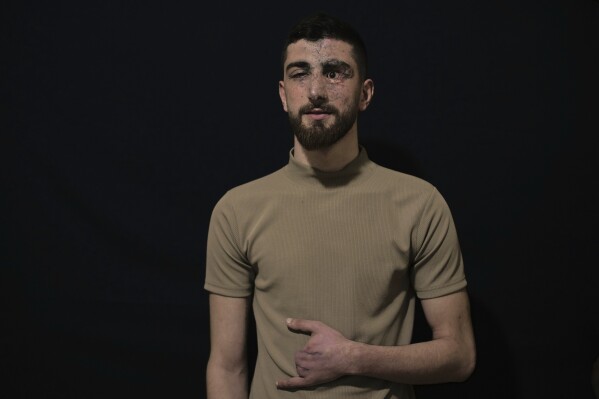
As extensively noted in a report at VIN News, the AP’s 2,150-word report and accompanying photo essay humanize Hezbollah fighters injured in the Israeli strike, portraying them as “survivors” and detailing their personal suffering, without once referencing the group’s terrorist status or its role in launching repeated cross-border attacks into northern Israel since October 2023.
The September 17th operation marked a turning point in Israel’s clandestine war with Hezbollah, with Israeli defense officials describing it as a landmark achievement in technological warfare. According to the information provided in the VIN News report, Israeli intelligence had tracked and distributed modified communication pagers to hundreds of Hezbollah operatives. These devices were later remotely detonated, leading to a wave of targeted injuries among Hezbollah field personnel.
One such operative, 23-year-old Mahdi Sheri, is the focal point of the AP report. The article states that Sheri responded to a message on his pager just before it exploded, sending shrapnel into his left eye socket. Sheri was treated in Syria and Iraq, as hospitals in Lebanon reportedly lacked capacity due to the ongoing conflict. Surgeons later fitted him with a prosthetic eye. “He can no longer play football,” the article laments, noting that Hezbollah is “helping him find a new job.”
Yet, as the VIN News report pointed out, Sheri is referred to only as a “Hezbollah fighter” with no mention of the group’s violent ideology or record of attacks. The AP article does not acknowledge Hezbollah’s designation as a terrorist group by the U.S. State Department in 1997 — a classification still in force — nor does it reference the group’s documented history of targeting both Israeli and American civilians and military personnel.
The term “terror” does not appear in the AP’s report. Instead, the piece emphasizes the physical toll on wounded Hezbollah members, describing their recovery journeys and the emotional scars they carry. The AP’s choice of language — including references to Hezbollah as “a major Shi’ite political party” with “a wide network of social institutions” — mirrors rhetoric often employed by the group’s political supporters and public relations apparatus.
Critics contend that the omission of Hezbollah’s violent operations and terror designation represents a significant distortion in public framing. “Humanizing a militant group while excluding its terrorism record amounts to narrative manipulation,” a VIN News editorial stated this week, warning that such coverage can dangerously obscure the realities faced by Israeli civilians and international stakeholders.
Since Hamas’s October 7th massacre in southern Israel, Hezbollah has dramatically escalated its rocket attacks against Israeli border towns in the north, prompting mass evacuations and daily shelter alerts. Thousands of families from Kiryat Shmona, Metula, and other towns along the border remain displaced due to near-daily barrages.
While the AP acknowledged that Hezbollah has fired rockets into Israel “nearly daily… in solidarity with Palestinians in Gaza,” the article makes no reference to the humanitarian toll inflicted by these attacks. Nor does it examine the indiscriminate nature of Hezbollah’s rocket fire, which Israeli officials have consistently characterized as violations of international law. The report instead centers on whether Israel’s pager operation might be considered “indiscriminate,” citing unnamed “human rights and United Nations reports.”
Israeli officials reacted strongly to the AP’s omission of Hezbollah’s terror designation and its focus on the group’s injured fighters. A defense ministry spokesperson, speaking to VIN News, expressed dismay that “the Associated Press would dedicate so much space to Hezbollah operatives without referencing their active involvement in terror campaigns against civilians.”
Prime Minister Benjamin Netanyahu, who famously presented President Donald Trump with a ceremonial golden pager as a symbol of the strike’s success, has defended the operation as “a clean, targeted blow to the infrastructure of terrorism.” The Israeli government maintains that those injured in the strike were combatants directly involved in hostile operations and that all efforts were made to limit collateral damage.
The AP’s coverage has reignited a broader debate over how media organizations report on militant actors, particularly when those actors possess dual identities as political entities and armed groups. Hezbollah operates a sophisticated information network and often highlights its social services and political activism to deflect from its paramilitary activities. By amplifying that narrative without acknowledging the group’s documented terrorist acts, critics say, media outlets risk laundering the reputations of violent organizations.
As the VIN News report emphasized in its reporting, the framing of Hezbollah as merely a political movement with a humanitarian arm disregards the evidence — including the group’s involvement in the 1983 U.S. Marine barracks bombing in Beirut, the 2012 Burgas bus bombing in Bulgaria, and ongoing operations in coordination with Iran’s Islamic Revolutionary Guard Corps.
The Associated Press’s decision to omit mention of Hezbollah’s U.S. terror designation in a profile of its wounded operatives has drawn substantial criticism for what many view as a sanitized portrayal of a globally recognized terrorist organization. As the VIN News report underscored, balanced reporting on conflicts involving non-state actors must include acknowledgment of those actors’ full history — including acts of terrorism — to present an accurate picture to readers.
In conflicts where information is as much a weapon as firepower, how a story is framed can shape global perception. The omission of critical context risks turning propagandists into “survivors” and terrorists into mere political players — with consequences far beyond the printed word.

AP, Reuters and others are Muslim monster terrorist supporters and vicious antisemites.