



|
Getting your Trinity Audio player ready...
|
By: Fern Sidman
In the wake of U.S. military strikes on Iran’s nuclear infrastructure, conflicting assessments have surfaced regarding the extent of the damage, casting doubt on the true impact of Operation Iron Shield. While President Donald Trump has publicly lauded the air campaign as a decisive success, multiple reports — including one published by World Israel News — suggest a more restrained verdict: Iran’s nuclear ambitions may have been temporarily hindered, but far from neutralized.
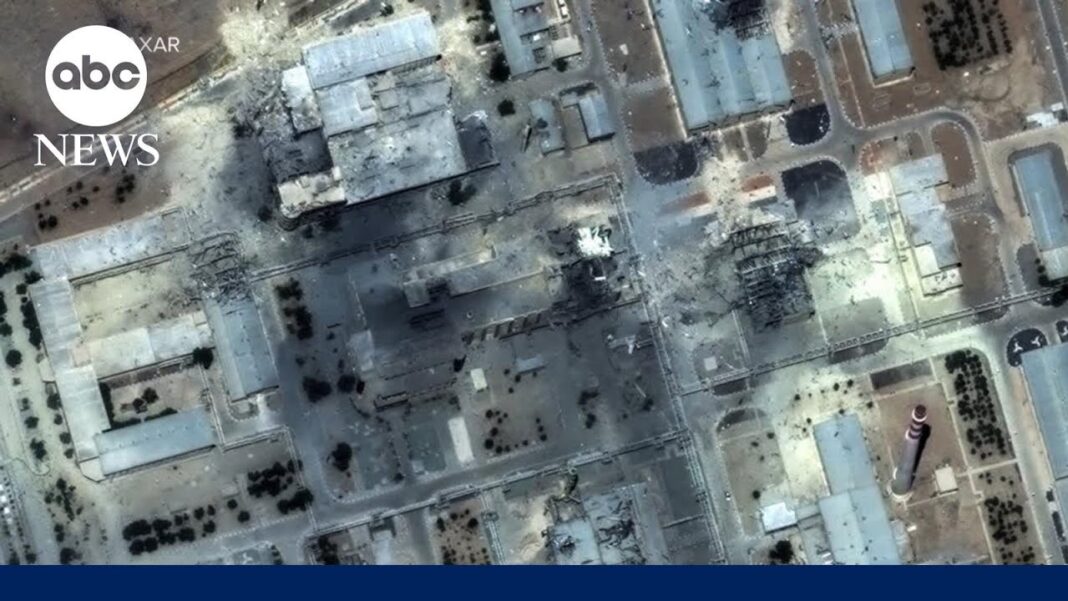
The operation, led by seven B-2 Spirit stealth bombers and utilizing the Pentagon’s most formidable non-nuclear bunker-busting arsenal, dropped 14 GBU-57 Massive Ordnance Penetrators on three of Iran’s most fortified nuclear sites: Natanz, Fordow, and Isfahan. These facilities represent the hardened core of the Islamic Republic’s uranium enrichment capacity. According to the information provided in the World Israel News report, satellite imagery confirms extensive physical damage at all three sites, including scorched terrain, debris fields, and cracks in surrounding infrastructure — visual indicators of what analysts describe as “non-trivial setbacks.”
Yet behind the scenes, a different narrative is emerging — one that has ignited a fresh wave of controversy within U.S. intelligence circles and the international media. On Wednesday, World Israel News reported that a newly surfaced U.S. intelligence assessment — though not officially attributed to any particular agency — concludes the operation may have delayed, but not dismantled, Iran’s nuclear program.
President Trump, clearly irked by press accounts disputing the efficacy of the strikes, did not mince words in his response. “CNN is scum and so is MSDNC,” he said on Tuesday, taking aim at MSNBC while departing Washington for The Hague. “The fake news – like CNN in particular – they’re trying to say, ‘Well, I agree that it was destroyed, but maybe not that destroyed.’ You know what they’re doing. They’re really hurting great pilots that put their lives on the line.”
The report at World Israel News noted that Trump’s comments reflect more than political irritation; they signal his administration’s commitment to framing the airstrikes as both a tactical and symbolic blow to Iran’s atomic aspirations. “I think it’s been completely demolished,” Trump insisted. “Those pilots, those B-2 pilots, did an unbelievable job.”
Nevertheless, according to Reuters and corroborated by World Israel News, unnamed intelligence officials say the reality is more nuanced. The strikes may have achieved substantial structural damage, but Iran had allegedly anticipated the possibility of such an assault and dispersed large quantities of enriched uranium to undisclosed secondary sites in the weeks leading up to the bombings.
This strategic foresight, if verified, would mean that Iran’s core technical capacity — its centrifuges, uranium stockpile, and weapons research — remains partially intact, if not fully operational. The International Atomic Energy Agency (IAEA), which had previously warned that Tehran was enriching uranium to 60% purity — just shy of weapons-grade — estimated before the strikes that Iran had enough enriched material to produce nine to ten nuclear bombs if processed further to 90%.
The choice of munitions and aircraft highlights the seriousness with which the U.S. viewed the threat. According to the information contained in the GBU-57, colloquially known as the “bunker buster,” is designed to penetrate up to 200 feet of reinforced concrete before detonating — ideal for targeting subterranean facilities such as Fordow, which is buried deep within a mountain near Qom. The deployment of B-2 Spirits, which are capable of flying undetected across continents, highlighted the clandestine and high-risk nature of the operation.
Despite these advantages, U.S. officials speaking to World Israel News caution that “obliteration” is difficult to achieve in a single wave of strikes against a deeply entrenched and redundantly designed program. “Iran has spent two decades hardening its nuclear assets,” one source said. “You can damage centrifuges, you can destroy lab space, but as long as the intellectual capital and uranium stockpiles remain, the program survives — albeit temporarily slowed.”
Indeed, reports suggest that Iran’s nuclear teams have already begun damage assessments and are working to reestablish production at alternate facilities. World Israel News reported that Iran’s Revolutionary Guard has sealed off access to the sites, restricting journalists and foreign observers, while simultaneously boasting that its nuclear program will be rebuilt “faster and stronger.”
For the Trump administration, the stakes are as much about messaging as they are about munitions. After months of escalating tension — including Iran’s support for proxy militias attacking American and Israeli targets — Trump needed to project strength. With the second term of his presidency already defined by high-stakes foreign policy choices, Operation Midnight Hammer was as much a political gambit as a military one.
In the days following the attack, Trump campaign aides have reportedly prepared messaging to highlight his “decisive action to protect America and our allies.” The World Israel News report noted that Trump’s team believes this operation stands in contrast to previous administrations’ reliance on diplomacy, which they argue only gave Iran more time to enrich uranium under the guise of negotiation.
However, critics warn that unless accompanied by a follow-up strategy — be it diplomatic or military — the operation risks being remembered as a short-term blow rather than a long-term solution. The concern is particularly acute among Israeli analysts quoted by World Israel News, who worry that Tehran may respond with asymmetrical retaliation: cyberattacks, attacks on Gulf shipping lanes, or support for terror proxies such as Hezbollah and the Houthis.
The public’s understanding of what transpired may ultimately hinge not on classified assessments, but on the information war now underway. World Israel News reported a growing divide between mainstream media’s cautious interpretations of the operation and the administration’s confident proclamations.
In that vacuum, adversaries are crafting their own narratives. Iranian state TV claimed that “American missiles fell on empty halls,” suggesting a lack of casualties or strategic losses. At the same time, Iranian officials have refused IAEA requests for access to the damaged sites — a move that World Israel News interprets as a signal that the regime has something to hide.
As for the international community, NATO allies have issued carefully worded statements praising American restraint, while also calling for renewed diplomacy. Behind closed doors, however, diplomats have expressed concern that the strike could spark a broader regional conflict if Iran chooses to retaliate.
Perhaps most troubling is the persistent ambiguity over the scope of Iranian nuclear capability post-strike. According to the report at World Israel News, no agency — whether the CIA, DIA, or NSA — has yet released a definitive public assessment. While internal briefings have been shared with Congressional leaders, the lack of an official damage report only deepens speculation.
What is known, according to the World Israel News report is that at least three Iranian nuclear scientists were killed in the strike on Natanz, though Iran has not publicly confirmed this. Whether their deaths represent a blow to Iran’s atomic brain trust remains unclear.
Ultimately, Operation Midnight Hammer may go down as a necessary, symbolic, and potentially effective action — but not an absolute one. As the World Israel News report pointed out, the battle against Iran’s nuclear program is as much about deterrence and delay as it is about destruction.
The real test will be whether the U.S. and its allies can capitalize on this window of time — however brief — to pressure Tehran into curbing its program, or whether the Islamic Republic will emerge more emboldened, defiant, and secretive than ever.
In the fog of modern warfare, success is rarely measured in rubble alone.
