



|
Getting your Trinity Audio player ready...
|
By: Fern Sidman
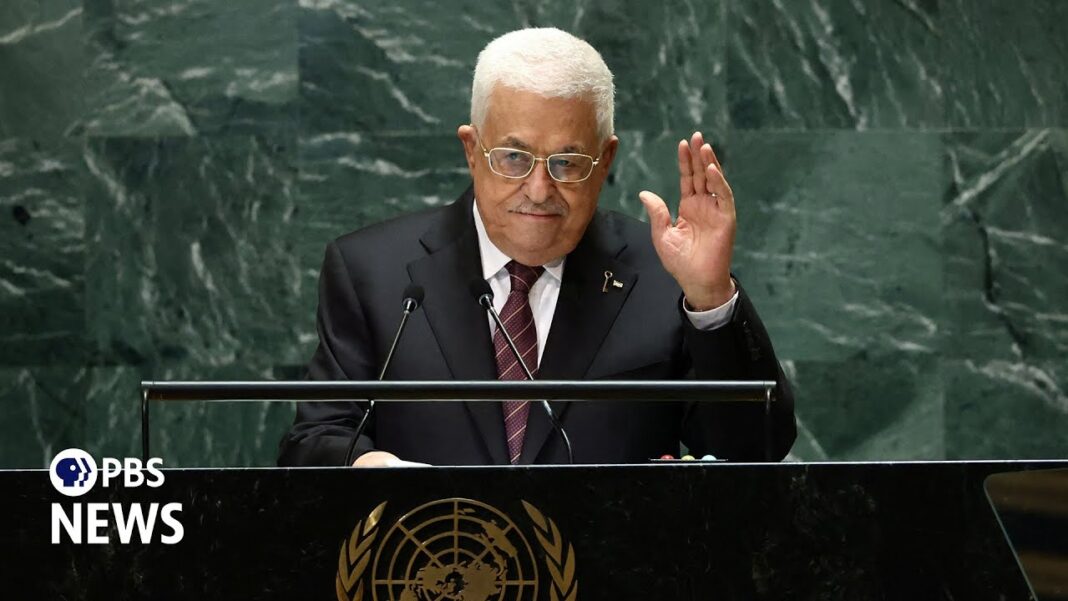
Palestinian Authority (PA) President Mahmoud Abbas appeared before the United Nations General Assembly on Thursday, not in person but by video, after the United States revoked his visa. His address, filled with predictable accusations against Israel and carefully staged assurances about his readiness to govern Gaza, immediately drew scrutiny in Jerusalem and across the Jewish world. While he presented himself as a responsible alternative to Hamas, a closer look at his record and rhetoric reveals why Israel and many in the international community remain deeply skeptical of his intentions.
As VIN News reported on Thursday, Abbas has a long track record of incendiary claims against Israel, delegitimizing its right to self-defense while ignoring the Palestinian Authority’s role in incitement and corruption. His Thursday speech fit neatly into that pattern. He declared that Hamas will have no role in Gaza after the war and demanded that the terror group hand over its weapons to his administration. Yet to anyone familiar with Palestinian politics, these promises ring hollow.
Abbas told the world body that Palestinians “reject” Hamas’ October 2023 atrocities against Israel, and that the PA stands “ready to bear full responsibility for governance and security in Gaza.” But as VIN News reported, these statements are designed for international consumption rather than domestic implementation. The PA itself has long been complicit in a culture of terrorism, glorifying violence through official media and schools while paying salaries to convicted terrorists under its “martyrs fund.”
It strains credulity that Abbas, whose administration has failed to curb terror in Judea and Samaria, could suddenly disarm Hamas, a movement with thousands of entrenched fighters, extensive weapons caches, and an ideology rooted in Israel’s destruction. Promising to confiscate weapons and govern Gaza responsibly is politically expedient before a global audience, but few Israelis—on the left or the right—take him at his word.
True to form, Abbas laced his UN speech with accusations against Israel, charging it with “war crimes” and “genocide” in Gaza. He pointed to what he described as mass destruction, starvation, and displacement caused by Israeli operations. These accusations are not new; they mirror the rhetoric Abbas has deployed for decades at international forums, even as VIN News and other outlets have shown that such claims ignore Hamas’ cynical use of human shields and systematic theft of humanitarian aid.
Israel’s strikes in Gaza have been carefully targeted at Hamas infrastructure and operatives, but Abbas’s speech erased that reality. By portraying Israel as the aggressor and Palestinians as the sole victims, he sought to secure international sympathy and deflect attention from his own failures. The PA has historically leveraged accusations of genocide and apartheid to manipulate the diplomatic arena, securing recognition and funding without addressing its own corruption or its support for terror.
Abbas also used his address to praise Western countries that recently recognized a Palestinian state, including France, the United Kingdom, and Canada. “Recognition alone is not enough,” he insisted, urging more governments to follow suit.
But as the VIN News report pointed out, unilateral recognition of “Palestine” rewards extremism and undermines direct negotiations, which remain the only path to genuine peace. Abbas’s gratitude for symbolic gestures of recognition belies his true objective: to bypass dialogue with Israel entirely and impose a state without concessions or accountability. By encouraging world powers to act unilaterally, he hopes to legitimize a Palestinian leadership that still refuses to recognize Israel as the Jewish state or renounce terrorism unequivocally.
“The dawn of freedom will emerge, and the flag of Palestine will fly high,” Abbas declared to applause from sympathetic delegations. He vowed: “We will not leave our homeland. We will not leave our lands.”
Such statements may stir nationalist pride among his supporters, but they also reveal the zero-sum worldview Abbas continues to espouse. Nowhere in his speech did he mention Israel’s right to exist as a sovereign state in its ancestral homeland. His repeated invocations of “our land” signal an uncompromising vision of Palestinian sovereignty “from the river to the sea”—a phrase that is a euphemism for the eradication of Israel itself.
Abbas’s rhetoric may appear less incendiary than Hamas’s open calls for jihad, but the end goal remains strikingly similar: an Israel that is delegitimized and weakened in the court of global opinion.
For decades, Abbas has postured as a moderate before international audiences while presiding over a regime steeped in incitement. Under his watch, the PA has renamed schools, squares, and cultural centers after terrorists; PA media has glorified “martyrs” who carried out massacres; and official stipends continue to incentivize violence. VIN News has highlighted that the so-called “martyrs fund” remains one of the clearest indications that Abbas is no partner for peace.
How can a leader who pays terrorists claim the credibility to disarm Hamas? How can a man who incites against Israel daily be entrusted with governing Gaza responsibly? Abbas’s record answers these questions, even if his UN rhetoric attempts to obscure them.
Abbas’s true strategy is not to fight Hamas but to manipulate the aftermath of the war to his advantage. By presenting himself as the only viable governing alternative, he aims to insert the PA into Gaza with international backing, thereby strengthening his political position without making meaningful reforms.
Meanwhile, his relentless accusations against Israel serve to weaken Jerusalem’s standing in the global arena. By branding Israeli self-defense as “genocide,” Abbas fuels campaigns in international courts and institutions designed to isolate and punish the Jewish state. The VIN News report warned that such diplomatic warfare is no less dangerous than rockets or suicide bombings, as it delegitimizes Israel in the eyes of the world.
Israelis across the political spectrum reacted to Abbas’s speech with deep skepticism. While some in the international community hailed his rejection of Hamas, most Israelis see it as a cynical ploy. As VIN News reported, Israeli leaders remain acutely aware that the PA has neither the capacity nor the willingness to confront Hamas militarily.
Prime Minister Benjamin Netanyahu has reiterated that Israel will not allow a Palestinian state to be imposed from the outside. Other senior officials have pointed out that Abbas cannot even secure Jenin or Nablus, cities plagued by terror factions, let alone govern a devastated Gaza.
Mahmoud Abbas’s video address to the UN was, in essence, an exercise in political theater. He posed as a statesman ready to bring stability to Gaza, but his words were undercut by years of incitement, corruption, and complicity in terror.
VIN News has documented again and again how Abbas plays a double game: condemning Hamas when it suits him, but refusing to dismantle the very structures of hate and violence that keep the conflict alive. His UN performance may have impressed sympathetic governments eager to recognize a Palestinian state, but for Israelis and anyone familiar with his record, it offered nothing new.
Abbas is no friend of Israel, no credible peacemaker, and certainly no answer to Hamas. He is, at best, a representative of Palestinian terrorism dressed in diplomatic garb. And as the VIN News report emphasized, Israel cannot afford to be deceived by empty promises and rhetorical flourishes.