



|
Getting your Trinity Audio player ready...
|
By: Fern Sidman
For a third consecutive week, the streets of Iran have throbbed with defiance, even as the state mobilizes its full coercive apparatus to extinguish the uprising. According to a report on Sunday by Ynet Global, Iran’s police chief, Gen. Ahmad Reza Radan, confirmed Sunday that the regime has intensified what he called the “level of confrontation with rioters,” a phrase that has become a grim euphemism for a sweeping crackdown marked by mass arrests, expanding surveillance, and lethal force.
Radan’s declaration was not made in isolation. It followed a Saturday night wave of “significant arrests,” aimed, he said, at “key figures involved in the unrest.” These detainees, he vowed, will be prosecuted once the “legal process” is complete—language that many human-rights observers interpret as an ominous prelude to politically motivated trials.
The scale of the repression, as chronicled by Ynet Global through its network of regional correspondents and human-rights monitors, has grown alarmingly. The U.S.-based Human Rights Activists News Agency (HRANA) now reports at least 116 fatalities and roughly 2,600 arrests since the protests began, figures that continue to rise daily.
As security forces tighten their grip at home, Iran’s political leadership is amplifying its rhetoric abroad. In a dramatic special session of parliament broadcast live on state television, Speaker Mohammad Bagher Ghalibaf issued a warning that reverberated far beyond Tehran’s chambers.
According to the information provided in the Ynet Global report, Ghalibaf declared that Israel and U.S. military forces would become “legitimate targets” should Washington move against Iran. The remarks were framed as a response to statements by President Donald Trump, who has publicly warned Tehran against the continued killing of protesters.
Lawmakers punctuated Ghalibaf’s address with chants of “Death to America,” a ritualistic refrain that underscored the session’s bellicose tone. Ghalibaf went further, praising the police, the Islamic Revolutionary Guard Corps (IRGC), and particularly the Basij militia—an auxiliary force widely accused of brutal crowd suppression—for having “stood firm” against demonstrators.
“The Iranian people must know that we will deal with them in the harshest way,” he said, referring to protesters as “rioters,” and vowing severe punishment for those detained.
Ebrahim Azizi, head of parliament’s National Security Committee, echoed this posture, telling lawmakers that any actions against the United States and Israel would be considered “legitimate” and warning that Iran’s adversaries should expect “harsh revenge.” Such rhetoric, delivered amid domestic unrest, suggests a regime increasingly inclined to externalize its internal crisis.
Perhaps the most potent weapon in the state’s arsenal is not its batons or bullets, but silence. Since Thursday, Iran has been almost entirely severed from the global internet. NetBlocks, which monitors connectivity worldwide, estimates that national access has fallen to just 1% of normal levels.
The Ynet Global report documented how the blackout has crippled independent reporting, prevented protesters from coordinating, and obscured the true scale of the crackdown. Yet even this digital curtain has not been absolute. A handful of Iranians, primarily in wealthier urban neighborhoods, have managed to maintain contact using alternative technologies such as Elon Musk’s Starlink satellite system.
Through these fragile channels, images and messages continue to leak out—enough to confirm that protests persist across the country and that casualties are mounting.
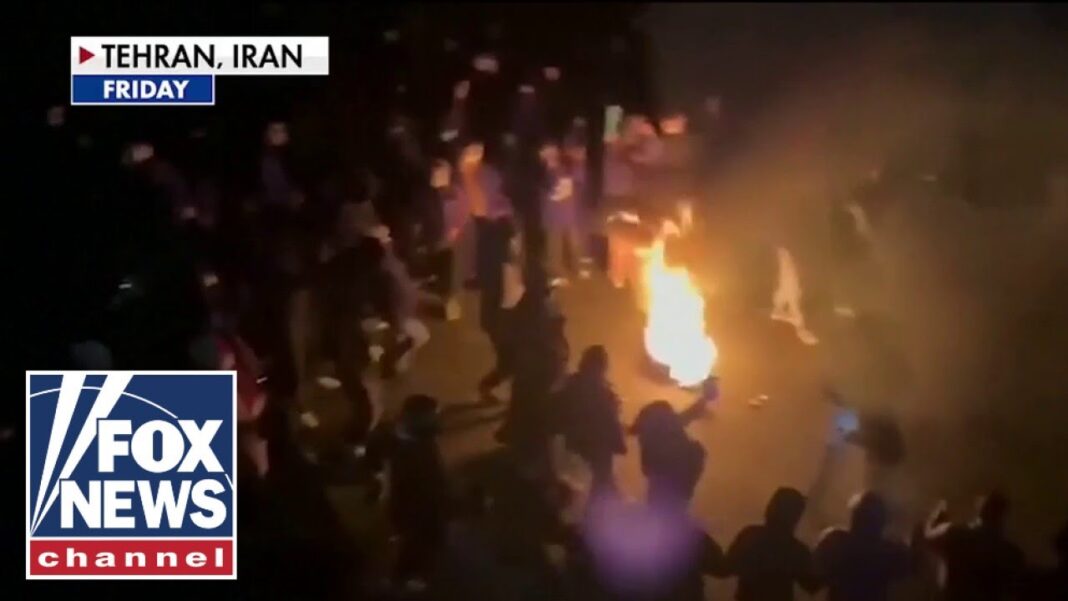
Footage shared Saturday night shows demonstrators flooding Tehran’s northern Punak neighborhood, blocking roads, illuminating the darkness with mobile-phone flashlights, and banging on metal barricades as fireworks streak overhead. Passing drivers honk in solidarity, turning the streets into a cacophony of resistance.
Elsewhere, the unrest has assumed symbolic dimensions. In Mashhad, Iran’s second-largest city and home to the Imam Reza Shrine—the holiest site in Shia Islam—videos depict protesters clashing with security forces as burning debris blocks major thoroughfares. The Ynet Global report emphasized the resonance of these scenes: protests in Mashhad strike at the spiritual heart of the Islamic Republic.
Unconfirmed reports also indicate demonstrations in Kerman, some 800 kilometers southeast of Tehran, suggesting the uprising is not confined to traditional urban strongholds.
Even state-aligned outlets have been forced to acknowledge the breadth of the unrest. London-based opposition channel Iran International, widely viewed by Tehran as a hostile actor, cited a report from Tasnim News Agency—an IRGC-linked publication—claiming that protesters set fire to several rooms in a courthouse in Fars Province overnight. The blaze reportedly spread from the ground floor to the first before security forces arrived to disperse the crowd.
While details remain sparse due to the blackout, the episode highlights how the protests are increasingly targeting symbols of judicial and political authority.
As street confrontations become more sporadic, HRANA has observed a shift in protest tactics. Large gatherings are giving way to short, mobile bursts of dissent designed to evade security forces. Yet the regime is responding with enhanced surveillance.
According to Ynet Global, HRANA has reported reconnaissance aircraft circling over known protest hotspots and a visible increase in patrols, indicating a nationwide monitoring campaign. The message to Iranians is unmistakable: the state is watching from the skies as well as the streets.
The Iranian leadership’s saber-rattling comes amid mounting pressure from Washington. On Saturday night, President Trump reiterated his support for the demonstrators, posting on Truth Social: “Iran is looking at FREEDOM, perhaps like never before. The USA stands ready to help!!!”
Reports in The New York Times and The Wall Street Journal indicate that Trump has been briefed on potential military options regarding Iran, though no final decision has been announced. The U.S. State Department added its own blunt warning: “Don’t play games with President Trump. When he says he’ll do something, he means it.”
While Iran’s cities simmer, state television is attempting to project an image of calm. Reporters have been dispatched to streets in Tehran, Qom, and Qazvin to broadcast live segments portraying daily life as if nothing were amiss. Editors prominently display the date on screen to underscore the footage’s recency.
The Ynet Global report observed that these broadcasts are interspersed with images of pro-government rallies and funerals for security personnel killed in clashes—an effort to recast the unrest as a fringe disturbance rather than a nationwide revolt.
Fueling the unrest is an appeal from Crown Prince Reza Pahlavi, the exiled son of the Shah deposed in the 1979 Islamic Revolution. Over the weekend, he urged Iranians to continue protesting on both Saturday and Sunday, calling on them to wave the Lion and Sun flag—emblematic of pre-revolutionary Iran—and to “take control of public spaces.”
Ynet Global reported that the call has resonated powerfully, with protesters in multiple cities hoisting the historic banner and chanting, “This is the final battle—Pahlavi will return.”
The current uprising did not begin with ideological slogans, but with bread-and-butter desperation. Two weeks ago, Tehran bazaar merchants staged spontaneous demonstrations over runaway inflation and the precipitous collapse of the national currency. Decades of Western sanctions tied to Iran’s nuclear program have hollowed out the economy, leaving ordinary citizens struggling to afford basic goods.
As with the fuel-price protests of 2019 and the “hijab protests” of 2022 following the death of Mahsa Amini, economic grievances rapidly evolved into overt opposition to the regime itself. Today, chants of “Death to the dictator,” directed at Supreme Leader Ayatollah Ali Khamenei, echo across city squares.
Protesters have vandalized statues of slain Quds Force commander Qasem Soleimani and torched government buildings, actions that symbolize a dramatic erosion of the fear once surrounding the Islamic Republic’s icons.
Human-rights activists warn that the internet blackout is designed not only to prevent coordination, but to hide evidence of state brutality from the outside world. Ynet Global, piecing together reports from satellite-connected sources and regional partners, stressed that what the world is seeing may represent only a fraction of the violence unfolding behind the digital curtain.
Iran, it seems, is no longer merely confronting dissent; it is engaged in a full-scale struggle for its own future. Whether the regime’s escalating crackdown will succeed in suppressing the revolt—or instead harden public resolve—remains the defining question of this perilous moment.
