



|
Getting your Trinity Audio player ready...
|
A Nation Radicalized: Turkey’s Descent into Antisemitic Extremism Under Erdoğan
By: Fern Sidman
By all available metrics and testimonies, Turkey under the rule of President Recep Tayyip Erdoğan has undergone a staggering transformation — one that has turned the nation into a haven for unabashed antisemitism cloaked in the rhetoric of Palestinian solidarity. As Israel Hayom has reported, the streets of Istanbul today are littered not only with Palestinian flags and militant slogans, but with hateful imagery so explicitly antisemitic that it draws upon the darkest propaganda traditions of the 20th century.
Perhaps nowhere is this toxic shift more visually apparent than in the disturbing elevation of Yahya Sinwar — the Hamas mastermind behind the brutal October 7, 2023, terrorist attacks against Israel. Israel Hayom correspondents on the ground noted that Sinwar’s image, glorified and sanctified, has been splashed across walls in broad daylight, a grotesque celebration of a man responsible for the deaths of over 1,200 Israeli civilians. Nearby, graffiti demanding the eradication of Israel blend seamlessly into the cityscape, tolerated and often celebrated by Erdoğan’s increasingly radicalized base.
Such scenes, once confined to fringe Islamist enclaves, have now permeated the very heart of Turkish society — including neighborhoods historically considered opposition strongholds. As the report at Israel Hayom emphasized, the degeneration from legitimate criticism of Israeli policy to unchecked antisemitism is not merely a political phenomenon but a cultural and societal collapse of moral boundaries.
What makes this transformation particularly alarming, according to experts cited by Israel Hayom, is its penetration across all strata of political life — from Erdoğan’s ultranationalist supporters to segments of the far left — and its seamless dissemination through Turkish media, particularly those tightly aligned with the regime.
One chilling example is the work of political cartoonist Ibrahim Ozdaba. His recent illustration — a monstrous octopus emblazoned with the Star of David, its tentacles encircling the globe — is lifted directly from classic antisemitic iconography found in Nazi-era Germany and Tsarist Russia. As the Israel Hayom report explained, such imagery has been resurrected in Turkish public discourse with little resistance and widespread amplification.
Israeli Prime Minister Benjamin Netanyahu has been the favored subject of this bigoted visual culture. A virally circulated cartoon by Erdogan Ozer, labeled “Netanyahudi” — a grotesque play on the Hebrew word for Jew — portrays the Israeli premier as a demonic, skull-clutching figure. As Israel Hayom reported, the piece was embraced across Turkish social media platforms and celebrated as a “symbol of resistance” by Erdoğan’s political surrogates.
Yet beyond cartoons, it is Turkey’s media elite that has accelerated this antisemitic regression. None more so than Ibrahim Karagul, a top columnist at Yeni Şafak, a pro-government outlet with vast reach. In a recent column detailed by Israel Hayom, Karagul issued what can only be described as a genocidal screed: “The time has come to destroy Israel,” he wrote. “Geography is a weapon, and this weapon must be ignited now. Today it’s Iran, tomorrow it’s Turkey, or Pakistan.” This is not the language of criticism or even hyperbole — it is the call of a nation preparing its public for holy war.
Dr. Assa Ophir, a leading Turkey scholar at Ariel University’s Department of Middle Eastern Studies and Political Science, spoke candidly with Israel Hayom about the ideological corrosion sweeping through Turkish society. “The hostility between Israel and Turkey has moved beyond diplomacy and now rests on a foundation of ideological hatred,” Ophir explained. “Since Oct. 7, 2023, antisemitic trends that once simmered on the margins of Turkish society have risen with frightening visibility and legitimacy.”
Ophir’s insights, as detailed in the Israel Hayom report, point to an orchestrated campaign of desensitization. Turkish audiences are inundated with grotesque imagery — images of maimed children, charred bodies, and mutilated corpses — almost always presented in a context that demonizes Israel without nuance or context. These images, many of them unverified or deliberately manipulated, are broadcast across state-run channels with language such as “murderous Israel” or “Zionist terror regime,” language that would be inconceivable on any reputable Western outlet.
As Israel Hayom reported, this is not merely a propaganda tactic, but a societal reprogramming. “It is a comprehensive transformation,” Ophir warned. “Antisemitic discourse now permeates virtually every corner of Turkey’s political landscape — from secular Kemalists to Islamist ideologues. The variations are in tone, not in kind.”
The range of antisemitic tropes now mainstreamed in Turkish society is staggering. As outlined by Ophir in his remarks to Israel Hayom, they span from medieval blood libels and organ-harvesting conspiracy theories to modern accusations of Jewish global domination and Zionist plots to rebuild a biblical empire stretching from the Nile to the Euphrates.
Even the fall of the Ottoman Empire — once a red line in Turkish historical memory — is now blamed on “Zionist manipulation” in mainstream commentary. As Israel Hayom reports, these absurdities are given full platforms in print, on television, and online, fueling paranoia and violent radicalism. The intertwining of such beliefs with populist nationalism and Islamic revivalism creates a combustible ideology with global ramifications.
Perhaps most tragically, is how normalized antisemitism has become for the younger generation, as was noted in the Israel Hayom report. Where once Turkish Jews — a dwindling and deeply-rooted minority — were largely left in peace, they now find themselves openly vilified. Jewish-owned businesses in Istanbul and Izmir have been vandalized and synagogues have ramped up their security measures to unprecedented levels. In Erdoğan’s Turkey, being visibly Jewish is no longer just a religious identity — it is a liability.
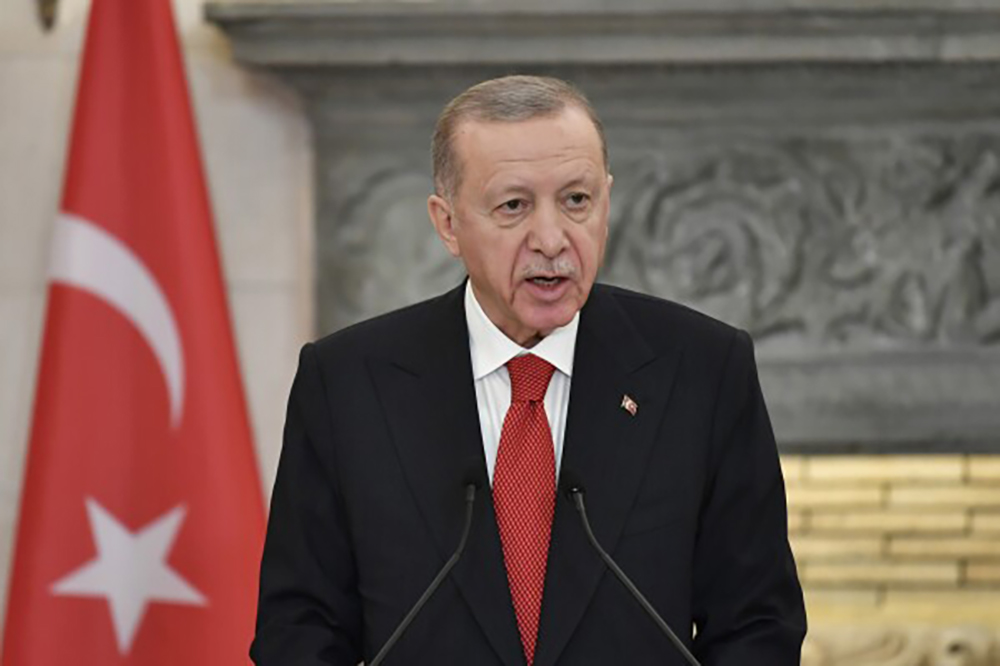
The Turkish president, for his part, has made little effort to conceal his sympathies. His speeches, often delivered in front of Palestinian flags, denounce Israel as a “terror state” and accuse it of committing “genocide” — accusations echoed in Turkish schools and religious sermons. As the report at Israel Hayom has detailed, Erdoğan’s political strategy now leans heavily on rallying domestic sentiment through anti-Israel fervor, a cynical manipulation that taps into ancient bigotries for contemporary political gain.
This leaves Israel, and its allies, with few options. Diplomatically, Ankara has become increasingly isolated from Jerusalem, despite sporadic efforts at normalization in previous years. The cultural and societal rift now seems too wide to bridge, at least in the near term. As one senior Israeli official told Israel Hayom under condition of anonymity: “You cannot negotiate with a country whose public has been taught to hate you at an existential level.”
Turkey’s descent into antisemitic radicalism is not merely a regional issue — it is a cautionary tale. It shows how quickly a nation can slip from criticism into hate, from disagreement into dehumanization, when rhetoric goes unchecked and extremism becomes policy. As the Israel Hayom report indicated, this is not just about Israel. It is about the future of liberal democracy in a region where authoritarianism thrives on division and hatred.
In Erdoğan’s Turkey, the “intifada” has become more than a slogan — it is a worldview. And the target, increasingly, is not only Israel, but the very concept of coexistence itself.
