



|
Getting your Trinity Audio player ready...
|
By: Fern Sidman
Iran ground almost to a halt this week as the clerical regime ordered a sweeping shutdown across much of the country, closing businesses, universities and government offices in an extraordinary attempt to stem a rapidly intensifying wave of protests. According to a report on Wednesday at Fox News Digital, the shutdown affected 21 of Iran’s 31 provinces and marked one of the most dramatic efforts by the Islamic Republic in years to regain control over a population increasingly defiant in the face of economic collapse, political paralysis and deepening repression.
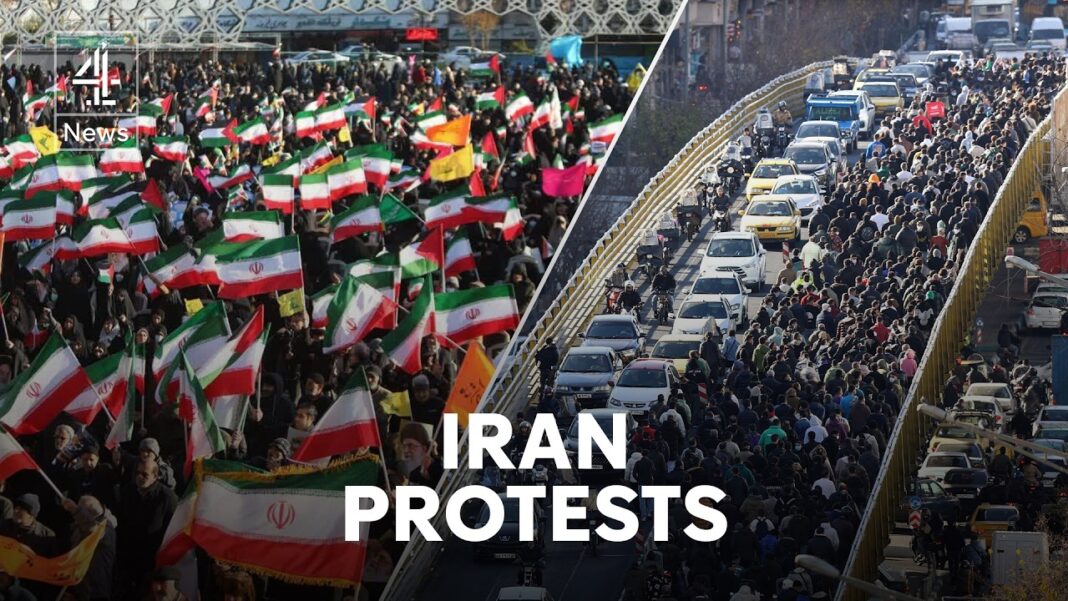
For four consecutive days, the country’s streets have reverberated with chants of rebellion. From Tehran’s historic bazaars to provincial cities long considered bastions of regime loyalty, Iran has been convulsed by demonstrations that, in scale and ferocity, have stunned even seasoned observers of the Islamic Republic. Fox News Digital has tracked video footage circulating online that depicts chaotic confrontations between protesters and security forces in Shiraz, Isfahan, Kermanshah and the capital itself, with crowds shouting “Death to the Dictator” and “Death to Khamenei” as tear gas, gunfire and flying debris filled the air.
The one-day government-ordered shutdown was not presented as a concession to public health or logistical necessity. Rather, it was a naked act of political containment. Officials ordered markets shuttered, lecture halls emptied and bureaucratic corridors abandoned in what Iranian analysts described as an effort to prevent crowds from coalescing and to starve the protest movement of oxygen.
Yet the attempt at immobilization has only underscored the severity of the crisis gripping the country. Iran’s economy has been battered by spiraling inflation, a collapsing currency and endemic corruption that has hollowed out the middle class and pushed millions closer to poverty. For bazaar merchants—traditionally a stabilizing force for the regime—to be leading demonstrations represents a “flashing red light” for the Islamic Republic’s survival instincts.
Nowhere was this more apparent than in Tehran, where bazaar-led protests took on a symbolic weight. Footage shared with Fox News Digital shows shopkeepers confronting security forces, berating them as “dishonorable” and refusing to reopen despite threats. These are not the fringe dissidents the regime can easily dismiss. They are the economic backbone of Iran’s urban society.
The unrest took a darker turn Wednesday with the reported death of a 21-year-old volunteer member of Iran’s paramilitary Basij force, a subdivision of the Islamic Revolutionary Guard Corps (IRGC). Iranian state media said the young man was killed in the western city of Kouhdasht in Lorestan province, roughly 250 miles west of Tehran.
Saeed Pourali, a deputy governor in Lorestan, claimed the guard was “martyred at the hands of rioters during protests in defense of public order,” a phrase that is typically deployed to legitimize violent crackdowns and reframe protesters as criminals. It marked the first acknowledged fatality among security personnel since the demonstrations erupted, a development that could be used by hardliners to justify a harsher response.
Yet the Fox News Digital report also emphasized that video footage from the region paints a more complex picture—one in which heavily armed forces confront largely civilian crowds in narrow streets, with shouting, chaos and sporadic gunfire audible in the background.
While Tehran’s bazaars captured the headlines, some of the most harrowing scenes unfolded in provincial cities. In the south-central city of Fasa, demonstrators reportedly stormed the gates of a government complex, shaking them until they burst open. Reuters later confirmed opposition claims that protesters had breached the governor’s office, prompting IRGC units to open fire.
Military helicopters were seen circling overhead, an intimidation tactic last widely deployed during the 2019 gasoline price protests that left hundreds dead. Fox News Digital cited regional analysts who believe the aerial displays are meant to evoke memories of those crackdowns, reminding citizens of the regime’s capacity for brutality.
In Kermanshah, video footage reviewed by Fox News Digital shows bazaar merchants confronting riot police, chanting “Dishonorable, dishonorable,” as armored vehicles idle nearby. In Shiraz and Isfahan, protesters hurled stones and improvised projectiles while chanting slogans that left little ambiguity about their target: Supreme Leader Ayatollah Ali Khamenei himself.
At the heart of the upheaval lies a profound economic breakdown. Iran’s currency has continued its relentless slide, obliterating purchasing power and turning basic necessities into luxuries. The Fox News Digital report documented how inflation—estimated by independent economists at well over 50%—has eroded wages to the point where even dual-income households struggle to survive.
The regime’s response has been a carousel of leadership changes that critics see as cosmetic rather than structural. On Wednesday, President Masoud Pezeshkian appointed Abdolnaser Hemmati, a former economy minister, as the new head of the central bank following the resignation of Mohammad Reza Farzin. State media quoted Pezeshkian as admitting the position was “extremely difficult and complex.”
In parallel, Supreme Leader Khamenei announced the appointment of IRGC Brigadier General Ahmad Vahidi as deputy commander in chief of the Guards, a move widely read as a signal that the regime is shifting decisively toward a security-first posture.
Demonstrations have now entered their fourth consecutive day, defying the shutdown and underscoring a reality Fox News Digital has highlighted repeatedly: Iran’s protest culture has evolved. No longer isolated flare-ups around discrete grievances, these movements are increasingly national in scope, coordinated across cities and fueled by social media networks that the regime struggles to suppress.
Chants captured in MEK-shared footage and analyzed by Fox News Digital—“Proud Arakis, support, support” and “Shame on you, shame on you”—reflect a sophisticated political language, drawing on regional identity while reinforcing a collective sense of defiance.
The participation of bazaar merchants is particularly significant. Historically aligned with the clerical establishment after the 1979 revolution, their break with the regime suggests that even the Islamic Republic’s most reliable constituencies are fracturing under the weight of economic despair.
The protests have coincided with a period of unusual political volatility. President Pezeshkian, who took office pledging economic reform, now presides over a country where the rial’s collapse has erased any goodwill he might have enjoyed. Fox News Digital reports that even regime insiders privately concede that policy coherence has evaporated, with ministries operating in silos and power increasingly concentrated in the hands of the IRGC.
The appointment of Vahidi—himself a figure associated with Iran’s most repressive internal-security campaigns—suggests that Khamenei and his inner circle view the unrest not as a socio-economic crisis but as a security threat requiring militarized solutions.
Iran’s rulers have been here before. The 2009 Green Movement, the 2017-18 economic protests, and the 2019 gasoline riots all followed a familiar trajectory: mass mobilization, regime paralysis, then overwhelming force. Fox News Digital notes, however, that this time the variables are different.
The economy is weaker than ever. The population is younger, more connected, and less ideologically tethered to the Islamic Republic’s founding myths. And the regime itself appears riven by factionalism, its top ranks shuffling positions even as the streets burn.
The death of a Basij volunteer may provide hardliners with the pretext they seek to unleash a more violent crackdown. But Fox News Digital analysts caution that repression now carries higher risks. Every act of brutality deepens the reservoir of resentment, making future eruptions more likely—and potentially more explosive.
As Iran stares into an uncertain future, the images emerging from its cities tell a story of a society that has lost patience with empty promises. The government-ordered shutdown was intended to freeze dissent. Instead, it has become a symbol of a state so afraid of its own people that it prefers paralysis to dialogue.
Fox News Digital’s on-the-ground reporting, supplemented by opposition footage and wire-service confirmations, paints a stark picture: a regime fortified by guns and helicopters, confronting a citizenry armed with little more than voices and fury.
Whether this uprising will follow the tragic arc of its predecessors or break new ground remains unknown. What is clear is that Iran is no longer merely simmering—it is boiling. And in the streets of Tehran, Fasa, Kermanshah and beyond, the chant echoing off shuttered storefronts is not one of reform, but of reckoning.

Don’t be surprised if Israel knows where the hotshots of the Iranian regime and their families live, work, go to school and play. If the Iranian regime gets to fresh with Israel, maybe Israel should release all of that information to the Iranian public. Then they will have no place to hide.