



|
Getting your Trinity Audio player ready...
|
By: Fern Sidman
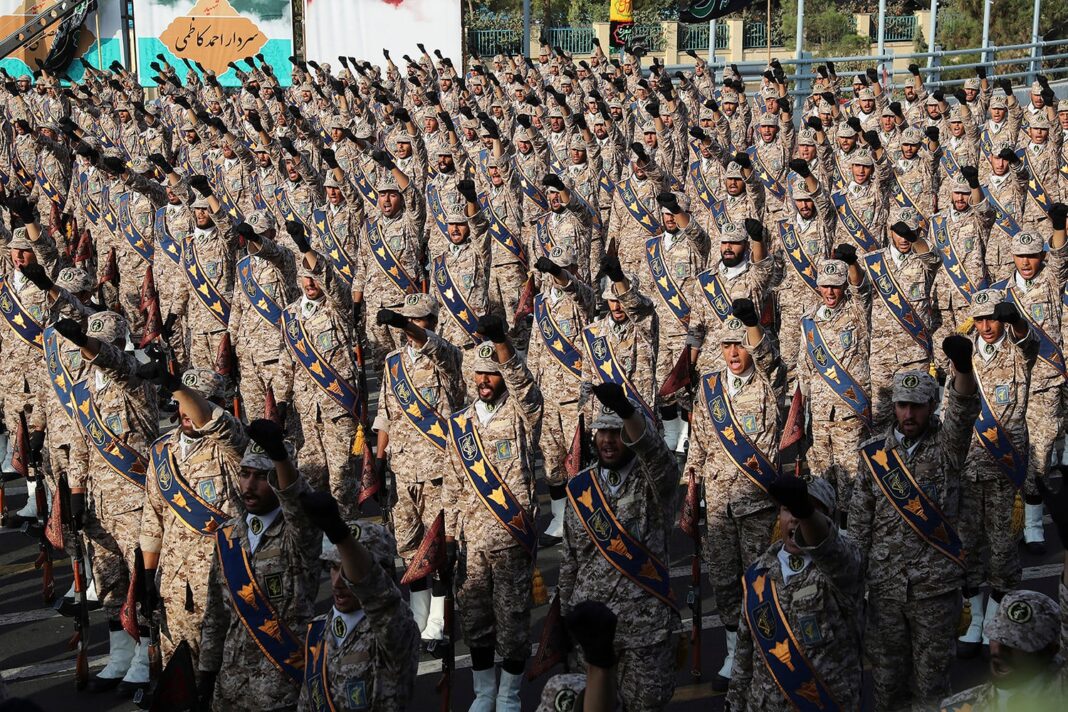
In a decisive and far-reaching move with profound geopolitical ramifications, Argentine President Javier Milei has formally designated Iran’s Islamic Revolutionary Guard Corps (IRGC) Quds Force as a terrorist organization, placing the powerful paramilitary body on Argentina’s official registry of proscribed entities. The announcement, which reverberated across diplomatic circles from Buenos Aires to Jerusalem, marks one of the most forceful actions yet taken by a Latin American government against Tehran’s global network of terror.
The decree, signed Saturday and reported by Israel National News, places not only the Quds Force itself on Argentina’s Public Registry of Persons and Entities Linked to Acts of Terrorism and Its Financing (RePET), but also names 13 individuals connected to its overseas operations. It imposes stringent financial sanctions, travel restrictions, and operational constraints designed to cripple the group’s ability to function within or through Argentine territory.
In the carefully worded document, the Argentine government made explicit reference to the dark chapter in its own history that has forever linked the nation to Iran’s terror apparatus. “The Quds Force is a division of Iran’s Islamic Revolutionary Guard Corps, specializing in training for carrying out terrorist attacks in other countries,” the decree declares. It further states that Argentina was directly victimized by the organization’s activities during the 1990s, citing the devastating 1992 bombing of the Israeli Embassy in Buenos Aires and the 1994 attack on the AMIA Jewish community center.
Those attacks remain seared into Argentina’s national consciousness. The embassy bombing killed 29 people and injured hundreds more, while the AMIA massacre two years later left 85 dead and approximately 300 wounded. To this day, it stands as the deadliest terrorist attack in Argentina’s history. Investigations conducted over the decades have repeatedly pointed to Iranian involvement, with Hezbollah operatives believed to have carried out the bombings at Tehran’s direction.
As Israel National News emphasized in its coverage, the Milei administration framed the decree not merely as a diplomatic gesture, but as an act of historical justice. “As of today, this group has been included in the Public Registry of Persons and Entities Linked to Acts of Terrorism and Its Financing,” the document states, underscoring that Argentina is no longer willing to allow the architects of those atrocities to operate with impunity.
The practical implications of the designation are significant. By blacklisting the Quds Force, Argentina has empowered its financial institutions and law enforcement agencies to freeze assets, block transactions, and prevent any form of economic support from reaching the organization. The decree specifies that members of the group and their associates will now be subject to “financial sanctions and operational restrictions aimed at limiting their capacity to act, as well as protecting Argentina’s financial system from being used to economically support their activities.”
This aspect of the move carries particular weight. Iran has long relied on a sprawling international web of front companies, charities, and covert operatives to finance its activities abroad. Argentina’s decision sends a powerful message that the country will no longer serve as a potential conduit for such schemes.
The decree also singles out Ahmad Vahidi, the former commander of the Quds Force from 1989 to 1998, who is currently wanted by INTERPOL for his alleged role in the AMIA bombing. Despite the outstanding international warrant, Iran has continued to elevate Vahidi within its political and military hierarchy, even appointing him deputy commander of the IRGC in recent years.
“Despite this, the Iranian regime has not only failed to cooperate with his prosecution, but has promoted him,” the decree notes pointedly. The reference underscores Argentina’s enduring frustration with Tehran’s refusal to acknowledge responsibility for the attacks or assist in bringing those involved to justice.
The move was immediately welcomed in Israel, where officials have long urged the international community to adopt a more uncompromising stance toward Iranian terror networks. Israeli Foreign Minister Gideon Sa’ar issued a statement praising Milei’s decision and calling on other nations to follow suit.
“I commend the decision of the Argentine government, under the leadership of President Javier Milei, to designate the Quds Force as a terrorist organization,” Sa’ar wrote, in remarks highlighted by Israel National News. He described the decree as a step that “strengthens the international front against Iranian terrorism and honors the memory of the victims of the attacks on the Israeli Embassy and the AMIA.”
Sa’ar went further, emphasizing that the Quds Force is not merely a regional menace but a global one. “The Quds Force is part of the Islamic Revolutionary Guard Corps that continues to export terror to the Middle East and all over the world, while terrorizing its own people,” he said. “More countries should follow Argentina’s example and call these terror organizations by their names.”
Israel has long been at the forefront of efforts to counter Iranian influence, particularly the activities of the Quds Force, which has been instrumental in arming and training Hezbollah in Lebanon, Hamas in Gaza, and various Shiite militias across Iraq, Syria, and Yemen. From Jerusalem’s perspective, Argentina’s decision represents not only a symbolic victory but a concrete contribution to the broader campaign to isolate Tehran.
Argentina is not acting in isolation. As the Israel National News report noted, the IRGC is already designated as a terrorist organization by a number of major Western and regional powers, including the United States, Canada, Israel, Saudi Arabia, Bahrain, Paraguay, and Ecuador. Australia has labeled it a state sponsor of terrorism, while several European countries have imposed sanctions on individual commanders.
Nevertheless, Argentina’s action is particularly significant because of the country’s direct experience with Iranian-backed terrorism. Few nations outside the Middle East have suffered such devastating attacks on their own soil. By formally linking the Quds Force to those events, Buenos Aires has reinforced the narrative that Iran’s terror activities are not a distant problem confined to Israel or the Arab world, but a global threat with worldwide consequences.
The designation also comes on the heels of another assertive move by the Milei administration: the decision to label branches of the Muslim Brotherhood in Egypt, Lebanon, and Jordan as terrorist organizations. Together, these steps signal a broader strategic realignment in Argentina’s foreign policy—one that places the country firmly in the camp of nations confronting Islamist extremism.
Since taking office, President Milei has sought to reposition Argentina as a staunch ally of Israel and the United States. A libertarian economist by background, Milei has embraced a distinctly pro-Western and pro-Israel worldview, repeatedly denouncing Iran, Hezbollah, and other radical groups.
His government’s decision to blacklist the Quds Force is consistent with that trajectory. It reflects a belief that Argentina must take a more proactive role in the global struggle against terrorism, rather than remaining a passive observer.
Analysts quoted by Israel National News have suggested that Milei’s actions are also aimed at strengthening Argentina’s relationship with Israel and Jewish communities worldwide. By confronting the perpetrators of the AMIA attack, the Argentine president is addressing a longstanding grievance that has strained relations between Buenos Aires and its Jewish citizens for decades.
The move may also have broader implications for Latin America, a region where Iranian influence has quietly expanded over the years. Tehran has cultivated ties with several leftist governments and has used countries such as Venezuela as logistical hubs for its operatives.
By drawing a firm line against the Quds Force, Argentina is sending a message to its neighbors that cooperation with Iranian proxies will no longer be tolerated. It may encourage other governments in the hemisphere to reconsider their own policies toward Tehran.
For Iran, the designation represents yet another setback at a time when the regime is already under intense international pressure. With sanctions mounting and diplomatic isolation deepening, the loss of operational space in Argentina adds to the growing constraints on its global reach.
Above all, the decree represents a measure of closure for the victims of the 1992 and 1994 bombings and their families. For decades, they have watched as suspects evaded justice and as political considerations often overshadowed accountability.
Argentina’s formal proscription of the Quds Force does not bring back the dead, nor does it resolve all unanswered questions. But it does affirm, in unequivocal legal terms, what many have long known: that the architects of those atrocities were not rogue extremists but agents of a state-sponsored terror machine.
As the Israel National News report noted, the decision marks “a historic step in the global effort to confront Iranian terrorism.” It is a reminder that even after thirty years, the pursuit of justice can still move forward—and that nations, like individuals, are capable of learning from their past.
In a world increasingly accustomed to equivocation and moral ambiguity, Argentina has chosen clarity. And in doing so, it has sent a resounding message that terror, no matter how powerful its patrons, will not be allowed to hide behind diplomacy forever.