



|
Getting your Trinity Audio player ready...
|
By: Tzirel Rosenblatt
In the long and harrowing aftermath of the Bondi Beach terror attack, the story of Leibel Lazaroff has emerged as one of endurance, anguish, and unyielding faith. As reported on Tuesday by VIN News, the young man—who sustained catastrophic injuries in the antisemitic assault that claimed multiple lives—now faces yet another major surgical ordeal, underscoring the brutal and lingering consequences of extremist violence long after the headlines fade.
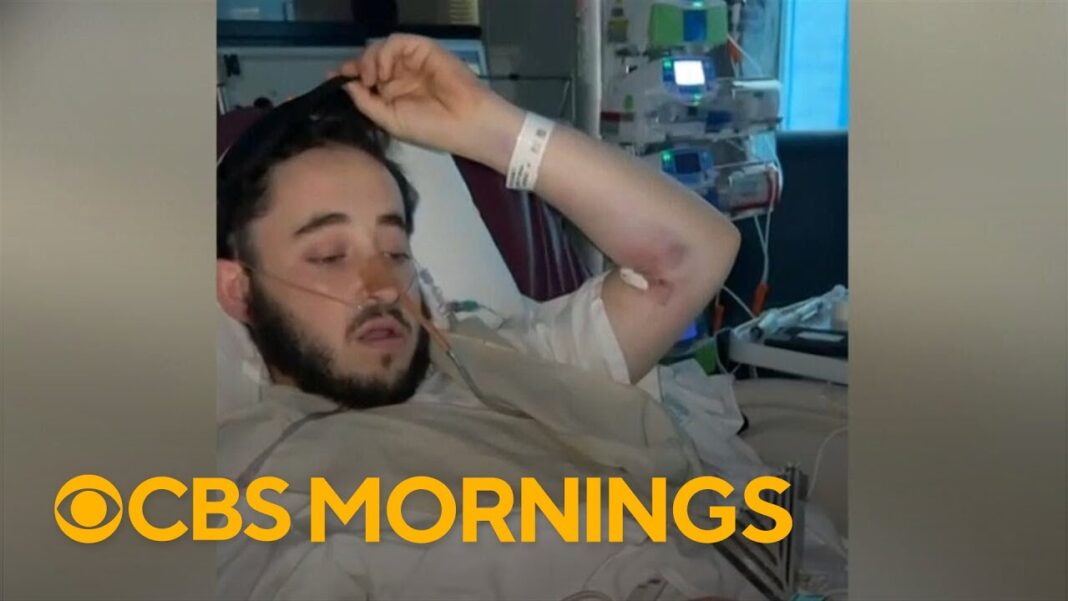
According to updates shared by his family and closely followed by VIN News, doctors treating Lazaroff have discovered new and serious complications stemming from his original wounds. Speaking Monday night from his son’s hospital bedside, Leibel’s father, Yossi Lazaroff, revealed that following Leibel’s fourth surgery, medical teams identified a hole that had developed in his abdomen—an alarming condition that required immediate and complex reconstruction of the abdominal wall.
“That procedure was done a week ago,” Lazaroff explained, his words carrying the weight of exhaustion and resolve. Yet even after enduring that major intervention, Leibel’s struggle is far from over. He is now being prepared for yet another return to the operating room, confronting a fifth surgery as doctors continue their painstaking efforts to stabilize injuries that remain life-threatening.
For the Lazaroff family, the relentless cycle of surgeries, setbacks, and cautious hope has taken an immense emotional toll. In his update, Yossi Lazaroff shared a moment that encapsulated the depth of their ordeal. Sunday, he said, marked the first time since the massacre that he saw his son cry.
“That broke me,” Lazaroff admitted, according to the VIN News report, offering a rare glimpse into the quiet devastation experienced by families of terror victims—grief not only for what was lost, but for the suffering that continues behind hospital doors. For months, Leibel had endured pain, procedures, and uncertainty with stoic determination. Seeing him finally release his anguish underscored just how profound the trauma has been.
Throughout this ordeal, Lazaroff emphasized, his wife Manya has been the family’s emotional anchor. “My wife Manya has been my rock at my side,” he said, words echoed by VIN News in its coverage. “She is the most generous soul, a caring mother, with such a strong conviction that everything is going to be OK.”
Those close to the family describe Manya Lazaroff as a steady presence amid chaos—a woman whose quiet strength has sustained not only her wounded son, but an entire family navigating the cruel uncertainty that follows acts of terror. Such resilience often becomes a lifeline in moments when medical outcomes remain uncertain and each day brings fresh challenges.
Leibel Lazaroff remains hospitalized as doctors continue to address the extensive injuries he sustained during the Bondi Beach attack, an act of antisemitic violence that shocked Australia and reverberated across the Jewish world. While authorities have focused on the security and ideological implications of the attack, VIN News has consistently highlighted the human cost—the shattered bodies, grieving families, and long recoveries that rarely command sustained public attention.
Medical experts familiar with trauma cases have told VIN News that abdominal injuries of the type described by the Lazaroff family are among the most complex to manage. Reconstructing the abdominal wall after severe trauma often requires multiple surgeries, prolonged hospitalization, and a high risk of complications. Each operation, while potentially lifesaving, carries its own dangers, making the path to recovery anything but linear.
For Leibel, that path has been marked by extraordinary endurance. His survival thus far has been attributed to both rapid emergency response at the scene of the attack and the tireless efforts of surgical teams working around the clock. Yet survival alone does not capture the magnitude of what he faces. Recovery, if it comes, will likely involve months—if not years—of rehabilitation, additional procedures, and psychological healing.
The Lazaroff family has been candid about the uncertainty ahead. In their updates, they have avoided offering false optimism, instead choosing to share the reality of their situation with honesty and humility. At the same time, they have repeatedly expressed gratitude for the global outpouring of support that has surrounded them since the attack.
As VIN News has reported, messages of prayer, solidarity, and encouragement have poured in from around the world, spanning continents and communities. For the family, this wave of compassion has been more than symbolic. “It has helped sustain us,” Lazaroff said, acknowledging that during moments of despair, knowing they are not alone has provided a crucial source of strength.
The Lazaroff story has become emblematic of a broader truth: terror does not end when the violence stops. Its repercussions ripple outward, embedding themselves in hospital wards, family dynamics, and the quiet hours of waiting that follow each medical update. For victims like Leibel, the attack is not a single moment frozen in time, but an ongoing battle fought one surgery at a time.
Community leaders have also pointed to the Lazaroff family’s ordeal as a call to deeper reflection. While political leaders debate policy responses and security measures, the VIN News report has underscored the importance of remembering the individuals whose lives are forever altered. Leibel’s struggle serves as a stark reminder that behind every statistic is a human being enduring pain beyond measure.
As Leibel prepares to undergo yet another operation, his parents remain steadfast at his side, balancing fear with faith and exhaustion with hope. Their message is not one of despair, but of perseverance—a refusal to allow hatred and violence to define the final chapter of their son’s story.
In hospital corridors far from the shoreline where terror struck, the Lazaroff family continues its vigil. Each surgery represents both a risk and a promise: the risk inherent in invasive medical intervention, and the promise—fragile but real—that life may yet reclaim ground stolen by violence. His story stands as a testament to the resilience of the human spirit and the enduring power of faith, family, and communal support in the face of unimaginable adversity.