



|
Getting your Trinity Audio player ready...
|
By: Fern Sidman- Jewish Voice News
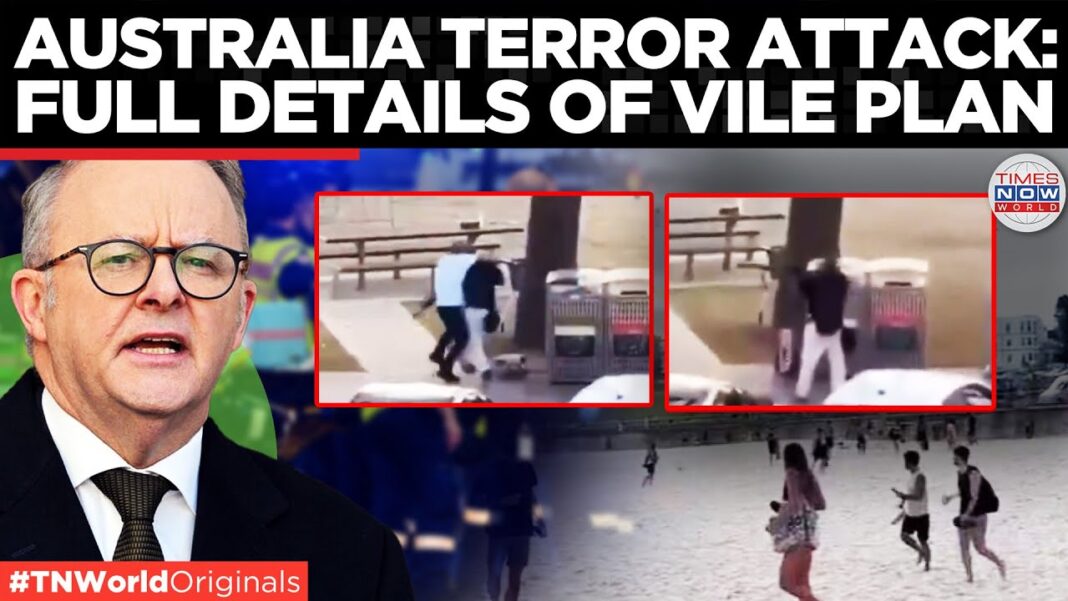
The massacre that unfolded on the sands of Bondi Beach during a public Chanukah celebration has reverberated far beyond Australia’s shores, igniting an unprecedented outpouring of grief, outrage, and moral reckoning from Jewish organizations, Israeli leaders, and civil society voices across the globe. As documented extensively by Chabad.org, the attack—which claimed the lives of at least 11 people at a Chabad-hosted Chanukah gathering—has been universally condemned as a deliberate act of antisemitic terror aimed not only at individuals, but at the very legitimacy of Jewish public life.
In the hours following the atrocity, leading Jewish institutions issued stark warnings that what occurred in Sydney was not an isolated eruption of violence, but the foreseeable culmination of years of unchecked incitement, ideological radicalization, and moral equivocation. Again and again, their statements returned to a singular, chilling conclusion: Chanukah was targeted precisely because it is the most public and unapologetic expression of Jewish faith.
Among the most forceful responses came from the Union of Orthodox Jewish Congregations of America (OU), which released a statement framing the massacre in unmistakable terms. The OU declared itself “horrified” by the shooting at the Chabad Chanukah event and emphasized that the violence constituted a direct assault on Jewish existence in the public square.
“Chanukah is the most public of Jewish holidays,” the OU statement read. “We mark the defeat of ancient antisemitic persecution by lighting our menorahs openly and unapologetically. That is precisely why this attack matters.”
The OU underscored that the massacre was intended to intimidate Jews into retreating from public visibility. Yet, in language echoing the defiant spirit long championed by Chabad-Lubavitch, the organization insisted that the attempt would fail.
At a time when antisemitism is increasingly cloaked in ideological language, the OU warned that extremist rhetoric—particularly slogans such as “globalize the intifada”—should no longer be dismissed as abstract political speech.
“They are not slogans,” the statement asserted. “They are threats, and they lead directly to violence.”
The OU’s demand was unequivocal: governments and civic leaders must confront antisemitic incitement decisively, without silence or moral hedging. Jews, the organization insisted, have an inalienable right to celebrate their faith openly and safely anywhere in the world.
That warning was echoed, and deepened, by the Institute for the Study of Global Antisemitism and Policy (ISGAP). In a statement issued by ISGAP’s founding director, Dr. Charles Asher Small, he described the Bondi Beach massacre as the violent outcome of an ideological climate that has been systematically normalized.
“Antisemitism in Australia has not simply increased,” Dr. Small said. “It has been fueled.”
ISGAP’s research, he explained, has documented how extremist networks—often supported by foreign-funded influence operations—have spent years embedding antisemitic narratives into universities, media institutions, and public discourse. These ideological ecosystems, he warned, do not merely target Jews but undermine democratic societies themselves.
ISGAP specifically highlighted the role of Islamist regimes promoting Muslim Brotherhood ideology through soft power investments, a strategy that has allowed radical worldviews to gain legitimacy within Western institutions. The failure of policymakers to confront these developments, ISGAP argued, allowed hatred to metastasize until violence became inevitable.
“Antisemitism is not a parochial issue,” Dr. Small emphasized. “It is a direct assault on the stability and fabric of democratic life.”
The global resonance of the attack was further reflected in a statement by Ambassador Ronald Lauder, president of the World Jewish Congress (WJC). Lauder expressed profound shock at the deadly terror attack and solidarity with Australian Jews.
“No community should ever fear coming together to celebrate its faith, traditions, or identity,” Lauder said.
The WJC, he added, was in close contact with local leaders and monitoring ongoing threats, underscoring the need for heightened vigilance worldwide. Yet Lauder’s message was not one of retreat.
“Make no mistake,” he declared, “this will not break us.”
That resolve—defiant, collective, and forward-looking—has been a recurring refrain, reflecting a communal determination to preserve Jewish life in the face of terror.
The Religious Zionists of America (RZA–Mizrachi) also issued a strongly worded condemnation, mourning the victims while demanding accountability not only from the perpetrators, but from those who incited the violence.
“Our hearts are shattered,” said RZA President Stephen M. Flatow, in a statement sent to the media. “Jewish communities must be able to gather openly—on holidays, at community celebrations, and in public spaces—without fear.”
The RZA emphasized that law enforcement efforts must extend beyond apprehending attackers to dismantling the ideological and organizational networks that radicalize and incite. The organization also offered prayers for first responders and medical teams, reinforcing the sense that the entire civic fabric had been tested by the attack.
Perhaps the most philosophically sweeping response came from Moshe Feiglin, former Deputy Speaker of the Israeli Knesset, whose remarks situated the Sydney massacre within a broader crisis of moral clarity.
“What happened in Sydney did not begin in Australia,” Feiglin said. “It began with a global failure of moral clarity.”
Feiglin argued that for decades, Israel and the Jewish world have framed their legitimacy through tragedy rather than justice, allowing Jewish existence to be perceived as conditional or negotiable. Antisemitism, he asserted, is not a reaction to Israeli policy but to perceived weakness.
“When Israel hesitates to say clearly that it exists by right,” he warned, “hatred fills the vacuum.”
In Feiglin’s analysis, radical Islamism and progressive ideology have converged into a force that targets Israel as the first obstacle to dismantling Western civilization itself—making Jewish communities worldwide increasingly vulnerable.
The Sydney attack, he concluded, was not a local tragedy but a warning to the entire free world.
Israel National News reported that President Isaac Herzog issued a message of condolence and solidarity on Sunday to Australia’s Jewish community in the wake of the deadly terror attack in Sydney.
Writing from the President’s Residence in Jerusalem, Herzog addressed Australian Jewry directly, expressing profound grief over the bloodshed and reaffirming Israel’s unwavering support during a moment of deep pain and shock.
“On behalf of the State of Israel, I extend my heartfelt condolences to the Jewish community of Australia following today’s horrific terror attack,” the president said. He underscored that the assailants had “intentionally targeted innocent Jewish families who were celebrating the first night of Hanukkah.”
Herzog emphasized that the people of Israel stand shoulder to shoulder with Jews in Australia, describing the attack as a deliberate effort to snuff out light, faith, and hope. Yet he stressed that such acts of terror cannot break the spirit or unity of the Jewish people.
“Even in moments of terror and tragedy, we must remember who we are,” Herzog said, calling the Jewish people “an eternal nation” and affirming that the enduring message of Hanukkah remains unchanged.
He concluded with a pledge that Jewish life and tradition would continue without fear or interruption. “The lights of Hanukkah will continue to shine,” Herzog said, “in Sydney’s Bondi Beach, across Australia, in Israel, and throughout the world—bringing light, resilience, and hope that will always overcome darkness.”
Other Israeli leaders echoed these sentiments. MK Rabbi Gilad Kariv, Chairman of the Knesset Committee on Immigration, Absorption and Diaspora Affairs, described the massacre as a horrific tragedy and called on the Australian government to act decisively.
Kariv affirmed that combating antisemitism abroad is a duty of the State of Israel and announced that his committee would convene to address the issue alongside Israel’s Minister for Diaspora Affairs.
The Creative Community for Peace, a coalition of entertainment industry professionals advocating against antisemitism, issued a statement emphasizing that the attack was neither random nor inexplicable.
“This is what ‘globalize the intifada’ looks like in practice,” the organization said in a statement to the media.
The group condemned attempts to separate anti-Zionism from antisemitism, warning that such distinctions collapse when rhetoric manifests as violence against Jewish civilians celebrating a religious holiday.
The statement concluded with a somber reflection on Chanukah itself—a holiday devoted to light in the face of darkness—and a prayer that the memories of those murdered would be a blessing.
Throughout its coverage, Chabad.org has situated the massacre within the spiritual framework articulated by the Lubavitcher Rebbe, Rabbi Menachem M. Schneerson, whose teachings emphasized that light is not merely symbolic but transformative. Public menorah lightings, the Rebbe taught, are acts of spiritual resistance—statements that Jewish faith belongs not in hiding, but in the public square.
That philosophy now stands as both a challenge and a mandate.
The attack on Bondi Beach sought to extinguish that light. Instead, it has illuminated a global crisis demanding clarity, courage, and action. Jewish leaders across continents have made clear that mourning alone is insufficient. What is required, as Chabad.org has repeatedly emphasized, is a renewed commitment to protecting Jewish life, confronting antisemitism without euphemism, and insisting—without apology—on the right of Jews to live openly and proudly.
In the words echoed across statements and continents, the message is unmistakable: the menorah will continue to be lit. And the light, however fiercely challenged, will endure.