



|
Getting your Trinity Audio player ready...
|
A Community in Mourning: Sydney’s Jewish World Bids Farewell to 10-Year Old Matilda; A Child Lost in Terror
By: Fern Sidman
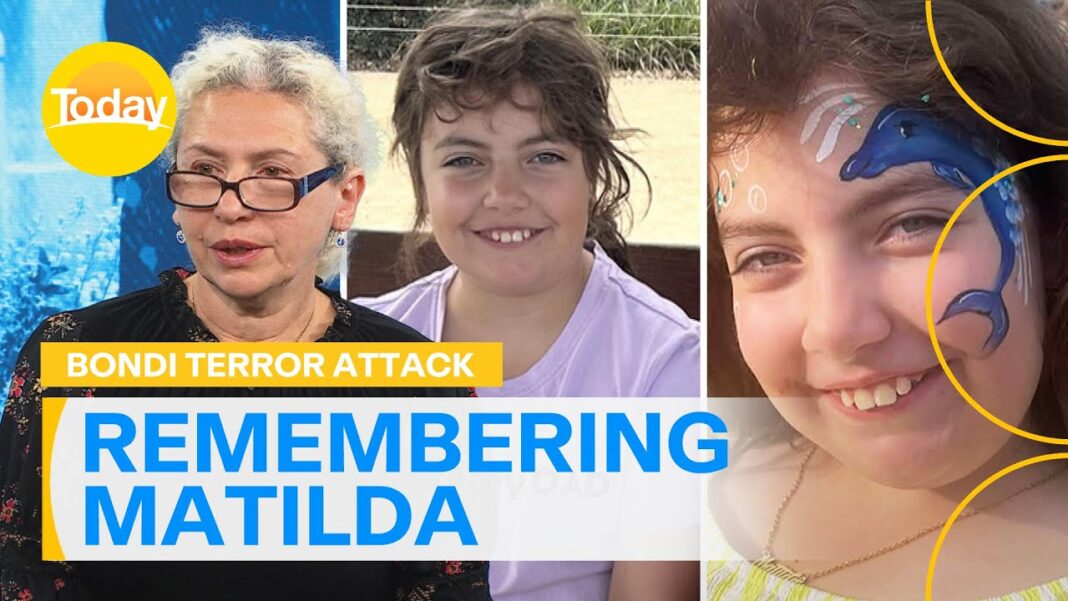
The funeral of Matilda, a 10-year-old girl murdered earlier this week in what authorities have described as an ISIS-inspired massacre at a Hanukkah celebration in Sydney, unfolded on Thursday as a moment of collective grief, stunned silence, and aching disbelief. According to a report on Thursday at Israel National News, the service became a somber focal point for a shattered Jewish community in Australia and a searing reminder of the global reach of antisemitic terror.
Matilda’s small white coffin was adorned with a large plush bee, a tender tribute to her middle name, “Bee,” a symbol chosen by her family to reflect the innocence, sweetness, and joy that defined her brief life. Additional bee motifs surrounded the coffin, and at the family’s request, mourners were given stickers bearing a simple bee drawing—an emblem that quickly became a quiet symbol of collective remembrance and shared sorrow. As the Israel National News report noted, the imagery spoke not only to the child herself, but to a community grasping for gentleness in the aftermath of unspeakable brutality.
Presiding over the funeral, the rabbi’s voice faltered as he articulated a truth that reverberated through the sanctuary. “Matilda never had the chance to live the life she was meant to have,” he said, a sentence that captured both the cruelty of her death and the incalculable loss of unrealized potential. For many present, those words crystallized the emotional devastation wrought by the attack: a future extinguished before it had truly begun.
The massacre that claimed Matilda’s life also claimed fourteen others, turning what should have been a joyous Hanukkah gathering into one of the darkest chapters in the history of Australian Jewry. Israel National News has reported extensively on the victims, whose lives spanned generations, continents, and histories, yet were united in death by an act of ideological hatred.
Among those murdered was Rabbi Eli Schlanger, a Chabad-Lubavitch emissary in Sydney, described by congregants as a tireless builder of Jewish life and a source of warmth and spiritual leadership. Also killed was Rabbi Yaakov Levitan, another Chabad emissary, whose presence at the event symbolized the movement’s longstanding commitment to Jewish outreach and communal resilience.
Boris Tetleroyd, 68, attended the celebration with his son, who survived but was injured in the attack. Tetleroyd did not. Edith Brutman, also 68, was murdered alongside her relative Tibor Weitzen. Weitzen, according to accounts cited by Israel National News, was shot while attempting to shield his wife, who survived the assault. These acts of instinctive bravery—spouses protecting one another in the face of terror—have become haunting testaments to love and courage amid chaos.
Alex Kleytman, an 87-year-old Holocaust survivor, was also among the dead. His wife later testified that he was killed while trying to protect her, a tragic echo of the very horrors he had survived decades earlier in Europe. For many in attendance at Matilda’s funeral, Kleytman’s death symbolized a grim historical continuity: the same hatred that once hunted Jews across continents now manifesting again, in a new land and a new century.
The victims also included Dan Elkayam, a 27-year-old Jewish-French citizen who had immigrated to Sydney only about a year ago, seeking opportunity and belonging. Reuven Morrison, 62, originally from the Soviet Union and a devoted member of the Chabad community, was remembered for his quiet generosity and steadfast faith. Former police officer Peter Meagher, who served nearly four decades in the New South Wales Police and was working as a freelance photographer at the Hanukkah event, was killed while documenting what should have been a celebration of light and survival.
Elderly community members were not spared. Marika Pogany, 82, and the couple Boris and Sofia Gurman were murdered in the attack. According to reports referenced by Israel National News, the Gurmans were shot at point-blank range after attempting to physically confront the terrorist—an act of defiance that underscored the human impulse to resist even when the odds are hopeless.
Israeli Ambassador to Australia Amir Maimon attended Matilda’s funeral, underscoring the gravity with which Israel has viewed the massacre and its implications for Jewish communities worldwide. Speaking to Kan Reshet Bet’s Ilil Shahar, Maimon described a community pushed to the brink of emotional exhaustion. “This is one of many funerals that have taken place over the last two days,” he said, as quoted by Israel National News. “The community’s feelings are difficult, and today it reached its peak. It’s very sad, there has been much crying and pain that words cannot describe, and the crisis that the community is experiencing.”
His words captured not only the immediate anguish, but the cumulative weight of loss. Funerals, one after another, have transformed Sydney’s Jewish neighborhoods into spaces of mourning, where familiar streets and synagogues are now marked by grief rather than celebration. As Israel National News has emphasized in its coverage, the psychological toll extends beyond the victims’ families to an entire community grappling with fear, vulnerability, and the shattering of assumed safety.
The choice of Hanukkah as the target of the attack has added a layer of symbolic cruelty. Hanukkah, the Festival of Lights, commemorates resilience, religious freedom, and the triumph of spiritual endurance over oppression. That a child was murdered while celebrating this holiday has been described by commentators cited by Israel National News as a deliberate attempt to extinguish not only lives, but meaning itself.
Yet even amid devastation, signs of communal solidarity have emerged. Supporters leaving flowers and notes, strangers attending funerals to stand with grieving families, and the quiet distribution of bee stickers at Matilda’s service all reflect an insistence on remembrance and unity. These gestures, though small, form a counter-narrative to terror—one that affirms continuity, compassion, and collective identity.
Security concerns now loom large for Jewish institutions across Australia. While investigations continue, the massacre has reignited urgent debates about protection, vigilance, and the responsibilities of governments to safeguard minority communities. Israel National News has reported that Jewish leaders are calling for enhanced security measures and a national reckoning with the rise of extremist ideologies that fuel such violence.
For Matilda’s family, however, these broader discussions offer little immediate solace. Their grief is intimate, profound, and irrevocable. The bee that adorned her coffin has already become a symbol not only of who she was, but of who she might have been—a child whose laughter, curiosity, and future were stolen in an instant.
As mourners filed out of the funeral, many carried with them the bee stickers, pressing them gently onto coats, prayer books, or handbags. In doing so, they transformed a child’s nickname into a quiet emblem of memory. As the Israel National News report observed, it was a way of ensuring that Matilda’s name, and the names of all the victims, would not fade into abstraction or statistics.
In the days ahead, Sydney’s Jewish community will continue to bury its dead, console its wounded, and confront the trauma left behind. But as the funeral made painfully clear, it will also continue to remember—to speak the names, to tell the stories, and to insist that even in the face of terror, the light of human dignity must not be extinguished.