



|
Getting your Trinity Audio player ready...
|
By: Tzirel Rosenblatt -Jewish Voice News
When British archaeologist Howard Carter first broke through the sealed doorway of Tutankhamen’s tomb in November 1922, his benefactor, Lord Carnarvon, famously asked what he could see. Carter’s answer — “Wonderful things” — entered history as one of the most thrilling sentences ever uttered in the annals of discovery. Now, more than a century later, those same wonderful things have come home — not merely to Egypt, but to a new, visionary stage designed to redefine how the world encounters one of humanity’s greatest civilizations.
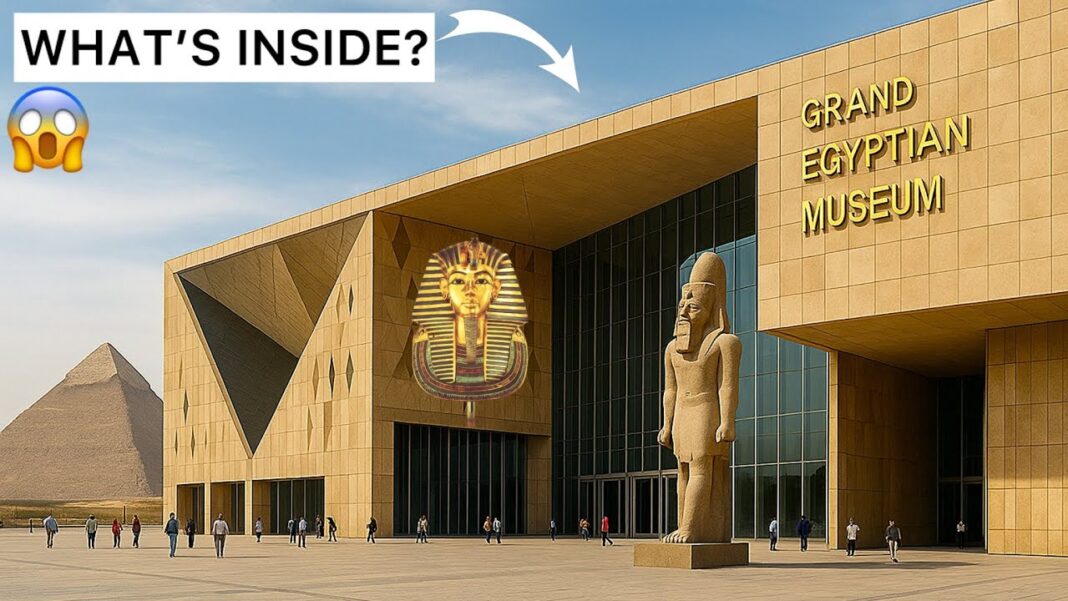
This week, after decades of anticipation, the Grand Egyptian Museum — or GEM, as it is known — finally opened its colossal doors to the public. As The New York Times reported on Thursday, the museum’s debut marks a monumental turning point not only for Egypt’s cultural landscape but for the very narrative of archaeology itself. Situated at the edge of Cairo with the Great Pyramids of Giza rising majestically in the background, the museum is being hailed as both an architectural marvel and a symbolic reclamation of Egyptian heritage long dispersed across Western institutions.
The museum’s opening ceremony was itself a scene of theatrical grandeur. Egyptian President Abdel Fattah el-Sisi, addressing a glittering audience of dignitaries, diplomats, and scholars, declared the new complex “a gift from Egypt to the world.” Behind him, the pyramids gleamed under floodlights — a timeless backdrop to a modern declaration of cultural sovereignty.
For more than twenty years, the GEM has been Egypt’s most ambitious national project — delayed by revolution, counterrevolution, economic crisis, and pandemic, but never abandoned. Its scale defies comprehension. As The New York Times report detailed, the museum spans 5.4 million square feet, an area equivalent to more than 90 football fields, and is home to over 100,000 artifacts, including all 5,500 objects excavated from Tutankhamen’s tomb — the first time they have ever been displayed together since Carter’s discovery.
The museum’s alabaster façade glows in the desert twilight, shaped into subtle pyramidal geometry that echoes its ancient neighbors. Upon entering, visitors ascend a grand staircase lined with colossal statues of pharaohs and gods — silent guardians resurrected in the soft amber light. The design, a synthesis of modern minimalism and ancient majesty, invites not just viewing but reverence.
“This is not a museum,” one Egyptian archaeologist told The New York Times. “It is a resurrection.”
For many, the museum’s true heart beats within its Tutankhamen galleries — a series of vast, dimly lit chambers that narrate the life, death, and afterlife of Egypt’s most famous boy king.
Entering through a corridor illuminated with flashing hieroglyphics, visitors are immersed in both archaeology and imagination. One hall recreates the electrifying moment of Carter’s 1922 discovery, with grainy black-and-white film projected on surrounding walls: Carter, lantern in hand, stooping to peer into eternity. Nearby, the artifacts themselves shimmer under careful lighting — a gilded stool carved with lion’s feet, a translucent alabaster vase shaped like lotus blossoms, beaded sandals meant for the afterlife.
The New York Times report described the effect as “almost devotional,” a sensory dialogue between the relics and the reverent gaze of modern visitors. The highlight, of course, is Tutankhamen’s gold funerary mask, glowing under a single, divine beam of light — perhaps the most recognized visage in all of archaeology.
But the exhibition extends beyond splendor. One gallery delves into modern forensic studies that have re-examined Tutankhamen’s life and mysterious death through DNA sequencing and CT scanning, offering new insight into ancient disease, incestuous royal lineages, and the fragile mortality that belied his golden immortality.
The result, as The New York Times wrote, is an exhibition that “bridges the myth of divinity with the science of humanity.”
Yet the Grand Egyptian Museum is more than a showcase for relics. It is a national project intended to revive Egypt’s battered economy and reassert the country’s central place in global culture.
Tourism, once the lifeblood of Egypt’s economy, has suffered from years of political instability and global downturns. Now, the government hopes the GEM will serve as both pilgrimage site and economic engine. Sherif Fathy, Egypt’s Minister of Tourism and Antiquities, predicted that the museum could attract up to five million visitors annually, generating billions in tourism revenue. According to the information provided in The New York Times report, developers are already racing to construct 12,000 new hotel rooms in the greater Cairo area to accommodate the expected influx.
But the GEM’s ambitions are also profoundly domestic. On opening day, the museum’s vast halls were filled not only with tourists but with Egyptians from every walk of life — families from Alexandria, schoolchildren from Aswan, elderly farmers in flowing robes standing shoulder to shoulder with smartphone-toting youths.
One young woman, Mai Mohammed, a 26-year-old influencer who attended wearing pharaonic-inspired earrings and winged eyeliner, told The New York Times, “I’ve come so many times since the soft opening, but today feels different. Today, I’m watching Egypt show the world who we are.”
For many Egyptians, that “who we are” extends far beyond nostalgia. The museum’s state-of-the-art conservation laboratories, staffed by more than 300 Egyptian restorers, are a direct assertion that Egypt is no longer dependent on foreign expertise to preserve its own past. As Ahmed Ghoneim, the museum’s chief executive, told The New York Times, “This field was created in Egypt, but it flourished abroad. We’re bringing it home.”
For decades, Egypt’s most celebrated antiquities have resided in European institutions, often taken under dubious colonial-era agreements. The GEM’s completion now strengthens Egypt’s moral and practical argument for their repatriation.
Foremost among these contested treasures are the 3,300-year-old bust of Queen Nefertiti, held at Berlin’s Neues Museum; the Rosetta Stone, centerpiece of the British Museum; and the Dendera Zodiac, displayed at the Louvre in Paris.
“The old arguments against return are crumbling,” Egyptologist Monica Hanna told The New York Times. “For years they said Egypt lacked the facilities, the climate control, the security. But now look around. The Grand Egyptian Museum is the answer to every one of those claims.”
Indeed, the museum’s infrastructure rivals — and, in some cases, exceeds — that of the world’s leading institutions. Its high-security vaults, seismic-resistant architecture, and advanced humidity-controlled display cases make it one of the safest repositories of ancient artifacts anywhere on earth.
Nevertheless, as The New York Times reported, repatriation remains an uphill legal and diplomatic battle. Western museums often argue that artifacts like the Rosetta Stone were acquired legally under the laws of the time, while critics counter that those laws were products of colonial coercion.
Egypt’s Supreme Council of Antiquities has taken a more conciliatory tone. Its secretary general, Mohamed Ismail Khaled, told the paper that Egypt prefers to pursue dialogue rather than confrontation. “We would like to host them, even temporarily,” he said, referring to Nefertiti and the Rosetta Stone. “So that Egyptians have the right to see their ancestors.”
Still, public sentiment within Egypt is more impatient. Influencers and historians alike have flooded social media with calls for the return of looted heritage. As one Cairo-based Egyptologist, Bassam El Shamaa, told The New York Times with characteristic bluntness: “Don’t talk to me about protection, please. We need our stuff back — especially from the Louvre.”
While Tutankhamen’s treasures may be the museum’s star attraction, its soul arguably lies elsewhere — in the galleries that chronicle the everyday existence of ordinary Egyptians who lived thousands of years ago.
These exhibits, as The New York Times report observed, bring to life not kings or gods, but bakers, brewers, artisans, and families. One display features statues of brewers at work, another a clay figurine of a man petting his dog, a tender snapshot of humanity frozen in time. The exhibits of women’s hairstyles — short bobs, elaborate curls, and wigs designed to display earrings — reveal how personal style flourished even under the desert sun.
“The most significant items are those that connect us to the non-royal population,” said Hanna. “They remind us that civilization is not built by pharaohs alone.”
Through the creative use of digital projection mapping, visitors can step into reconstructed tombs where ancient wall paintings animate before their eyes: hunters draw bows, gazelles leap, farmers bend under the weight of harvest baskets. The effect, The New York Times wrote, “transforms the static into the living, giving motion back to the stillness of time.”
Culturally, politically, and symbolically, the GEM is Egypt’s declaration of presence — a counterpoint to decades of narratives that cast the country as the site of discovery rather than the steward of civilization.
Internationally, Egypt hopes the museum will restore its standing as a global cultural capital and intellectual hub for Egyptology — a field historically dominated by Western academia. With partnerships forming between the GEM and universities around the world, Cairo aims to reclaim ownership not only of its artifacts but of the interpretation of its history.
In a country of 108 million people, many of them young and struggling economically, the museum’s significance extends beyond heritage. It is a reminder that Egypt’s identity — ancient yet alive — remains its most powerful export. As The New York Times report put it, “The Grand Egyptian Museum is both a resurrection and a rebranding: a bridge between a civilization that built pyramids and a nation striving to rebuild its future.”
It has been 101 years since Carter’s lantern illuminated the face of Tutankhamen, buried in darkness for three millennia. The world’s fascination with Egypt’s golden boy never waned, but for too long, his treasures — like much of Egypt’s heritage — were fragmented, dispersed, or viewed through foreign eyes.
Now, for the first time, they have a home built for eternity.
As the sun sets behind the pyramids, casting long shadows across the museum’s glass façade, the silhouette of Egypt’s past and future converges. The voices of artisans from four thousand years ago — bakers, priests, queens, and children — whisper from behind the glass, reclaiming their place in the continuum of civilization.
And as visitors gaze upon the golden mask of the boy king, aglow under the soft desert light, one phrase seems to echo again, as if from Howard Carter himself: “Wonderful things.”
For Egypt, as The New York Times report observed, the Grand Egyptian Museum is not simply a collection of relics — it is a statement of renewal, pride, and permanence. A century after the discovery that captivated the world, Egypt has reclaimed not just its treasures, but its narrative — the story of a civilization that still refuses to fade into history.
The Egyptians of today are a different people. They can take pride in the restoration, but the grandeur has nothing to do with “who they are.”