



|
Getting your Trinity Audio player ready...
|
By: Chaya Abecassis
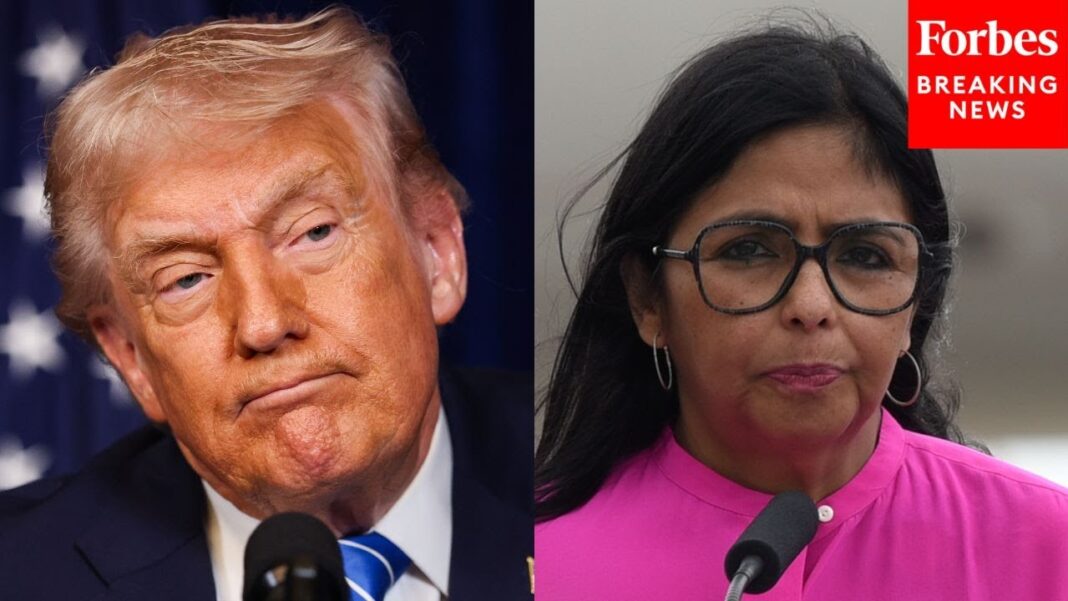
By any contemporary standard, the language emanating from the White House this weekend was breathtaking in its candor and in its implications for the global order. According to a Reuters report on Sunday, President Trump issued an unmistakable warning to Venezuela’s vice president, Delcy Rodríguez, suggesting that she could face consequences even more severe than those imposed on the now-ousted Nicolás Maduro if she fails to comply with Washington’s demands in the aftermath of the dramatic U.S. seizure of the Venezuelan strongman.
The comments, delivered during a telephone interview with The Atlantic as Trump arrived at his West Palm Beach golf club on Sunday, underscore a profound shift in U.S. foreign policy — one in which regime change is no longer couched in euphemism or diplomatic ambiguity, but articulated with a starkness that has not been heard since the height of the Cold War.
Reuters reported that Trump’s warning was directed squarely at Rodríguez, who until days ago served as Maduro’s chief deputy and remains one of the most powerful figures in Caracas. The president had initially offered cautious praise for her statements following Maduro’s capture, but that tone hardened after Rodríguez vowed publicly that Venezuela would defend its natural resources against foreign encroachment.
“If she doesn’t do what’s right, she is going to pay a very big price, probably bigger than Maduro,” Trump was quoted as saying, according to Reuters’ account of the interview. The phrasing reflects a president who appears increasingly comfortable leveraging American power not merely as a deterrent, but as a punitive instrument.
The Reuters report emphasized that the remarks were not isolated. Trump defended the extraordinary decision to seize Maduro by force, dismissing concerns over legality and sovereignty with a blunt utilitarian calculus: “Rebuilding there and regime change, anything you want to call it, is better than what you have right now. Can’t get any worse.”
As Reuters has reported, Maduro’s capture followed years of legal groundwork laid by U.S. prosecutors in the Southern District of New York, where the Venezuelan leader faces charges of narcoterrorism conspiracy, cocaine importation, and weapons offenses. The administration has framed the operation not as a coup, but as the execution of a long-standing criminal warrant against a man it characterizes as the head of a transnational drug cartel masquerading as a head of state.
Yet Trump’s rhetoric moves well beyond the courtroom. In his comments to The Atlantic, he portrayed the operation as a necessary act of geopolitical hygiene — a sweeping away of a criminal order in favor of something, anything, ostensibly better. Reuters noted that this language has unsettled even seasoned diplomats, who fear that such an approach risks normalizing the extraterritorial apprehension of foreign leaders.
Rodríguez is no ordinary caretaker. As Reuters has reported in previous profiles, she has been a central architect of the Maduro regime’s survival strategy, managing relations with allies in Russia, China and Iran, while overseeing Venezuela’s oil diplomacy at a time when U.S. sanctions have strangled the country’s formal export channels.
Her declaration that Venezuela would defend its resources was widely interpreted, Reuters wrote, as a warning that any American attempt to take control of the country’s oil sector — a prospect Trump has openly entertained — would be met with fierce resistance. That defiance appears to have provoked the president’s ire.
By singling her out, Trump has effectively personalized the future of U.S.–Venezuelan relations, transforming what might have been a multilateral reconstruction effort into a showdown between Washington and the last surviving pillar of the chavista state.
The Reuters report noted Trump’s insistence that Venezuela is not an anomaly. In the same interview, he suggested that other countries could face American intervention if they obstruct U.S. interests.
“We do need Greenland, absolutely,” he said, referring to the vast Arctic island that remains a territory of Denmark, a NATO ally. The remark resurrected a proposal Trump floated during his first term that was widely dismissed at the time as eccentricity. In the present context, however, it reads less like a whim and more like a declarative marker of a new strategic posture: American power unshackled from the constraints of polite diplomacy.
The ripple effects of Trump’s words were felt almost immediately. Reuters reported that global energy markets swung wildly on Monday as traders attempted to price in the possibility of U.S. control over Venezuelan oil infrastructure. Diplomatic channels from Brussels to Ottawa were similarly jolted, with officials privately expressing concern that the seizure of Maduro could establish a precedent that erodes the norm of sovereign immunity.
For Latin America, the implications are existential. Reuters cited regional analysts who warned that if Washington succeeds in reshaping Venezuela through force, pressure will mount to deploy similar tactics elsewhere — from narcotics-plagued Central American states to mineral-rich nations whose governments are deemed insufficiently cooperative.
The president’s defenders argue that this muscular approach is overdue. In interviews cited by Reuters, administration officials insisted that decades of sanctions and negotiations had failed to dislodge a regime that presided over the collapse of one of the world’s richest oil economies. From this perspective, Trump’s warning to Rodríguez is not reckless, but restorative — a signal that impunity has an expiration date.
As Reuters reported, the coming days will determine whether Trump’s threat to Rodríguez is rhetorical theater or a prelude to further action. For now, the Venezuelan vice president remains in Caracas, commanding what is left of a fractured state apparatus, while the deposed president awaits arraignment in New York.
In this fraught interregnum, one fact is already undeniable: the vocabulary of American power has changed. When the president of the United States can publicly threaten a foreign vice president with a fate “bigger than Maduro,” and in the same breath muse about acquiring the territory of a NATO ally, the world is no longer navigating the familiar grammar of post-Cold War diplomacy.
It is confronting the emergence of a new era — one in which the old rules of sovereignty are being rewritten not in conference rooms, but in telephone interviews from golf courses.