



|
Getting your Trinity Audio player ready...
|
By: Fern Sidman – Jewish Voice News
In a stunning act of transatlantic political solidarity, President Trump has formally urged Israeli President Isaac Herzog to issue a presidential pardon for Prime Minister Benjamin Netanyahu, declaring that the Israeli leader has been “a formidable and decisive wartime Prime Minister” and that the legal cases against him amount to a “political, unjustified prosecution.”
The letter, revealed by President Herzog’s office and reported on Wednesday by Israel National News, immediately reverberated through Israeli political circles and international diplomatic forums, merging the language of personal loyalty, foreign policy triumph, and political vindication into a single dramatic appeal.
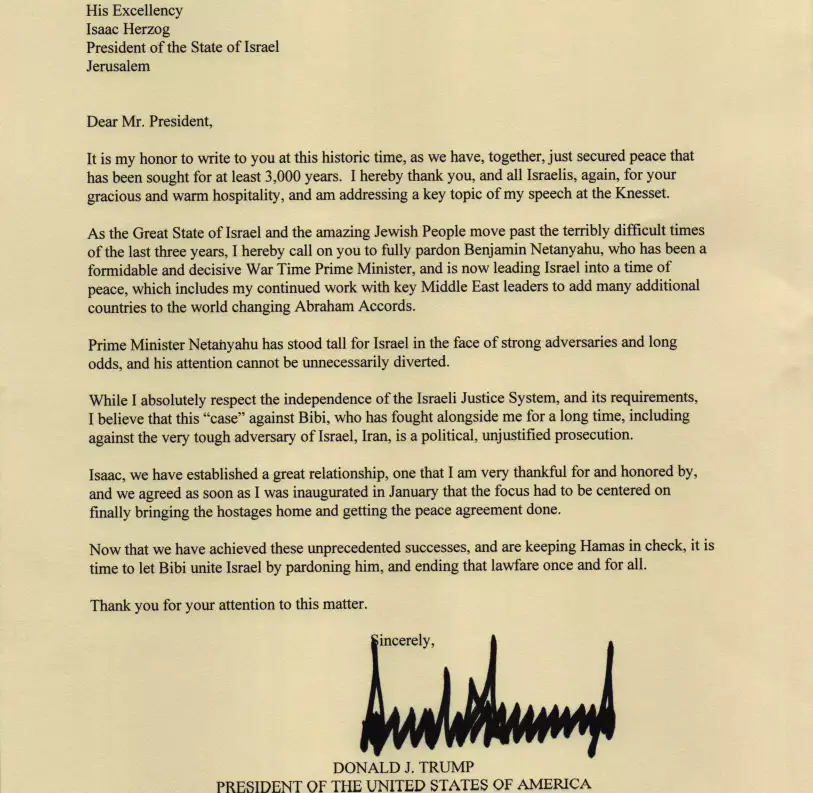
Dated this week and addressed personally to President Herzog, Trump’s letter opened with a tone of mutual respect and historical gravity. “It is my honor to write to you at this historic time,” Trump wrote, “as we have, together, just secured peace that has been sought for at least 3,000 years.” The reference, as the report at Israel National News noted, alluded to Trump’s role in brokering the Abraham Accords and his recent involvement in expanding normalization agreements across the Middle East — a diplomatic campaign that continues to resonate deeply in Israeli political discourse.
“I hereby thank you, and all Israelis, again, for your gracious and warm hospitality,” the letter continued, “and am addressing a key topic of my speech at the Knesset.” Trump went on to tie his appeal for Netanyahu’s pardon to the broader narrative of regional peace, asserting that the Israeli Prime Minister’s leadership was indispensable to the continuation of that mission.
“As the great State of Israel and the amazing Jewish People move past the terribly difficult times of the last three years,” Trump wrote, “I hereby call on you to fully pardon Benjamin Netanyahu, who has been a formidable and decisive wartime Prime Minister, and is now leading Israel into a time of peace, which includes my continued work with key Middle East leaders to add many additional countries to the world-changing Abraham Accords.”
According to the information provided in the Israel National News report, the letter reflects Trump’s characteristic directness and his enduring admiration for Netanyahu, whom he has often described as “one of the toughest and smartest leaders anywhere in the world.”
In one of the most forceful passages of the letter, Trump framed the legal proceedings against Netanyahu — which have spanned years and centered on allegations of bribery and breach of trust — as politically motivated. “While I absolutely respect the independence of the Israeli justice system and its requirements,” Trump wrote, “I believe that this ‘case’ against Bibi, who has fought alongside me for a long time, including against the very tough adversary of Israel, Iran, is a political, unjustified prosecution.”
This assertion, as the Israel National News report observed, mirrors a growing sentiment within segments of Israel’s right-wing electorate, who have long viewed the cases against Netanyahu as part of a broader campaign of “lawfare” — the use of judicial mechanisms to weaken or neutralize political opponents. Trump’s letter elevated that critique to the international stage, effectively inviting Israel’s president to close the chapter through a sweeping act of clemency.
Trump’s letter also framed the pardon as a tool for national healing and unity, appealing to Herzog’s longstanding message of reconciliation amid Israel’s fractious political climate. “Isaac,” Trump wrote in a notably personal tone, “we have established a great relationship, one that I am very thankful for and honored by, and we agreed as soon as I was inaugurated in January that the focus had to be centered on finally bringing the hostages home and getting the peace agreement done.”
“Now that we have achieved these unprecedented successes, and are keeping Hamas in check,” Trump continued, “it is time to let Bibi unite Israel by pardoning him, and ending that lawfare once and for all.”
As the Israel National News report noted, the phrasing called attention to Trump’s vision of Netanyahu not merely as an embattled political figure but as a historic statesman uniquely capable of leading Israel through both war and peace. The invocation of hostages and ongoing peace negotiations suggested that Trump’s letter was as much about cementing a shared political legacy as it was about exonerating a friend.
Within hours of Herzog’s publication of the letter, Netanyahu himself issued a statement on X (formerly Twitter), publicly thanking Trump for his gesture. “Thank you, President Trump, for your incredible support,” the Prime Minister wrote. “As usual, you get right to the point and call it like it is. I look forward to continuing our partnership to bolster security and expand peace.”
According to the information contained in the Israel National News report, Netanyahu’s message reflected both gratitude and strategic subtlety. By aligning his response with Trump’s emphasis on peace and partnership, he avoided direct mention of the legal proceedings while reinforcing the image of an unbreakable political alliance with Washington’s most pro-Israel former president.
The Office of President Isaac Herzog, in its own carefully worded statement, expressed appreciation for Trump’s longstanding friendship toward Israel while reaffirming the procedural independence of the Israeli pardon process. “President Herzog holds President Trump in the highest regard,” the statement read, “and continues to express his deep appreciation for President Trump’s unwavering support for Israel, his tremendous contribution to the return of the hostages, to reshaping the situation in the Middle East and Gaza especially, and to ensuring the security of the State of Israel.”
However, the President’s Office also made clear that formal channels must still be respected. “Alongside and notwithstanding this,” the statement added, “as the Office of the President has made clear throughout, anyone seeking a Presidential pardon must submit a formal request in accordance with established procedures.”
As the Israel National News report observed, the statement was a diplomatic balancing act — simultaneously honoring Trump’s stature as an ally and reaffirming the principle of judicial propriety.
For many observers, Trump’s appeal to Herzog was more than an act of personal loyalty; it was an unmistakable signal of Trump’s enduring engagement in Middle East diplomacy and of his intent to influence Israeli public opinion ahead of a possible return to the White House.
As Israel National News reported, the letter also comes at a moment when Israel’s government is navigating renewed peace initiatives, regional volatility, and domestic divisions. By linking his appeal for a pardon to Israel’s broader geopolitical achievements — particularly the Abraham Accords and hostage negotiations — Trump framed the matter not as legal or political, but civilizational: a moment to transcend internal rifts and reward steadfast leadership.
Political analysts cited by Israel National News noted that the letter’s publication could also resonate deeply with Israel’s conservative electorate, where Trump remains extraordinarily popular. His description of Netanyahu as “a formidable and decisive wartime Prime Minister” echoes the language used by Netanyahu’s supporters to describe his stewardship during conflict and diplomacy alike.
Whether or not Herzog entertains Trump’s appeal, the episode underscores how Netanyahu’s legal saga has become intertwined with Israel’s identity politics and international diplomacy. Trump’s intervention, unprecedented in tone and scope, highlights the depth of their political alliance and the degree to which Israel’s internal politics now occupy the attention of global statesmen.
As the Israel National News report emphasized, the letter also represents the continued convergence of Trump-era diplomacy and Netanyahu’s vision of regional peace through strength — a shared doctrine that produced the Abraham Accords and continues to shape Israeli strategic thought.
For Netanyahu, Trump’s support could not have arrived at a more symbolically potent time: as Israel faces mounting challenges — from ongoing security threats to international scrutiny — and as the Prime Minister seeks to preserve his political legacy amid a still-unresolved trial.
In its final paragraph, Trump’s letter closed on a tone of camaraderie and continuity, declaring his unwavering commitment to Israel’s future. “Thank you for your attention to this matter,” he wrote, before signing off in his characteristically emphatic style.
For all its diplomatic formalities, the letter reads, as Israel National News concluded, less like a political request than an affirmation of faith — in Netanyahu, in Israel’s destiny, and in the unbreakable bond between two leaders whose partnership has defined a turbulent but transformative era in U.S.-Israel relations.