



|
Getting your Trinity Audio player ready...
|
By: Fern Sidman
On Yom Kippur morning, the holiest day of the Jewish year, the Heaton Park Hebrew Congregation in Manchester was transformed from a sanctuary of prayer into the scene of horror. As worshippers stood in solemn reflection, the cries rang out: “Shut the doors!” Someone was pounding furiously from outside, desperate to force his way into the synagogue.
Inside, Ivan Telzer, a congregant, recalled the chaos. “The rabbi and others used their bodies to barricade the doors,” he told reporters in the aftermath. “We didn’t know what was happening, only that someone was trying to get in.”
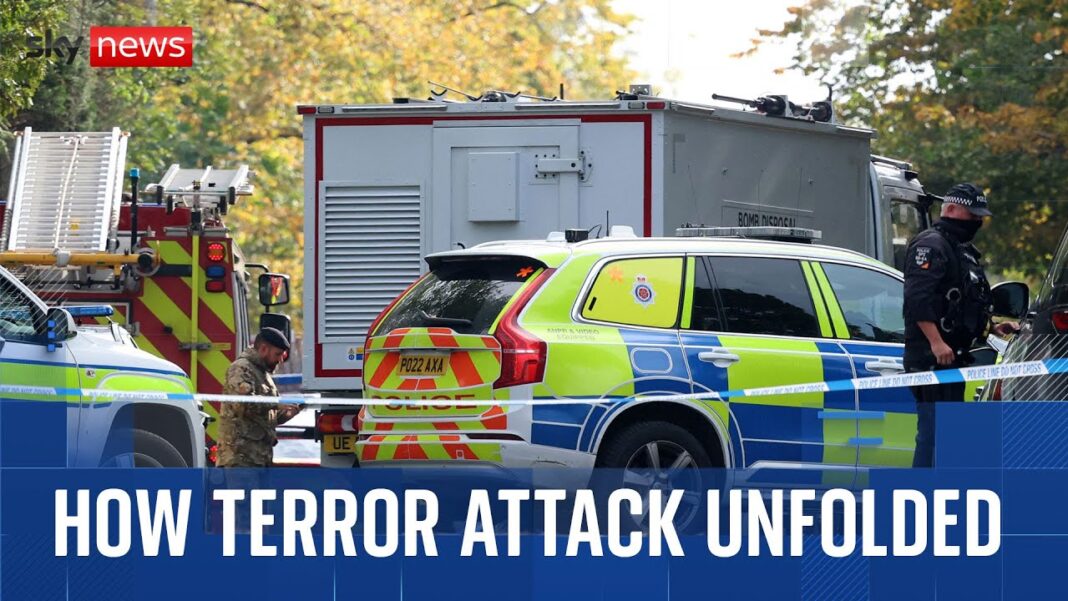
That someone was later identified as 35-year-old Jihad al-Shamie, a Syrian-born British citizen. According to police, at 9:31 a.m. on Thursday, al-Shamie began his rampage by ramming his vehicle into worshippers outside the synagogue. He then leapt from the car, brandishing a knife, and began stabbing indiscriminately. By 9:38 a.m., armed officers had shot him dead. In that span of seven minutes, two men — Adrian Daulby, 53, and Melvin Cravitz, 66 — lay dead, four others were seriously injured, and Britain’s Jewish community was left reeling.
The tragic detail that compounded the anguish: one of the deaths appears to have been caused by police gunfire. The Greater Manchester Police confirmed that one congregant died from an officer’s bullet as security forces rushed to neutralize al-Shamie. As The New York Times reported on Friday, authorities have not yet clarified whether Daulby or Cravitz was the victim of this accidental police fire.
The headline in The Jewish Telegraph, the Manchester-based Jewish newspaper, captured the collective trauma in blunt Yiddish: “TERROR AT SHUL GATES.” For a community that has lived side by side with Muslim and Sikh neighbors for generations, the attack was both shocking and — as some admitted with grim resignation — expected.
“It was shocking,” said Anne Goldstone, 67, sipping coffee the following morning at a bakery guarded by three armed security officers. “But it was kind of a bit of an inevitability. You know, we were always worried.”
Manchester, home to Britain’s second-largest Jewish population after London, has long been considered a place where Jewish life could flourish in relative peace. The neighborhoods of Cheetham Hill, Broughton Park, and Crumpsall have sustained Jewish schools, kosher shops, synagogues, and even the Manchester Jewish Museum, housed in a 19th-century Sephardic synagogue. But that sense of stability has been steadily eroding.
As The New York Times report emphasized, antisemitic incidents have surged in Britain since Hamas’ October 7, 2023 massacre in southern Israel, which left 1,200 people dead and over 250 kidnapped. Israel’s subsequent military campaign in Gaza, which Palestinian sources claim has killed more than 60,000 people, has further inflamed tensions. Across Europe, antisemitism has spiked to levels not seen in decades.
“Everyone is scared and worried,” said Nati Azar, a 47-year-old local resident who heard the gunshots. “People don’t like us because of the Middle East war. We don’t know when the next attack is going to come.”
For those in the sanctuary that morning, the attack unfolded with terrifying speed. Telzer described the moment one of the congregants slumped to the floor after being struck by police bullets. “We were praying, and suddenly someone collapsed,” he said. “We realized even inside we were not safe.”
Rabbi Daniel Walker, according to eyewitnesses, displayed extraordinary composure, closing the synagogue doors and barricading the worshippers inside as al-Shamie attempted to enter. “He is a hero; this could have been even worse,” one congregant told local media.
Hundreds remained trapped inside for hours as police feared al-Shamie was wearing an explosive vest. Ultimately, the device proved nonviable, but the panic it induced reflected the heightened sense of vulnerability Jewish communities in Britain now feel.
The attack claimed the lives of two men deeply rooted in Manchester’s Jewish community.
Melvin Cravitz, 66, was described by friends as a devoted son who cared for his elderly mother until her passing. Semi-retired, Cravitz still worked part-time at a local supermarket and volunteered at a food bank. “He did not have a single bad bone in his body,” said Avrom Baker, 63, a care worker who had known him for years. “He did not deserve to get killed.”
Adrian Daulby, 53, was remembered as a family man and regular worshipper whose quiet presence made him beloved in the congregation.
The police have not publicly identified which man was struck by the accidental police gunfire, compounding the grief of their families.
In the aftermath, the Greater Manchester Police praised the “immediate bravery” of worshippers and security staff, as well as the “fast response” of officers who neutralized the attacker. Yet questions remain about the chain of events — particularly the friendly fire that claimed a life.
Chief Constable Sir Stephen Watson acknowledged the tragedy while insisting that the rapid intervention prevented a far greater massacre. “Thanks to the immediate bravery of those inside, and the swift response of our officers, the attacker was prevented from gaining access,” he said.
By Friday, armed police patrols were conspicuously stationed at the entrances of synagogues, Jewish schools, and cultural institutions across Manchester. The government promised to review security funding for faith institutions. A vigil for the victims was scheduled for Friday evening.
The attack unfolded against a backdrop of escalating hostility toward Jews across the UK. As The New York Times report noted, reports of antisemitic harassment, vandalism, and physical assaults have spiked since the Gaza war began. Posters of Israeli hostages have been ripped down across London neighborhoods. Jewish students have been told to hide their school uniforms. Parents have withdrawn their children from Jewish schools on days when large pro-Hamas demonstrations are planned.
Jewish leaders warn that the line between anti-Israel activism and antisemitism has been blurred beyond recognition. Chief Rabbi Pinchas Goldschmidt of the Conference of European Rabbis said in response to the Manchester attack: “Jews in Manchester woke up this morning to pray and were murdered in their own synagogue. More needs to be done to stamp out murderous ideologies. Governments the world over should spare us the statements and instead ensure Jews are safe.”
The attack has landed in a politically charged environment. UK Prime Minister Keir Starmer, who cut short his attendance at a European summit to return to London, called the assault “all the more horrific” because it occurred on Yom Kippur. He announced that additional police would be deployed to synagogues nationwide.
King Charles III and Queen Camilla said they were “deeply shocked and saddened” by the attack. Israeli President Isaac Herzog revealed that he had recently written to the king warning of rising antisemitism in the UK, calling the Manchester tragedy a chilling confirmation of those fears.
Yet for many British Jews, official statements of sympathy are no longer enough. As The New York Times has underscored, they are demanding concrete action: tougher prosecution of hate crimes, bans on groups glorifying Hamas, and greater resources for community security.
The attack in Manchester reverberates far beyond the city. It represents a culmination of mounting anxieties among Jews across Europe who see themselves as targets not just of fringe extremists but of a broader culture of hostility.
For decades, Britain prided itself on being a country where Jews could thrive, their institutions supported by the state. The presence of vibrant communities in London, Manchester, Leeds, and elsewhere was testimony to that. But Thursday’s events have revealed how fragile that sense of security has become.
“Statements of solidarity are not enough,” said one Jewish parent at a community gathering two days later. “We need to know that our children can go to school without fear, that we can pray without needing barricades.”
The timing of the attack — almost two years to the day since Hamas’ massacre in Israel — was not lost on observers. For many Jews, it underscored a grim truth: that the terror unleashed on Israel has emboldened extremists far from the Middle East.
As The New York Times reported, Jewish residents believe that Hamas’ actions, and Israel’s military response, have been cynically exploited by agitators in Britain to stoke animosity toward Jews. “People don’t like us because of the Middle East war,” said Azar. “It’s the same hatred that killed Jews in Israel now showing up on our streets.”
For Ivan Telzer, who survived the attack inside the synagogue, the trauma lingers. He tried to distract himself by going to work the following day at a local supermarket, but he admitted, “I’m scared to go to the synagogue. I’m just scared.”
That fear — raw, unshakable, and widespread — is now the reality for Britain’s Jews. The Manchester attack was not just another violent incident. It was a watershed, proof that antisemitic violence has crossed a line that cannot be ignored.
As The New York Times report observed, the attack “shattered a community where Orthodox Jews had lived peacefully alongside Muslim and Sikh neighbors” and forced Britons to confront the consequences of rising hate. The challenge now, for both government and society, is whether that recognition will translate into action strong enough to reassure a community that feels under siege.
The massacre at Heaton Park Hebrew Congregation will be remembered not only for its brutality but for its symbolism: Jews, gathered in prayer on Yom Kippur, barricading the doors of their synagogue against a terrorist intent on slaughter.
Two men are dead, four are wounded, and hundreds more are traumatized. The British government promises more security, more police, more vigilance. But Britain’s Jews know that no measure of protection can erase the deeper problem: a climate where antisemitism, once relegated to the margins, now feels like a mainstream threat.
For them, the Yiddish headline in The Jewish Telegraph said it all — “TERROR AT SHUL GATES.” It is a headline, and a reality, that no community should have to endure.
‘For a community that has lived side by side with Muslim and Sikh neighbors for generations’ could also describe at least some parts of Europe before world war two.