



|
Getting your Trinity Audio player ready...
|
Netanyahu Demands Full Dismantling of Iran’s Nuclear Infrastructure in Any U.S. Agreement
By: Fern Sidman
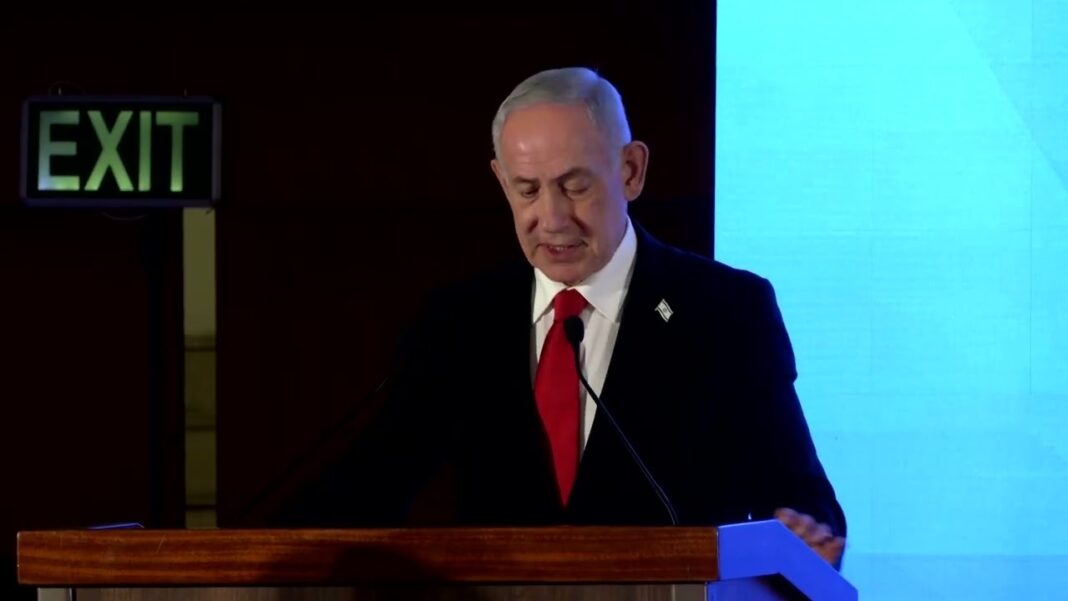
As Washington and Tehran tentatively reopen the long-suspended channels of nuclear diplomacy, Israel’s prime minister has moved decisively to inscribe his own red lines onto a negotiation that, by its very nature, is unfolding beyond Jerusalem’s direct control. In remarks delivered on Sunday at the annual Conference of Presidents of Major American Jewish Organizations, Prime Minister Benjamin Netanyahu articulated a maximalist vision of what any prospective agreement between the United States and Iran must entail, insisting that partial measures and incremental concessions would be insufficient to neutralize what he regards as an existential threat. His intervention, reported by Al Jazeera on Sunday, situates Israel squarely at the fault line between diplomacy and deterrence at a moment when regional tensions have rarely been more combustible.
Netanyahu’s comments came as Iran’s foreign minister, Abbas Araghchi, traveled to Switzerland for a second round of nuclear talks with the United States, part of a renewed diplomatic push that began earlier this month in Oman. According to the Al Jazeera report, the Israeli leader expressed open skepticism that any deal with Tehran could be genuinely effective, yet he made clear that he had conveyed to President Trump a set of non-negotiable conditions during their most recent meeting in Washington.
These conditions, Netanyahu argued, must go far beyond temporary freezes or cosmetic limitations and instead strike at the core of Iran’s nuclear capabilities.
At the center of Netanyahu’s framework is the demand that all enriched nuclear material be removed from Iranian territory, a measure intended to deprive Tehran of the stockpiles that could, under different political circumstances, be rapidly converted into weapons-grade fuel. Yet, as Al Jazeera emphasized in its report, Netanyahu did not stop there. He called for the complete dismantling of Iran’s enrichment infrastructure itself, arguing that halting enrichment processes without destroying the machinery that enables them merely postpones the moment at which Iran could resume its advance toward nuclear breakout.
The third pillar of his proposal addresses Iran’s ballistic missile program, which Netanyahu regards as an inseparable component of Tehran’s strategic threat, given that delivery systems are as integral to nuclear weapons as fissile material.
Underlying these demands is a deep mistrust of verification regimes that have historically been vulnerable to evasion and obfuscation. Netanyahu’s insistence on “real inspection” regimes—substantive, intrusive, and devoid of advance warning—reflects a conviction that Iran’s nuclear file cannot be safely managed through trust-based diplomacy. Tehran has long bristled at what it perceives as infringements on its sovereignty in the name of inspection, framing such demands as asymmetrical burdens imposed by Western powers. This tension between the imperatives of verification and the sensitivities of national pride has long bedeviled nuclear negotiations with Iran, and Netanyahu’s remarks suggest little appetite in Jerusalem for compromise on this front.
The backdrop to this renewed diplomatic effort is a landscape profoundly altered by recent conflict. The collapse of earlier talks followed Israel’s unprecedented bombing campaign against Iran last June, an operation that spiraled into a 12-day war and drew in the United States, which struck three Iranian nuclear sites. Al Jazeera’s chronicle of that confrontation underscored the degree to which the regional equilibrium has been destabilized, with each escalation reinforcing mutual suspicion and narrowing the space for de-escalatory diplomacy. It is against this volatile history that Netanyahu’s latest public intervention must be read: not merely as policy prescription, but as an attempt to preempt any agreement that, in Israel’s view, could legitimize an Iranian nuclear threshold.
For his part, President Trump has adopted a posture that oscillates between hawkish resolve and transactional pragmatism. Following his meeting with Netanyahu in Washington—their seventh encounter since Trump’s return to office—he told reporters that no definitive agreement had been reached on how to proceed with Iran, but that he had insisted negotiations continue to test whether a deal could be consummated. The Al Jazeera report captured this duality: a willingness to explore diplomatic avenues, coupled with a readiness to deploy coercive instruments should talks falter.
This ambivalence is further illustrated by reports, cited by Al Jazeera, that Trump and Netanyahu agreed to intensify economic pressure on Iran, particularly by tightening constraints on its oil exports to China, which account for the vast majority of Tehran’s petroleum revenue.
Here, however, the convergence between Washington and Jerusalem appears to fray. While both leaders agree on the desired end state—an Iran without the capability to acquire nuclear weapons—they diverge sharply on the means. Netanyahu has reportedly told Trump that the prospects for a “good deal” are illusory, whereas Trump has expressed cautious optimism that diplomacy might yet succeed.
This divergence reflects deeper philosophical differences: Netanyahu’s strategic culture is steeped in a doctrine of preemption and skepticism toward adversarial commitments, while Trump’s approach is informed by a belief in deal-making as a tool of statecraft, even with hostile regimes.
Tehran, meanwhile, continues to deny any intention to pursue nuclear weapons, insisting that its atomic program is purely civilian in nature. Al Jazeera has chronicled Iran’s long-standing position that it is willing to discuss limits on enrichment in exchange for sanctions relief, but that it will not accept constraints on its missile program, which it frames as a sovereign right to self-defense. This refusal to link nuclear and missile issues strikes at the heart of Netanyahu’s demands and underscores the profound gap between Israeli expectations and Iranian negotiating positions. The chasm between these positions raises fundamental questions about the feasibility of any comprehensive agreement, even before the mechanics of implementation and verification are considered.
Complicating the diplomatic picture further are reports that Trump told Netanyahu during a December meeting in Florida that he would support Israeli strikes on Iran’s ballistic missile program should diplomacy fail. While neither Washington nor Jerusalem has officially commented on this account, its circulation adds a combustible dimension to the negotiating environment. The implicit message to Tehran is that the diplomatic track is shadowed by the credible threat of force, a dual-track strategy that may strengthen bargaining leverage but also heightens the risk of miscalculation.
The region’s strategic temperature has been further elevated by Washington’s visible military posture. Trump’s decision to dispatch a second aircraft carrier to the Middle East, accompanied by rhetoric openly contemplating regime change in Iran, has reverberated across the region. Al Jazeera has reported that Iranian officials have responded with stark warnings that any attack would be met with retaliation against US bases in the Middle East, reinforcing the specter of a wider regional conflagration. In this climate, diplomacy is not merely a forum for negotiation but a fragile membrane separating crisis from catastrophe.
Netanyahu’s intervention thus serves multiple audiences. To Washington, it is a reminder that Israel will not acquiesce in an agreement it deems insufficiently robust, and that any deal perceived as legitimizing Iranian nuclear latency could strain the strategic partnership. To Tehran, it is a declaration that Israel’s red lines are fixed and that the window for compromise, if it exists at all, is vanishingly narrow. And to the international community, it is a signal that the politics of the Iranian nuclear file are inseparable from the broader geopolitics of Middle Eastern security.
The report’s attention to these dynamics highlights the paradox at the heart of the current moment. On the one hand, there is an earnest, if embattled, effort to revive diplomacy as a means of averting another cycle of war. On the other, there is an unmistakable drumbeat of militarization, as carriers move into position and leaders speak openly of force as a contingency. The juxtaposition of these tracks raises a profound question about the nature of contemporary diplomacy in high-conflict environments: whether negotiations conducted under the shadow of overwhelming force can produce durable agreements, or whether they merely postpone the reckoning.
As Araghchi engages American counterparts in Switzerland and Netanyahu continues to press his conditions, the contours of a potential deal—and the obstacles to its realization—are coming into sharper relief. The stakes are enormous, not only for the immediate parties but for a region already strained by years of conflict and upheaval. The Al Jazeera report situates this moment as a hinge point, one in which the interplay between diplomacy and deterrence will determine whether the Middle East moves, however tentatively, toward de-escalation, or whether it slides once more toward confrontation.
In this precarious balance, Netanyahu’s red lines are not merely negotiating positions; they are markers of a strategic worldview forged in the crucible of regional insecurity, one that will shape Israel’s posture regardless of the outcome of talks in far-off negotiating rooms.
