



|
Getting your Trinity Audio player ready...
|
Knesset Overwhelmingly Affirms Israeli Sovereignty Over Judea, Samaria, and the Jordan Valley in Landmark Vote
By: Fern Sidman
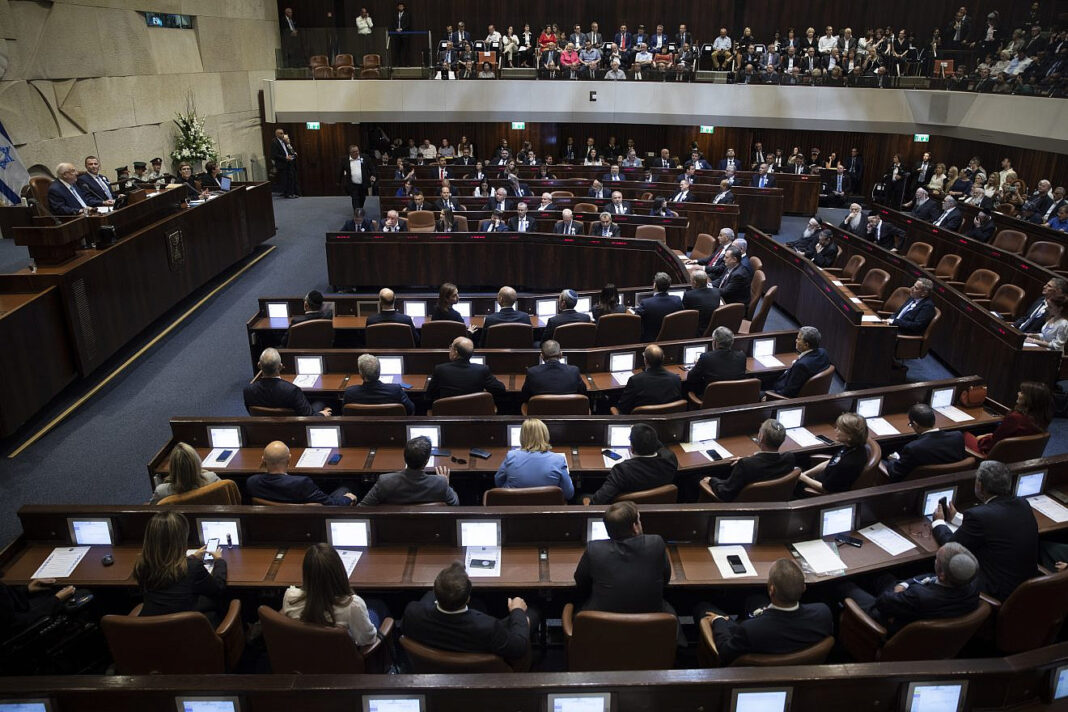
In a historic and highly consequential step, Israel’s Knesset voted decisively on Wednesday to affirm the Jewish state’s historic, legal, and moral right to sovereignty over Judea, Samaria, and the Jordan Valley. The symbolic resolution, passed by a resounding majority of 71–13, reflects broad national support for asserting Israeli ownership over these regions—territories that have long stood at the heart of Israel’s ancient heritage and modern security concerns.
As reported by World Israel News, the measure illustrates Israel’s enduring claim to key biblical and strategic areas, including the ancient cities of Hebron, Shechem (Nablus), Beit El, and Shiloh—locations whose names are deeply etched into Jewish religious and national consciousness. The resolution, while declarative in nature, calls on the government to act without delay to extend full Israeli sovereignty to Jewish communities in these regions.
MK Simcha Rothman (Religious Zionism), one of the principal authors of the resolution, declared in the Knesset chamber, “The Land of Israel belongs to the people of Israel—yesterday, today, tomorrow, and forever.” His remarks were met with thunderous applause from members of the coalition and many in the public gallery. According to the report at World Israel News, Rothman emphasized that the vote not only recognizes historical truth but also sets a clear course for future policy.
The resolution comes at a time of heightened national unity and political momentum in the wake of the October 7 Hamas massacre, which claimed the lives of more than 1,200 Israelis and removed any remaining public support for the establishment of a Palestinian state in the liberated territories of 1967. The measure explicitly cites the events of October 7 as a strategic turning point, stating that the concept of a Palestinian state has become “a strategic threat” and should be “decisively rejected.”
MK Dan Illouz (Likud), speaking in support of the resolution, echoed this sentiment. “Judea and Samaria are not bargaining chips—they are the heart of our ancestral homeland,” he told the Knesset, as reported by World Israel News. Illouz further argued that applying full sovereignty in these regions “will lead to victory, security, and moral clarity not only in Israel but throughout the world.”
While the resolution does not carry the force of law, its political implications are significant. It calls for an expedited governmental process to implement sovereignty measures and normalize Israeli governance across the entirety of Jewish communities in Judea, Samaria, and the Jordan Valley—areas that are presently administered under a patchwork of civil and military legal regimes due to the complex arrangements established by the Oslo Accords.
Supporters of the resolution say that formal annexation would eliminate legal ambiguities, deter terrorism, and send a powerful message of national resilience. “This is not merely a declaration—it is a call to action,” said Yisrael Ganz, head of the Binyamin Regional Council. “We are at a historic juncture. This is the time to act.”
Ganz further noted that the resolution represents “clear and undeniable evidence of the national will to realize our values and our right to our land.” He urged the government to respond accordingly by adopting legislation or executive action to apply full Israeli law across the territories.
The resolution also makes specific reference to the Jewish people’s unbroken spiritual and physical connection to the land. The text affirms that Judea and Samaria are not only integral to Israel’s security but are also the cradle of Jewish civilization, containing sites of unparalleled religious, cultural, and historical significance.
World Israel News reported that many of the speeches in favor of the resolution drew on religious and historical themes, emphasizing the ancient presence of Jewish life in the region and the centuries-long longing to return. References were made to the biblical patriarchs and matriarchs, ancient sanctuaries, and the continuity of Jewish settlement—even during times of foreign occupation and exile.
Despite its overwhelming support in the Knesset, the resolution was not without opposition. Thirteen MKs voted against the measure, most of them members of left-leaning or Arab parties, who warned that applying sovereignty could inflame regional tensions and undermine international support for Israel. However, their voices were largely overshadowed by a unified and assertive message from the majority of lawmakers, who framed the vote as both a moral imperative and a national necessity.
Observers note that the resolution builds upon longstanding efforts by Israeli political leaders to secure recognition of Jewish rights in these territories. Previous governments have hesitated to move forward with full annexation, largely due to concerns about international backlash and diplomatic fallout. However, the post-October 7 political environment has dramatically shifted domestic priorities, with security considerations and national identity taking precedence.
According to the information provided in the World Israel News report, there is a growing consensus within the governing coalition that now is the time to consolidate Israel’s territorial claims and reassert its sovereignty in areas viewed as foundational to the state’s character and future.
The international community has yet to officially respond to the resolution, but diplomatic sources cited by World Israel News suggest that foreign governments are closely monitoring developments. Israel’s allies, including the United States, have traditionally discouraged unilateral annexation efforts. However, the widespread public support and the postwar context may complicate efforts to pressure Jerusalem to reverse course.
The resolution’s approval marks a major milestone in Israel’s effort to reshape its national map in alignment with historical claims and contemporary realities. While the next steps remain to be seen, supporters are hopeful that the momentum generated by the vote will result in concrete policy shifts in the near future.
As the World Israel News report indicated, Wednesday’s Knesset vote represents far more than symbolic affirmation. It is a statement of intent, a national reckoning, and potentially the beginning of a new chapter in Israel’s relationship with Judea, Samaria, and the Jordan Valley. Whether the government follows through with legislative or executive measures to implement sovereignty remains to be seen, but the resolution leaves little doubt about the direction in which Israel’s political winds are now blowing.

Even the east side of the Jordan river should be Israel and this is biblical.
Too many articles have just said there should be no “two-state solution” now because of Palestinian Arab attitudes, leaving open maybe later. This vote makes clear that Judea-Samaria and Jordan Valley are historically and legally ours, period.