



|
Getting your Trinity Audio player ready...
|
By: Andrew Carlson
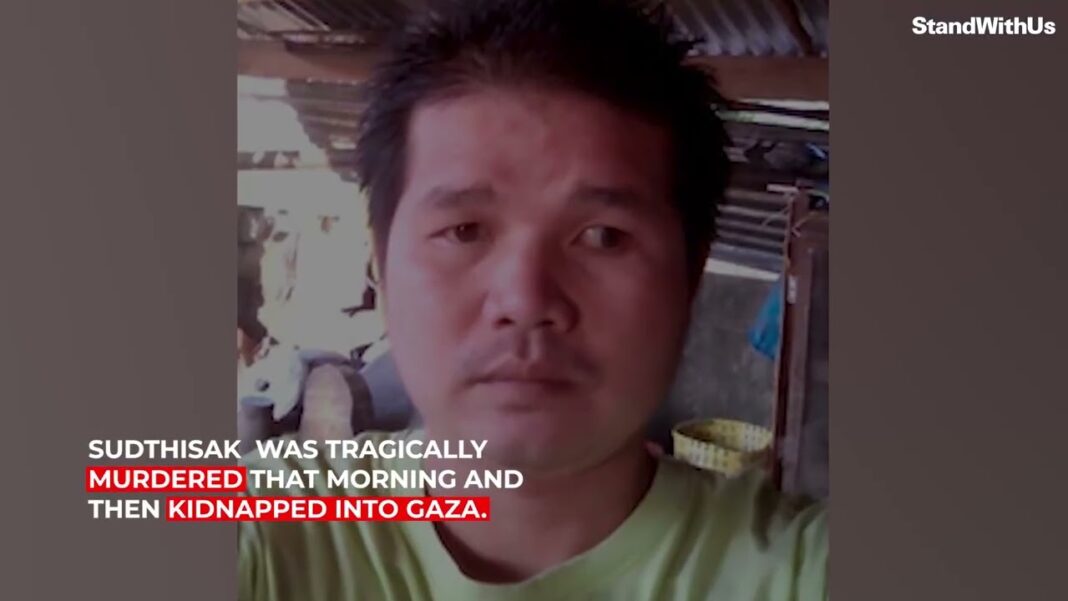
Israel announced on Thursday morning that the body of Thai national Sudthisak Rinthalak, abducted and killed during the Hamas massacre of October 7, has been recovered and formally identified following a painstaking joint forensic process. According to a report that appeared on Ynet News, the identification was completed through a coordinated effort by the National Center of Forensic Medicine, the Israel Police, and the IDF Rabbinate—marking a somber but crucial development in the ongoing endeavor to account for all victims of the most devastating terror attack in Israel’s history.
The announcement, delivered by Gal Hirsch, Israel’s Hostages and Missing Persons Coordinator, brings partial closure to a family that has waited in anguish for more than a year. Hirsch informed Rinthalak’s relatives that Israeli authorities, in cooperation with the Thai Embassy, will oversee arrangements to ensure his remains are repatriated with dignity to his hometown in northern Thailand.
In remarks relayed by Ynet News, Israeli officials conveyed “the deep sorrow of the Government of Israel, the people of Thailand and all families of the fallen hostages,” underscoring the tragic global reach of Hamas’s brutality. Thailand—home to thousands of agricultural laborers working in Israel—suffered a particularly heavy toll on Oct. 7, when dozens of its nationals were murdered or abducted during the rampage across the Gaza periphery.
For Rinthalak’s family, the confirmation ends months of agonizing uncertainty that began when communication abruptly ceased during the October 7 assault. As the Ynet News report recounted the 43-year-old agricultural laborer had been working in orchards near Kibbutz Be’eri since 2017. A native of Ratnawee in northern Thailand, he had taken on the role of primary breadwinner for his aging parents and remained in close contact with them through calls and text messages.
“About ten days before October 7 was the last time we spoke,” his mother, On, told Ynet News, recalling their final conversation. “We asked him to come home to Thailand for a visit. We hadn’t seen him for many years.” Her son planned to return home permanently after saving a bit more money—plans cut short by the massacre.
Rinthalak was abducted while working in the fields near Be’eri and held by Palestinian Islamic Jihad. It was only on May 16, 2024, more than six months after the attack, that his family received official confirmation of his murder on the day of the assault. Since then, they have waited for news of his body with a mixture of despair and resolve.
His father, Thaung-Na, expressed the quiet grief that has enveloped the family: “I miss him so much,” he told Ynet News, sitting alongside his wife. His sister, Ratda Gongpat, described the broader impact on their village, where “almost every household has someone who went to work in Israel.” Rinthalak, she said, was “polite, well-liked, the head of the family and the main provider.”
The return of his body, she noted, brings a measure of consolation but not relief. “Everyone here misses him. They sit with us, they grieve with us.”
The identification of Rinthalak’s remains comes amid complex international efforts to secure the return of all hostages—living and deceased—from Gaza. According to the Ynet News report, Israeli authorities stressed that Hamas is duty-bound under the existing ceasefire-mediation framework to return the bodies of all deceased hostages.
A statement from the Hostages and Missing Persons Directorate reiterated: “We will not compromise and will spare no effort until he is brought home.” The same commitment, they said, applies to every hostage, including those known to be dead.
But Ynet News reported that one case remains unresolved: the abduction and death of Sgt. First Class Ran Gvili, a special forces officer whose body is still held by Hamas. Israeli officials have expressed growing frustration that Hamas continues to stall, saying they believe the terror organization knows the body’s location but is attempting to exploit the situation for political leverage.
Under heavy American pressure, Israel has allowed additional time—though begrudgingly—for Hamas to “locate” the body. According to Ynet News, Israel’s defense establishment considers the return of Gvili’s remains essential to completing the first phase of the ceasefire arrangement.
The dynamic reflects a broader pattern: Hamas’s history of withholding information on hostages and bodies to extort concessions. Israeli officials, citing Ynet News, have accused Hamas of using the families’ anguish “as a bargaining chip,” a practice that has amplified international outrage over the group’s disregard for humanitarian norms.
Sudthisak Rinthalak was one of thousands of Thai nationals who have come to Israel over the years to work in agriculture, typically for extended periods far from their families. According to the Ynet News report, his colleagues on the kibbutz viewed him as exceptionally dedicated and kind, a worker who became an integral part of the community’s daily life.
After separating from his partner, he returned to live with his parents and assume sole responsibility for supporting them financially. His family described him as hardworking, humble, and deeply committed to improving the lives of those he loved. His death has reverberated across his village, where many families share similar stories of sacrifice and reliance on income from Israel.
“People ask about him every day,” his sister said. “They grieve with us. They don’t talk much. That’s how it is for us Isaan people.”
The recovery and identification of Rinthalak’s body carries symbolic as well as diplomatic significance. Thailand has been among the countries most affected by the Oct. 7 attack, and its government has publicly pressed Israel to prioritize locating missing Thai nationals. According to the information provided in the Ynet News report, Thai Ambassador Pannabha Chandraramya personally thanked Israel for its “continuous efforts” to recover Rinthalak’s remains.
The Israeli government, in turn, has sought to reassure Thailand that the fate of its citizens remains a top priority. Officials told Ynet News that the repatriation of Rinthalak’s body reflects Israel’s “moral obligation” to return every hostage—Israeli or foreign—regardless of political pressures.
As Israel continues to search for the last remaining bodies, the return of Rinthalak’s remains is both a somber milestone and a reminder of the international dimension of Hamas’s atrocities. The Oct. 7 massacre claimed victims from more than two dozen countries, shattering communities far from Israel’s borders.
For the families of these foreign workers, the path to closure has been especially wrenching: prolonged uncertainty, limited communication, and the profound distance between their homes and the conflict zone.
The return of Rinthalak’s body—confirmed by Ynet News with forensic finality—closes one chapter but leaves many others still painfully open. It underscores the remaining work Israel must undertake to fulfill its pledge: that no victim, living or deceased, will be forgotten or abandoned.
And for his family in Ratnawee, it means one heartbreaking step closer to home
TJV has the basic obligation to identify for its readers whose writings it is publishing. Who is “Andrew Carlson”?
It is my belief that the constant obsession with “news“ of any remaining “hostage bodies“ is editorial political propaganda. There are many more important subjects which are being intentionally ignored.
One of the most timely and crucial real issues:
How the ADL Failed the Jewish Community
https://www.city-journal.org/article/anti-defamation-league-jewish-zohran-mamdani
There’s been a complete betrayal of the Jewish community by its organizations and institutions.