



|
Getting your Trinity Audio player ready...
|
Guy Birchall
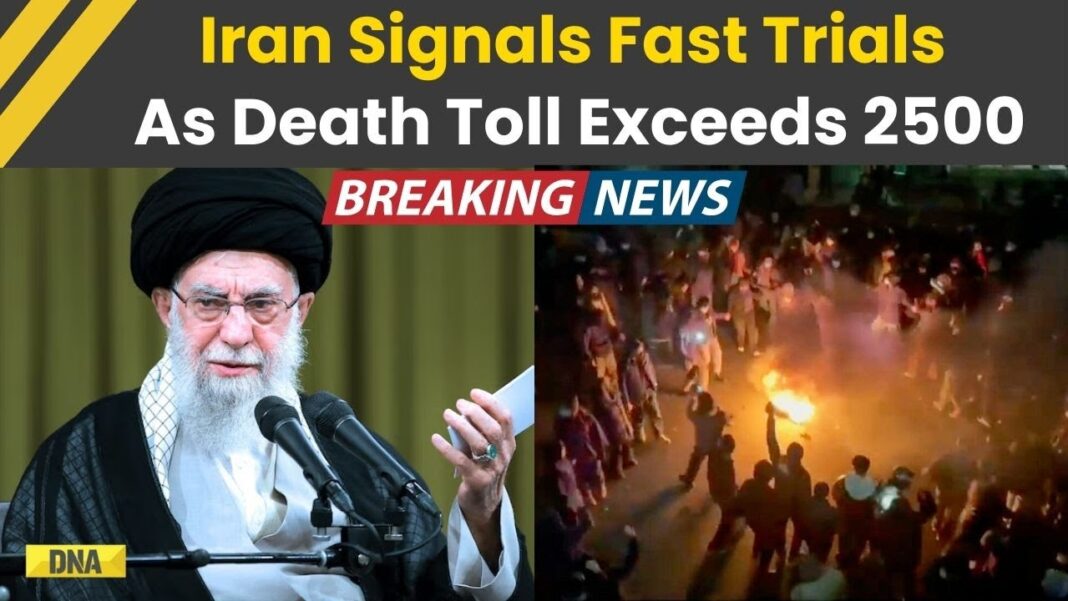
(Epoch Times) The head of Iran’s judiciary on Jan. 14 said there would be fast trials for those suspected of serious crimes during the nationwide protests sweeping the country, followed by swift punishment for those deemed guilty.
“If it becomes late—two months, three months late—it doesn’t have the same effect. If we want to do something, we have to do that fast,” he said.
The judiciary chief also said the trials should be held in public, The Times of Israel reported, citing Iranian media.
Mohseni-Ejei’s comments come as activists say the death toll of the protests has soared into the thousands.
“Additionally, nine non-protesting civilians (neither military personnel nor protesters) are included among the deceased. On the other side, 147 members of security forces and government supporters have been killed, including at least five civilian supporters of the government.”
That puts the total deaths at 2,571, far outstripping the death toll from any other round of protest or unrest in Iran in decades.
HRANA also stated that as of the 17th day of protests, a total of 614 protest gatherings have been recorded across Iran, taking place in 187 cities in all 31 provinces of the country.
Some 18,434 individuals have been confirmed as arrested, while 97 cases of forced confessions have been broadcast, and 1,134 people have been severely injured.
The Epoch Times is unable to independently verify HRANA’s figures.
When asked about the “end game” in Iran, Trump pointed to the examples of ISIS leader Abu Bakr al-Baghdadi and Iranian Gen. Qasem Soleimani, who were both eliminated during Trump’s first term.
“We don’t want to see what’s happening in Iran happen, and you know, if they want to have protests, that’s one thing. When they start killing thousands of people, and now you’re telling me about hanging, we’ll see how that works out for them. It’s not going to work out good,” Trump said.
“Save the names of the killers and abusers. They will pay a big price,” he said.
Communication Blackout
Since the protests began to intensify, the regime has blocked access to internet and telephone services in the country. This has made it difficult for international organizations to gauge the intensity of the protests and government responses.
“After weeks of continuous efforts, negotiations, and discussions with the Starlink team and United States authorities, we have successfully provided access to Starlink for free to serve the revolution,” it stated.
“Just turn on the device. Don’t forget physical camouflage, hiding the Starlink IP, and changing the wireless network name,” the group advised Iranian users.
Jamming Concerns
Musk has provided Starlink services to Iranians to help them bypass government restrictions, including during previous protests in 2022, when the White House engaged with the billionaire after protests sprang up following the death of 22-year-old Mahsa Amini in police custody.
Despite being illegal under Iranian law, Starlink is used in Iran by people with receivers. The receivers use GPS signals to position themselves to connect to a constellation of low-orbit satellites.
Rashidi said he had not witnessed such outages in his 20 years of research, adding that the technology being used is highly sophisticated and military-grade. These jammers, he said, were likely supplied to the regime by China or Russia, if they were not developed internally.
