



|
Getting your Trinity Audio player ready...
|
Hamas Submits Highly Ambiguous Response to Trump’s Peace Plan as Israel Prepares for Intense Negotiations
By: Fern Sidman
In a development carrying far-reaching implications for the trajectory of the Gaza war and the fate of Israeli hostages, the Hamas terrorist organization formally submitted its response on Friday evening to President Donald Trump’s much-discussed peace plan. Reports from Al Jazeera and the Qatari Al-Araby channel, later confirmed by regional sources, indicate that Hamas conveyed its position to mediators, marking a pivotal moment in negotiations that have gripped global attention for weeks.
According to a statement released by Hamas, the organization expressed “appreciation” for what it termed the “Arab, Islamic, and international efforts, as well as those of President Donald Trump” to secure a ceasefire in Gaza. The group’s message, however, was laced with conditions, caveats, and calculated ambiguity. As Israel National News emphasized in its extensive coverage on Friday afternoon, New York time, the organization’s willingness to engage with the framework presented by the White House does not signal a fundamental change in its ideological posture, nor does it necessarily mean a genuine concession.
The Hamas statement, circulated widely in Arabic-language media, outlined four major points of engagement with Trump’s proposal:
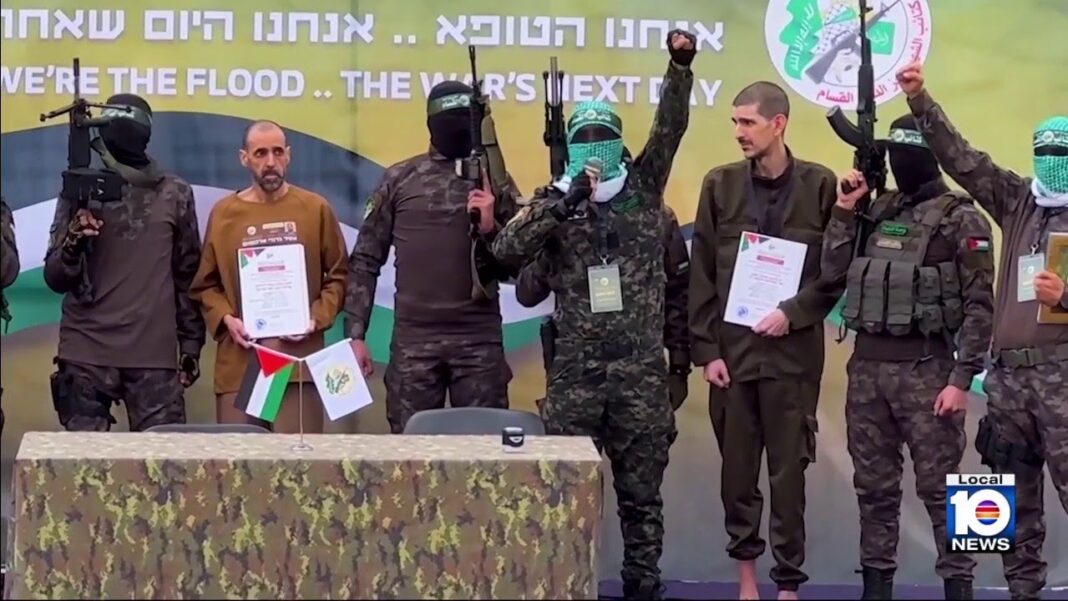
Hostages: Hamas declared its agreement to release all Israeli hostages — living and deceased — in accordance with the exchange formula included in Trump’s plan. This, however, was explicitly conditioned on “necessary circumstances on the ground” being met. The language suggested that Hamas intends to tie the release of hostages to Israeli troop withdrawals and logistical guarantees, particularly regarding the remains of deceased hostages.
Ceasefire and Withdrawal: Hamas claimed that it would commit to a cessation of hostilities and demanded a “complete withdrawal from the Gaza Strip,” which the Israel National News report noted was consistent with the group’s long-standing demand to maintain its grip over the territory.
Governance: Hamas expressed willingness to hand over the administration of Gaza to an “independent Palestinian technocratic body,” provided it was formed through “Palestinian national consensus” and supported by Arab and Islamic states. Analysts quoted by Israel National News argued that this was an attempt by Hamas to deflect responsibility for reconstruction while ensuring it retained influence behind the scenes.
Broader Palestinian Issues: The statement said other elements of Trump’s plan tied to Palestinian “authentic rights” and international resolutions would be handled within a “comprehensive Palestinian national framework.” This, Israel National News observed, was a veiled reference to Hamas’ intention to anchor any long-term arrangement in maximalist demands, including rejecting Israel’s legitimacy.
Within hours of Hamas’s reply, Israeli media outlets, including Kan 11 News, reported that senior officials in Jerusalem viewed the group’s response as an opening gambit that would trigger a new phase of negotiations. Israeli sources suggested that Hamas may seek additional time to fulfill its obligations on hostages, particularly regarding the return of bodies.
The Israel National News report noted that unlike the 20 living hostages believed to be in Hamas and Islamic Jihad custody — whose locations are known — the status of deceased hostages is more complex. Israel is preparing for Hamas to demand further concessions or a partial withdrawal of IDF forces in exchange for their return. Such delays could potentially extend the hostage release timeline beyond the 72 hours stipulated in Trump’s proposal.
Despite these anticipated complications, Israeli officials acknowledged that the Hamas statement marked the most concrete indication yet of the group’s readiness to engage with an American-brokered ceasefire framework. “There will be intensive negotiations,” Kan 11 News quoted one senior figure as saying. “We must be prepared for Hamas to attempt to maneuver, but this is not a rejection.”
The Hamas statement was delivered just hours after President Trump issued one of his most forceful ultimatums to date. Writing on his Truth Social platform, the president declared: “An Agreement must be reached with Hamas by Sunday Evening at SIX (6) P.M., Washington, D.C. time. Every Country has signed on! If this last chance agreement is not reached, all hell, like no one has ever seen before, will break out against Hamas. There will be peace in the Middle East one way or the other.”
The dramatic warning was amplified by White House Press Secretary Karoline Leavitt, who reiterated that Hamas faces “very grave” consequences should it reject Trump’s peace plan. According to the information provided in the Israel National News report, the timing of Hamas’s response — immediately after Trump’s ultimatum — was no coincidence. Analysts suggested that the group is keenly aware of the risks of outright rejection in the face of mounting international consensus behind the American proposal.
Reports in The Wall Street Journal highlighted the ambiguities in Hamas’s position. While the group signaled a willingness to accept large parts of Trump’s plan, it reportedly refuses to disarm — a central component of the American proposal and a non-negotiable requirement for Israel. The Israel National News report called attention to this contradiction, noting that Hamas’s rejection of disarmament leaves a gaping hole in the feasibility of any agreement. Without dismantling its terror infrastructure, Israel argues, Hamas cannot be trusted to honor commitments or prevent future escalation.
Hamas’s statement, as reported by Al Jazeera, struck a conciliatory tone by thanking mediators in Qatar and Egypt for their role in facilitating the dialogue. Both nations have long acted as intermediaries between Israel, Hamas, and the United States. However, the Israel National News report observed that the praise for Arab and Islamic actors was also a calculated bid to frame Hamas as a legitimate political actor operating within a broader regional consensus.
In Israel, reactions were cautious. Government sources stressed to Israel National News that “nothing has yet been decided” and that the IDF remains fully prepared to resume full-scale operations should Hamas renege or stall. The embassy of Israel in Washington reiterated that Hamas is still a terrorist organization committed to Israel’s destruction, regardless of its temporary willingness to engage with diplomatic frameworks.
The fate of the hostages remains the single most emotional and politically charged aspect of the negotiations. Families of those held in Gaza expressed guarded optimism after hearing of Hamas’s pledge to release captives under Trump’s plan. At the same time, they voiced deep skepticism about whether the group would honor its word.
Israel National News reported extensively on the anguish of hostage families, many of whom fear that their loved ones are being used as bargaining chips in a cynical game. Several Israeli officials echoed those concerns, warning that Hamas may attempt to exploit the emotional weight of the hostage issue to extract concessions that could compromise Israel’s security.
The Hamas response to Trump’s plan represents a fragile opening in a conflict that has defied resolution for nearly a year. While the group has not rejected the American framework outright, its refusal to disarm and its insistence on conditions tied to Israeli withdrawal leave the path forward strewn with obstacles.
For Israel, the calculus remains brutally simple: without guarantees of Hamas’s demilitarization, any ceasefire risks becoming a pause that allows the group to rearm and regroup. For the United States, the challenge is to leverage international consensus to pressure Hamas into concessions without alienating Israel or undermining the credibility of American guarantees.
As the Israel National News report observed, “The coming days will determine whether Hamas’s response is a genuine acceptance or another tactical maneuver in its long war of attrition against Israel.” With Trump’s Sunday deadline looming, the world will soon discover whether this moment of apparent pragmatism can be transformed into a durable agreement — or whether it will collapse into yet another cycle of bloodshed and broken promises.

In short, Hamas is saying no to giving peace a chance.
Nothing to negotiate about. Just carpet bomb them back to the Stone Age. Nothing stays alive below ground. 100,000 dead Muslim monsters would be a good start.