



|
Getting your Trinity Audio player ready...
|
From Kandahar to Constitution Avenue: The CIA-Linked Afghan Fighter Who Turned His Guns on National Guardsmen
By: Fern Sidman – Jewish Voice News
Since the deadly shooting on Wednesday afternoon near the White House that claimed the life of West Virginia National Guardsman Sarah Beckstrom, 20, and critically wounded her colleague Andrew Wolfe, 24, Americans have been inundated with shifting explanations and rapidly evolving revelations. At first, authorities offered a brief, muted account: the assailant was described simply as “an Afghan national,” a vague designation that conveyed little beyond his nationality.
But as open-source investigators, news outlets, and former intelligence officials began piecing together the suspect’s background, that sanitized public narrative collapsed with astonishing speed. What is now emerging—through multiple independent reports, public records, and statements from former senior officials—suggests that the attack may represent one of the most troubling intelligence lapses in recent memory.
Far from being a random Afghan migrant, the suspected gunman, Rahmanullah Lakanwal, 29, was by all available evidence a highly trained veteran of one of the most secretive, lethal, and U.S.-supported paramilitary units of the entire Afghan War.
The expanding picture raises urgent national security questions, including how an individual with his paramilitary pedigree entered the United States, why he was not monitored, and whether the rushed, chaotic evacuation from Afghanistan seeded unknown security threats into the American homeland.
In the first hours following the assault, the public was told only that the attacker was Afghan-born. But within hours, reports across the media ecosystem—citing former intelligence officials, military records, and interviews with Afghan veterans—painted a dramatically different portrait of who Lakanwal actually was.
Multiple outlets now report that Lakanwal served for over a decade in Afghanistan’s elite Commando Corps, a force trained, armed, and frequently embedded with U.S. Special Forces in some of the most dangerous battlefields of the war.
But even more alarming is evidence that he appears to have been a member of the CIA-backed Kandahar Strike Force (NDS-03)—a covert paramilitary unit described in numerous investigative reports as one of the most aggressive, controversial, and operationally autonomous components of the U.S. presence in Afghanistan.
Public documentation on this unit, though limited, suggests it engaged in nocturnal counterterror raids, intelligence-driven targeted killings, operations outside the normal chain of command, and missions overseen or directed by U.S. intelligence operatives.
The Kandahar Strike Force was, as one veteran told reporters, “a scalpel and a hammer at the same time”—deeply embedded with CIA paramilitary teams and often shielded from scrutiny.
The implications are enormous. Lakanwal was not merely an Afghan soldier; he was part of an intelligence-linked paramilitary apparatus that operated in the shadows for years with U.S. government support.
The breakthrough moment came when former CIA Director John Ratcliffe confirmed in a public statement—corroborated by Fox News and other outlets—that Lakanwal had indeed worked with U.S. agencies during the war. “Lakanwal worked with the U.S. government, including the CIA… He should never have been brought into the United States” Ratcliffe said.
It was a stunning admission—one that intensified scrutiny not only of Lakanwal’s background but of the federal intake system that allowed him to enter the United States in the first place.
According to NBC News and additional sources, Lakanwal entered the United States under the Special Immigrant Visa (SIV) program during the frantic, desperate evacuation from Kabul in August–September 2021.
The SIV program, long a lifeline for interpreters and Afghan partners, was expanded and accelerated during the withdrawal. Tens of thousands of Afghans were imported in a matter of days through a process that—multiple watchdogs later found—was incomplete, inconsistent, and in some cases impossible to conduct properly.
Lakanwal not only received humanitarian parole in 2021—he later applied for asylum in December 2024 and was approved in April 2025. He was living in Bellingham, Washington with his wife and five sons.
Federal records show no indication that he was under surveillance or additional review, despite his membership in a covert paramilitary unit. This is perhaps the most glaring of the many failures now under scrutiny: why did no intelligence alert tie his background to elevated risk?
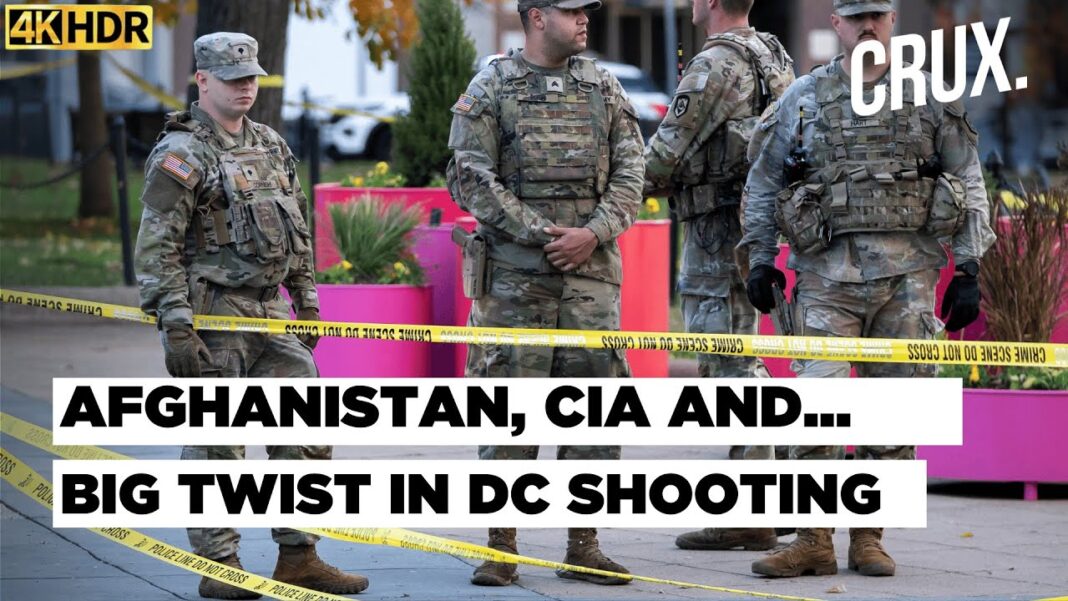
According to law enforcement, at 2:15 PM near the White House perimeter, Lakanwal ambushed two unarmed National Guardsmen on duty—opening fire and reportedly shouting the jihadist war cry “Allahu Akbar.”
National Guardsman Andrew Wolfe was critically injured. On Thursday afternoon, Guardsman Sarah Beckstrom, just 20 years old, succumbed to her injuries.
President Trump addressed the nation shortly after: “She’s no longer with us. She’s looking down at us right now. Her parents are with her.”
The brazenness of the attack—its location, its timing, and the identity of the shooter—sent shockwaves through the national security community.
One of the most chilling details uncovered by independent analysts involves public Google Trends data: searches for “Rahmanullah Lakanwal” spiked in the DC region hours before the shooting. This does not confirm operational coordination or foreknowledge. But it raises pressing questions about who was searching his name and why, whether the searches originated from foreign or domestic networks and whether this was a coincidence or a missed intelligence flag.
Experts argue that Congress should subpoena the IP and metadata to determine whether the spike reflects a deeper threat or a coordinated signal.
The emerging facts leave Americans facing a battery of deeply unsettling questions: How did someone with this military and intelligence-linked background enter the U.S. with limited scrutiny? Who vetted him in 2021 and again in 2024? Why was he not monitored after arrival—especially given his service in a covert paramilitary unit?
Who else from the Kandahar Strike Force or QSF units entered the U.S. through the rushed SIV pipeline? Where are they now, and what oversight exists? Did the intelligence community lose track of individuals it once trained and armed?
The answers to these questions could expose systemic vulnerabilities left behind by the 2021 evacuation—vulnerabilities that may now be surfacing in deadly fashion.
This incident cannot be dismissed as a lone act of violence. According to multiple analysts, it reflects structural breakdowns involving intelligence vetting, interagency communication, counterterror monitoring, refugee intake systems and post-withdrawal oversight gaps.
If the U.S. government trained and armed Lakanwal, then admitted him into the country without appropriate safeguards, the implications are profound.
It would mean the United States inadvertently re-imported highly trained warfighters from a CIA-associated unit straight into the American homeland—with little to no post-entry tracking.
Calls for a comprehensive investigation are rising across the political spectrum. Lawmakers are demanding clarity on how many Afghan paramilitary personnel have entered the U.S, what the government knew about their backgrounds, whether any were radicalized before or after arrival, and whether systemic failures in the withdrawal created long-term domestic risk.
For now, the administration remains tight-lipped. But the questions will not go away.
What began as a simple news alert—“an Afghan national opened fire near the White House”—has evolved into a far more complex and alarming national security scandal.
Based on what has now surfaced through open-source records, major news outlets, and former intelligence officials, this case touches upon covert CIA-linked paramilitary units, Special Forces alliances, SIV admission during a chaotic evacuation, asylum approval, open-source digital anomalies and fatal domestic violence involving American soldiers.
This story is no longer about immigration. It is no longer simply about a tragic attack.
It is about whether the United States imported a war it believed it had left behind—and whether failures in intelligence, vetting, and oversight have placed Americans in danger.
The public deserves answers. The families of the fallen deserve transparency.
And the nation deserves a full accounting of how a former U.S.-trained commando ended up murdering American service members in the shadow of the White House.
This is an excellent summary of a complex story that is fast evolving. When I want reportage, this is what I expect.