



By: Fern Sidman
A dramatic escalation in the ongoing conflict between Israel and Iran unfolded Thursday afternoon, as a barrage of missiles launched from Iranian territory targeted broad swaths of northern and central Israel. Among the most significant developments was a direct hit on the Bazan oil refinery complex in Haifa Bay—a critical node in Israel’s energy infrastructure—raising alarm across the country while simultaneously underscoring the evolving nature of the confrontation.
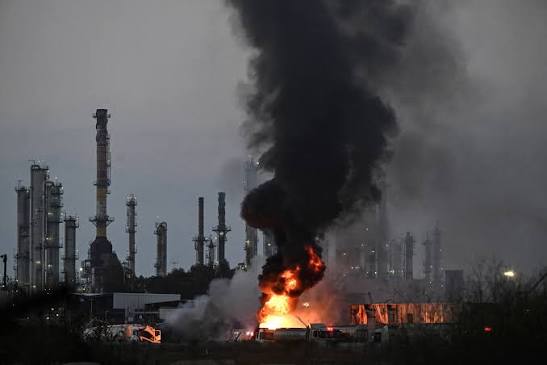
According to a report on Thursday at Israel National News, the Israeli military censor cleared for publication that one of the incoming missiles struck the refinery site, igniting a fire that required an immediate and coordinated emergency response. While the incident sparked widespread concern over potential environmental and industrial hazards, authorities have thus far confirmed that no injuries were reported, and fears of a hazardous material leak were ultimately unfounded.
The Bazan refinery, situated along the Haifa Bay, is one of Israel’s most vital industrial installations, responsible for a substantial portion of the nation’s fuel production and energy processing. Its strategic importance makes it a high-value target in any conflict scenario, and Thursday’s strike represents a significant moment in the current hostilities.
As reported by Israel National News, the missile impact triggered a large-scale firefighting operation, with crews rushing to contain the blaze and prevent it from spreading to adjacent facilities. The rapid response by emergency services appears to have been instrumental in mitigating what could have been a far more severe incident.
Despite the intensity of the strike, officials confirmed that the structural damage was limited and that no critical systems were compromised to the extent initially feared.
The immediate aftermath of the strike was marked by a surge of emergency activity across the Haifa region. Firefighters, supported by specialized response units, worked to extinguish the flames and secure the site. At the same time, infrastructure teams assessed the impact on surrounding systems, including the regional power grid.
Residents in the Haifa Bay area reported temporary power outages, a development that heightened anxiety in an already tense environment. However, Energy and Infrastructure Minister Eli Cohen sought to reassure the public, emphasizing that the disruptions were both localized and manageable.
“The damage to the power grid in the north is localized and not significant,” Cohen stated, according to Israel National News. “Israel Electric Corporation teams are already on site and have restored electricity to most of those affected.”
His remarks highlighted the resilience of Israel’s infrastructure and the capacity of its emergency services to respond effectively under pressure. Within hours, electricity had been restored to the majority of affected areas, with work continuing to address the remaining outages.
The strike’s impact extended beyond the immediate physical damage, reverberating through financial markets. Shares of Bazan, the company operating the refinery, fell sharply—closing down 7.9 percent on the Tel Aviv Stock Exchange.
This decline reflects investor concerns about the vulnerability of critical infrastructure in times of conflict, as well as the potential for further disruptions. As noted in coverage by Israel National News, such market reactions are indicative of the broader economic implications of the ongoing hostilities.
While the long-term effects remain uncertain, the incident underscores the interconnected nature of security and economic stability, particularly in a region where geopolitical tensions can have immediate financial consequences.
In the wake of the strike, Iranian state media presented a markedly different account of events. According to Iranian television reports, a power station in Haifa had “exploded,” with the incident framed as a retaliatory act in response to previous Israeli strikes on Iranian gas facilities.
This narrative, as reported by Israel National News, is part of a broader pattern of information warfare, in which competing sides seek to shape public perception and assert strategic messaging.
Israeli officials, however, have rejected these claims, emphasizing that the damage was contained and that no major infrastructure failures occurred. The divergence between these accounts highlights the role of media and messaging in modern conflict, where the battle for narrative can be as significant as the physical engagements themselves.
Thursday’s missile barrage is the latest in a series of escalating exchanges between Israel and Iran, reflecting a shift toward more direct and sustained confrontation. The targeting of infrastructure sites, in particular, signals a willingness to expand the scope of the conflict beyond traditional military objectives.
As Israel National News has observed, such developments raise important questions about the trajectory of the conflict and the potential for further escalation. The use of missiles against civilian and industrial targets increases the risk of unintended consequences, including environmental damage and broader regional instability.
For residents of northern Israel, the strike has reinforced a sense of vulnerability, even as the absence of casualties has provided a measure of relief. The sight of flames rising from a major industrial site, combined with temporary power outages, served as a stark reminder of the proximity of the conflict.
At the same time, the swift restoration of services and the effective response by emergency personnel have contributed to a sense of resilience. Public confidence in the country’s defense systems and infrastructure remains a critical factor in maintaining stability during periods of heightened tension.
From a strategic perspective, the targeting of the Bazan refinery may reflect an effort by Iran to exert pressure on Israel’s economic and energy sectors. By striking at key infrastructure, such actions aim to create both immediate disruption and longer-term uncertainty.
However, the limited damage and absence of casualties suggest that the strike fell short of achieving its most severe potential outcomes. This raises questions about the effectiveness of such tactics and the broader strategic calculus underpinning them.
The missile strike on the Haifa refinery stands as a dramatic episode in an increasingly volatile conflict, illustrating both the risks and the limits of escalation. While the attack targeted a critical asset and generated significant concern, its ultimate impact was contained—a testament to the preparedness and resilience of Israel’s emergency and infrastructure systems.
As chronicled by Israel National News, the incident serves as both a warning and a reminder: a warning of the dangers inherent in the current trajectory, and a reminder of the capacity to withstand and respond to such challenges.
In the days ahead, the focus will likely remain on preventing further escalation while maintaining readiness for potential developments. For now, the flames over Haifa have been extinguished—but the broader conflict continues to burn, with its outcome still uncertain.
