



|
Getting your Trinity Audio player ready...
|
By: Fern Sidman
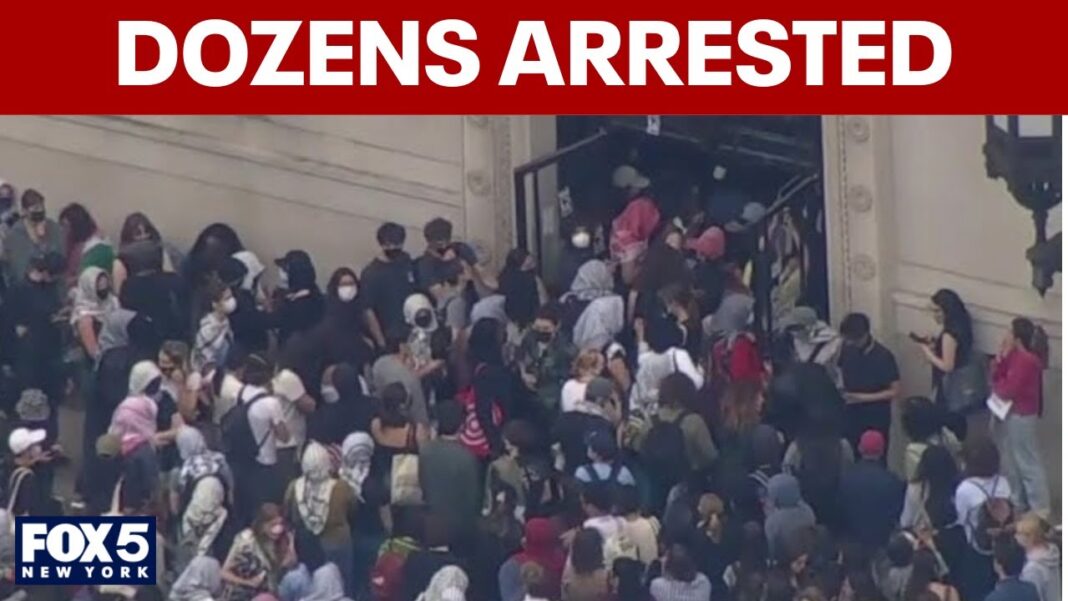
Chaos erupted once again at Columbia University on Wednesday when dozens of anti-Israel demonstrators stormed Butler Library, turning the campus’s most iconic academic building into a site of lawlessness and disruption. According to a report in The New York Post, nearly 80 protesters were hauled away in zip ties by NYPD officers after occupying the library for five hours — chanting, vandalizing, and forcing a complete shutdown of the space during the critical final exam season.
The action, captured in dramatic video obtained by The New York Post, showed lines of masked agitators being escorted out of the library and loaded onto waiting police buses. Many had refused to leave voluntarily unless permitted to do so without identification — a demand Columbia Public Safety rejected.
The fallout extended well beyond the university gates. Secretary of State Marco Rubio condemned the demonstrators and vowed a federal response, declaring on X: “We are reviewing the visa status of the trespassers and vandals who took over Columbia University’s library. Pro-Hamas thugs are no longer welcome in our great nation.”
His remarks reflect a growing push from lawmakers to scrutinize the status of international students involved in disruptive and antisemitic campus activism.
The protest began around 3:30 p.m., when demonstrators shoved past a security guard at the front entrance of Butler Library, according to eyewitness video and reports from The New York Post. Once inside, the group draped Palestinian flags and banners over bookshelves and began beating drums and chanting slogans like “Free, Free Palestine.” One of the banners named Bassel al-Araj, a Palestinian militant killed by the IDF in 2017 — though his name was misspelled “Basel.”
Photos published by The New York Post reveal the extent of the vandalism. Protesters defaced library walls, scrawled threatening messages like “Columbia Will Burn” on glass cases, and used colored tape to mark up desks and tables. Keffiyeh-clad activists danced on furniture and covered common study areas with political paraphernalia.
As the mob swelled inside, public safety officers formed a defensive line to contain the group — but were overwhelmed. Two officers were injured, officials confirmed to The New York Post.
Acting Columbia President Claire Shipman issued a sharp rebuke of the protesters, calling their actions not only disruptive but dangerous.
“Requesting the presence of the NYPD is not the outcome we wanted, but it was absolutely necessary to secure the safety of our community,” Shipman said in a statement cited by The New York Post. “Disruptions to our academic activities will not be tolerated… Columbia strongly condemns violence on our campus, antisemitism, and all forms of hate and discrimination, some of which we witnessed today.”
Shipman also noted that some of the arrested individuals were not affiliated with Columbia, raising questions about external agitators infiltrating student-led movements. This follows a growing pattern seen at other campus demonstrations in recent months, where non-student organizers have played significant roles in instigating violence and vandalism.
The incursion into Butler Library — a sanctuary for serious study during finals — left many students shaken and displaced.
“Somebody hung up a flag, posters, stickers, people were scribbling on the walls, dancing on the tables, singing … Chanting like, I don’t know, ‘Free Palestine,’ the classics,” said one international student in an interview with The New York Post. The young woman, who declined to be named for fear of retaliation, said she was among dozens forced to evacuate and abandon their exam preparation.
Others voiced outrage online. Columbia student Eden Yadegar, a Middle East Studies major, posted on X: “Why are the protestors able to continue disrupting the basic function of our university while all other students have to pay the consequences?”
New York City Mayor Eric Adams supported Columbia’s call for NYPD intervention. In a statement, Adams made clear the city “will never tolerate lawlessness” and affirmed that the arrests were conducted at the university’s request.
In a message of solidarity aimed directly at Jewish students, Adams declared, “To Jewish New Yorkers, especially the students at Columbia who feel threatened or unsafe attending class because of these events: Know that your mayor stands with you and will always work to keep you safe,” as reported by The New York Post.
Adams did not mince words in addressing both the demonstrators and their families: “To parents of students protesting: Call your children and make clear that breaking the law is wrong and they should exit the building immediately. To those protesting on campus who do not attend Columbia: Exit the campus immediately or you will be arrested.”
Reaction from Jewish community leaders was swift and pointed. Mark Treyger, head of the Jewish Community Relations Council, condemned the masked takeover in unambiguous terms: “It is unsafe, unbelievable, and unacceptable to have fully masked strangers barging into learning institutions,” Treyger told The New York Post. “This is not normal under any circumstance.”
Jewish faculty and staff also praised the university’s response, posting online, “Columbia leadership deserves tremendous credit for swiftly restoring order to Butler Library so that students can study for final exams. Invading a library to disrupt exam studying is not peaceful protest.”
They further urged both Columbia and local authorities to follow through with disciplinary action: “We expect the University to follow through on its commitment to hold the participating students accountable… and we call on the NYPD and the Manhattan District Attorney’s Office to do the same for non-affiliates.”
According to The New York Post, Columbia’s Office of Public Affairs acknowledged that school security responded quickly when the protest began, but noted that demonstrators refused to identify themselves — a tactic that may lead to further legal consequences.
The university had been bracing for renewed unrest amid rumors that protesters intended to re-establish the tent encampments that paralyzed Columbia for much of the spring. This latest incident confirmed those fears and placed additional pressure on the university to follow through on its pledge to create a safer, more accountable environment.
Columbia’s response to campus antisemitism has drawn intense scrutiny from the federal government, especially from the Trump administration, which has threatened to withdraw $400 million in federal grants unless the school takes meaningful action to root out hate and protect its Jewish community.
As The New York Post previously reported, Columbia in March agreed to several of the administration’s key demands, including empowering 36 campus security officers with arrest authority, restructuring leadership in the Middle East, South Asian, and African Studies departments, as well as the Center for Palestine Studies, and banning mask-wearing during student demonstrations that violate school policy.
The crackdown on masked protests comes in direct response to the dangerous anonymity that has emboldened agitators, many of whom are not even affiliated with Columbia.
Amid these developments, Columbia also announced it would terminate or decline to renew nearly 180 staff positions, most tied to federally funded academic research. The New York Post reported that in a statement issued Tuesday, Acting President Claire Shipman said the layoffs were an unavoidable consequence of the grant suspensions tied to the school’s inaction on antisemitism.
“Across the research portfolio we have had to make difficult choices and unfortunately, today, nearly 180 of our colleagues who have been working, in whole or in part, on impacted federal grants, will receive notices of non-renewal or termination,” Shipman explained, as reported by The New York Post.
The decision reflects not only a tightening budget but a larger institutional shift toward accountability, driven by external oversight and internal demands for reform.
The arrests in Butler Library mark a pivotal moment in Columbia’s ongoing battle against campus antisemitism. With high-level backing from city officials like Mayor Adams and federal pressure from Washington, the university appears to be moving — albeit belatedly — toward restoring order and reaffirming its commitment to student safety.
As The New York Post report noted, the university now faces the challenge of maintaining momentum: enforcing its rules, following through on promised disciplinary actions, and ensuring that Jewish students can participate fully in campus life without fear.
For many in the Columbia community, this week’s actions represent a long-overdue shift. For others, including those whose lives have been disrupted or whose safety has been threatened, the stakes remain higher than ever. The question now is whether Columbia will hold the line — or return to a status quo that allowed such chaos to take root in the first place.
