



|
Getting your Trinity Audio player ready...
|
By: Fern Sidman
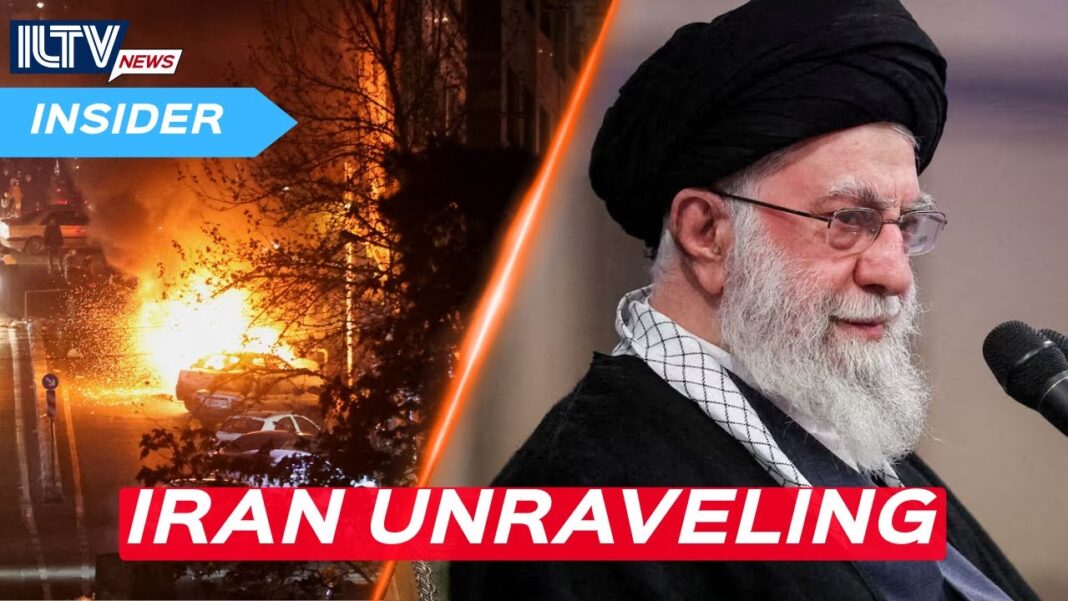
By any measure, Tuesday evening’s emergency session of Israel’s security cabinet marked one of the most consequential closed-door gatherings in Jerusalem in years. According to multiple senior officials cited in a report on Tuesday by VIN News, the meeting was hastily moved forward as intelligence assessments from across the region converged on a singular, unsettling conclusion: the Islamic Republic of Iran is no longer merely facing unrest—it is confronting the most serious internal challenge to its survival in decades.
The cabinet’s deliberations, attended by Prime Minister Benjamin Netanyahu and the heads of Israel’s principal intelligence agencies, were not about distant hypotheticals. They were about contingency, timing and the dangerous intersection of Iranian instability with American resolve.
Ordinarily, the Israeli security cabinet follows a carefully calibrated calendar, its agenda shaped by the steady rhythm of regional crises. This time, however, that cadence was shattered. The session, originally slated for later in the week, was abruptly advanced to Tuesday evening after fresh assessments from Tehran suggested a rapid deterioration in the regime’s grip on power.
Sources familiar with the discussions told VIN News that ministers were briefed on the possibility—no longer theoretical—of a cascading collapse of Iranian authority, a scenario that until recently had been treated in Jerusalem as improbable, if not implausible.
What forced the acceleration was not only the scale of the protests rippling through Iranian cities, but the emerging view inside Israel’s intelligence community that President Trump has already decided to intervene in some form. The scope, method and timing of that intervention remain opaque, but Israeli planners are operating under the assumption that Washington is preparing to move beyond rhetoric.
According to the information provided in the VIN News report, the meeting was attended by senior officials from the Mossad, Shin Bet and the Israel Defense Forces. Each came armed with updated situational analyses—snapshots of a regime under siege from within, struggling to contain demonstrations that have spread across urban and provincial centers alike.
The Mossad’s briefing reportedly focused on the Iranian leadership’s internal fractures: evidence of faltering loyalty within key bureaucratic and security structures, a proliferation of defections at lower levels, and an increasingly frantic propaganda apparatus.
The Shin Bet, Israel’s internal security service, addressed the domestic implications of any Iranian upheaval—particularly the likelihood of Iranian proxies in Gaza, Lebanon and in the Judea and Samaria region of Israel, attempting diversionary escalations to draw attention away from Tehran.
The military brass, for their part, outlined a spectrum of operational scenarios. While no decision was taken to authorize action, the IDF was instructed to maintain a heightened state of readiness, particularly along the northern frontier.
Central to the cabinet’s deliberations was the evolving posture of the United States. According to information contained in a Reuters report, Israeli ministers were told that Trump has concluded that passive observation is no longer tenable if the Iranian regime continues its violent crackdown.
Yet even as Washington signals readiness, Jerusalem remains acutely aware of the asymmetry of influence. Any meaningful Israeli action against Iran, cabinet members reportedly agreed, would have to be synchronized with the White House. Acting alone—however tempting—could fracture regional stability at precisely the moment when Iranian weakness presents both peril and opportunity.
For Netanyahu, whose career has been defined by warnings about Iran, the moment carries an almost historic gravity. After decades of sounding the alarm about Tehran’s ambitions, he now faces the paradox of a regime collapsing under the weight of its own repression, potentially without a single Israeli missile ever being fired.
The emergency meeting unfolded against a region still struggling to emerge from the shadow of war. The Gaza ceasefire brokered in October 2025, part of a U.S.-backed peace initiative, remains brittle. Phase II of that framework—designed to demilitarize Hamas and establish a “Board of Peace” to supervise reconstruction—has stalled.
As VIN News has reported, Israel continues to insist on full Hamas disarmament and the return of the remains of the final hostage before moving forward. In the meantime, Israeli forces have maintained a campaign of targeted strikes in Lebanon against Hezbollah infrastructure, notwithstanding the November 2024 truce nominally in effect.
These unresolved theaters form the backdrop to the Iranian crisis, creating a web of interdependence that leaves little margin for miscalculation.
What makes the Iranian situation uniquely volatile is the uncertainty surrounding the regime’s own calculations. Cabinet members were told that Tehran is operating in a reactive mode, oscillating between public defiance and private desperation. Internet blackouts, mass arrests and lethal force have not quelled dissent; if anything, they appear to have radicalized it.
According to briefings cited by VIN News, Israeli analysts believe that the longer the protests persist, the greater the likelihood that Iran’s leadership will seek an external confrontation to reassert authority. The list of potential targets is depressingly familiar: U.S. bases in the region, Israeli assets abroad, or an orchestrated escalation via Hezbollah.
It is this prospect—of a cornered regime lashing out—that dominated the later stages of the cabinet’s discussion.
Despite the charged atmosphere, Tuesday’s meeting concluded without a formal decision to act. Officials emerging from the session described the moment as one of “exceptional gravity,” a phrase that has become shorthand in Jerusalem for crises that resist immediate resolution.
Yet the absence of a declaration should not be mistaken for inertia. The cabinet reportedly agreed on a set of preparatory steps: intensified intelligence collection, expanded coordination channels with Washington, and contingency planning for scenarios ranging from Iranian regime implosion to a multi-front escalation involving Hezbollah and Hamas.
Israel is not positioning itself as the catalyst of regional upheaval, but as a state preparing for the shockwaves of an upheaval that may already be underway.
What emerges from the reports is a portrait of leadership navigating between restraint and readiness. Netanyahu’s government understands that history rarely announces its turning points in advance. The fall of the Soviet Union, the Arab Spring, the implosion of Saddam Hussein’s Iraq—each caught regional actors off guard, often at tremendous cost.
This time, Israel is determined not to be surprised.
Yet the cabinet’s caution also reflects a deeper dilemma. An Iranian regime collapse could usher in a more moderate order—or it could fracture the country into competing power centers, each armed, resentful and unpredictable. For Israel, the former would be a strategic victory; the latter, a nightmare scenario.
For now, Jerusalem is watching Tehran with the intensity of a chess grandmaster studying an opponent’s trembling hand. The next move may come from Washington, from within Iran itself, or from a miscalculation that no cabinet meeting can forestall.
As VIN News reported, officials left the room not with certainty, but with a sharpened awareness of how thin the line has become between internal Iranian unrest and a regional conflagration.
The security cabinet will reconvene soon—perhaps within days—its agenda shaped by events unfolding hundreds of miles east, in streets where chants, sirens and gunfire are rewriting the Middle East’s balance of power in real time.
