



|
Getting your Trinity Audio player ready...
|
By: Fern Sidman – Jewish Voice News
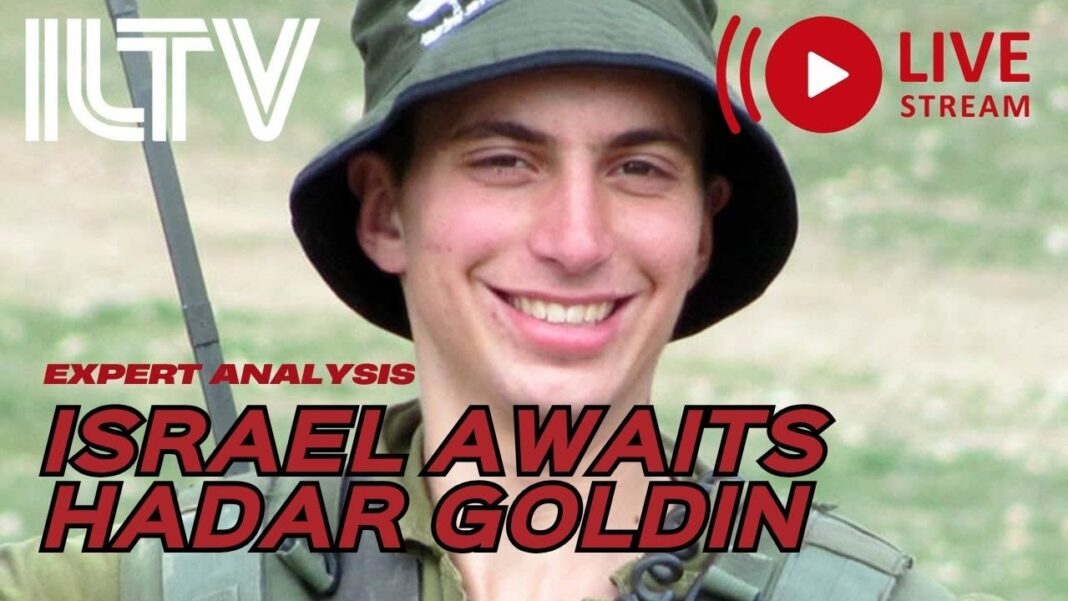
In a moment of profound national mourning and bittersweet closure, the State of Israel announced the return of Lieutenant Hadar Goldin’s body—eleven years after he was abducted and killed by Hamas terrorists during Operation Protective Edge in 2014. The announcement, confirmed by the Israel Defense Forces (IDF) and the Prime Minister’s Office, marks the end of one of the most enduring and agonizing ordeals in Israel’s modern history—a saga that has come to symbolize both the cruelty of Israel’s enemies and the unyielding faith of a family that refused to give up hope.
According to a report on Sunday at Israel National News, forensic experts at the National Institute of Forensic Medicine, working in cooperation with the Israel Police and the Military Rabbinate, formally identified the recovered remains as belonging to Lt. Goldin. Representatives of the IDF personally notified his parents, Leah and Simcha Goldin, that their son’s body had finally been returned for burial in Israel.
The long-awaited moment brought both relief and sorrow to a nation that has followed the Goldin family’s struggle for more than a decade. For 4,118 days and nights, the family waged an unrelenting campaign for Hadar’s return—petitioning governments, pleading before the United Nations, and urging successive Israeli leaders to bring him home. Throughout this time, Israel National News frequently chronicled their emotional appeals and their resolute insistence that the State of Israel must never leave its fallen soldiers behind.
Lieutenant Hadar Goldin was just 23 years old when he fell in battle on August 1, 2014, during one of the most volatile phases of Operation Protective Edge. He served as a platoon commander in the elite Givati Brigade’s reconnaissance unit, leading his men with distinction and valor.
The day he fell, a ceasefire between Israel and Hamas had supposedly taken effect. But as Israeli troops moved through the dense urban landscape of Rafah, Hamas militants exploited the lull, ambushing the unit and abducting Hadar amid heavy gunfire. The attack—later condemned by Israel and the United Nations as a blatant violation of the ceasefire—ignited what became known as the “Hannibal Protocol” incident, triggering intense combat to prevent the kidnappers from escaping with their captive.
Despite Israel’s efforts, Hadar was taken into Gaza, and for eleven years, his body remained in Hamas’s hands—a grim bargaining chip in the terrorist group’s calculated campaign of psychological warfare. His family’s anguish was compounded by Hamas’s cynical manipulation of the case, repeatedly releasing propaganda videos and false claims about his condition.
As reported by Israel National News, Hadar Goldin was remembered not only as a soldier but as a young man of profound depth, creativity, and moral strength. Together with his twin brother, Tzur, he grew up in Kfar Saba, where the two were inseparable—sharing a love of music, art, and faith. They both served as youth counselors in Bnei Akiva, and later studied at the Bnei David pre-military academy in Eli, an institution known for shaping Israel’s finest leaders and officers.
Hadar’s commanding officers described him as a soldier who “led by example,” combining compassion with courage. He was known for his quiet humility and unshakable sense of duty—a man who, as one colleague put it, “brought light into every room, even in the shadow of war.”
A gifted artist, Hadar left behind sketches, poems, and reflections that revealed a deeply spiritual soul grappling with questions of purpose and morality. His work, later compiled by his family into a book titled “A Hero in White,” continues to inspire young Israelis who serve in the IDF today.
Prime Minister Benjamin Netanyahu, addressing the Cabinet on Sunday, acknowledged the emotional weight of the moment, telling ministers that “Lt. Hadar Goldin fell in a heroic battle during Operation Protective Edge eleven years ago. His body was taken hostage by Hamas, which refused to return him all this time. Throughout this period, Israeli governments made great efforts to bring him back.”
As Israel National News reported, Netanyahu went on to express his gratitude to the IDF, the Israel Security Agency (Shin Bet), and the intelligence community for their perseverance in tracking Hadar’s whereabouts throughout the years of Hamas captivity. “This has been amidst the great agony of his family,” Netanyahu said, “which will now, at last, be able to give him a Jewish burial.”
The Prime Minister’s words underscored a cornerstone of Israel’s national ethos: that no soldier is ever forgotten, and the bond between the IDF and its soldiers extends beyond the battlefield, even into eternity.
According to the information provided in the Israel National News report, the operation to recover Goldin’s remains required a complex fusion of intelligence gathering, covert negotiation, and international mediation. Israel’s security agencies—particularly the IDF’s Unit 504, the Military Intelligence Directorate, and the Shin Bet—worked continuously for more than a decade to trace the chain of custody of Hadar’s body through Gaza’s terrorist networks.
Recent progress was reportedly made amid intensified Israeli operations in Rafah during the current conflict with Hamas, which weakened the terror group’s command structure and forced it into negotiations over multiple hostage files.
A diplomatic source told Israel National News that Israel viewed the delay in returning Hadar’s body as “a grave violation of humanitarian principles.” The source added, “Israel demands his immediate return and will not allow Hamas to extract political or military concessions over what is a moral obligation under international law.”
In recent days, Hamas sought to use the return of Hadar’s body as leverage in ongoing negotiations, allegedly offering to hand over his remains in exchange for the release of 150 terrorists trapped in a tunnel network in Rafah. Israeli officials flatly rejected the demand.
Instead, the exchange was mediated through the International Committee of the Red Cross, which coordinated the handover. On Saturday, Al Jazeera broadcast footage of Hamas and Red Cross teams arriving at a tunnel and extracting a body bag labeled “Hadar Goldin” in Hebrew, English, and Arabic—a video Israel later verified as authentic.
Since his abduction, Hadar’s parents, Leah and Simcha Goldin, have become moral beacons in Israel’s public life. Their advocacy—rooted in grief but guided by faith—transcended politics, embodying the national pledge that no soldier will ever be abandoned.
Leah Goldin, a university lecturer and a tireless activist, confronted world leaders and international organizations for years, demanding pressure on Hamas to return her son and other captives. Speaking before the United Nations Human Rights Council, she declared, “You cannot speak of human rights and ignore the humanity of my son, whose body is held hostage by terrorists.”
Their campaign galvanized the Israeli public, uniting people across political and religious divides. Israel National News has frequently featured the Goldin family’s appeals and their insistence that Israel condition all humanitarian aid to Gaza on the return of its missing soldiers and civilians.
With Hadar’s return, Leah and Simcha have finally achieved what many thought impossible. Yet the pain remains profound. “This is not the end,” one family friend told Israel National News. “It is a new beginning—a moment of closure mixed with heartbreak.”
Even as Israel mourns and honors Hadar’s return, four other deceased hostages remain in Hamas captivity: Ran Gvili, a Yasam officer; Meny Godard and Dror Or, both civilians murdered in the October 7 massacre; and Sudthisak Rinthalak, a Thai agricultural worker also killed that day.
Israel’s defense establishment has vowed to continue working for the recovery of all the bodies, as well as the release of any remaining living hostages still held in Gaza.
Lt. Hadar Goldin’s story is not only that of a soldier who fell in battle—it is the story of a people who refuse to surrender their values, even in the face of barbarism. His homecoming, after eleven long years, reaffirms Israel’s sacred covenant between the nation and those who defend it: that every life matters, every loss is remembered, and every fallen hero will, one day, come home.
In the words of Israel National News, which has chronicled his journey from Rafah to redemption: “Hadar Goldin’s return reminds us that even after years of darkness, the light of faith, perseverance, and love for Israel can never be extinguished.”
After 4,118 nights of waiting, Hadar Goldin has finally come home—not merely to his family, but to the eternal embrace of a grateful nation.