



|
Getting your Trinity Audio player ready...
|
By: Fern Sidman
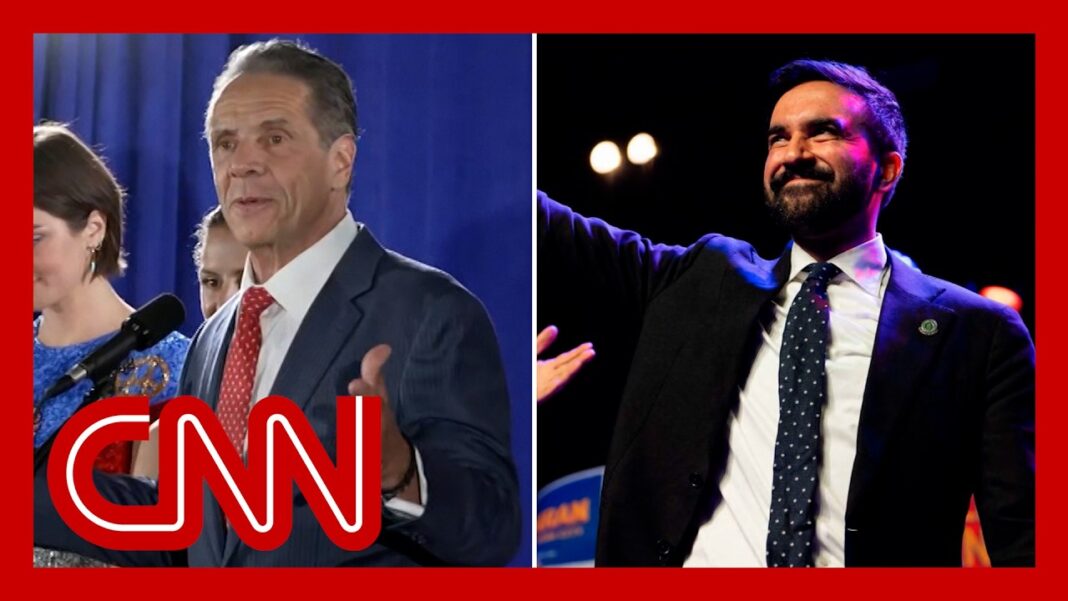
In what has rapidly become the pivotal political moment of New York City’s mayoral season, former Governor Andrew Cuomo conceded Tuesday night to freshman Assemblyman Zohran Mamdani, as reported by The Associated Press. With more than 80% of ballots counted and neither candidate securing a clear majority, the outcome now rests on the mechanics of ranked-choice voting. Yet Cuomo’s concession effectively seals the deal, setting in motion a possible watershed moment in the city’s history.
“I congratulate Zohran Mamdani on what appears to be a victory tonight,” Cuomo told supporters. “He has won, and we will take a look and make some decisions.” He added, perhaps succinctly summarizing a campaign defined by dual narratives of redemption and renewal: “Tonight is his night.” The Associated Press confirmed that Cuomo’s announcement came as his lead dwindled and Mamdani began a steady climb, marking a dramatic realignment of political winds in the city.
But Mamdani’s rise has ignited deep concerns — criticism that he embodies a radical ideology threatening the city’s stability, social cohesion, and particularly, its Jewish community.
Once little known beyond select progressive circles, Mamdani has seized the Democratic nomination with a campaign driven by radical promises: guaranteed free public transit, expanded paid child care, rent freezes, city-owned supermarkets, and a $30/hr minimum wage — all funded by steep tax hikes on the wealthy
The Associated Press noted that endorsements from progressive firebrands like Rep. Alexandria Ocasio‑Cortez and Sen. Bernie Sanders, combined with grassroots energy, snowballed into a late surge
Yet behind the youthful excitement lies a radical left agenda that risks alienating major swaths of the electorate and upending longstanding traditions, particularly regarding public safety and foreign relations.
Perhaps the most contentious of Mamdani’s proposals is police reform. He has publicly called for defunding the NYPD and replacing it with a Department of Community Safety — a concept critics argue would dangerously weaken law enforcement
With crime rates still a focus across the city, his stance unnerves many who worry about rising crime, especially in underserved neighborhoods.
Financially, his vision teeters on the brink of fantasy, with many analysts questioning how New York could sustain universal services without precipitating a tax exodus. The Associated Press reported his plans rely heavily on state-level cooperation — a tenuous assumption given the Legislature’s centrists.
Mamdani’s public record reveals a disturbing alignment with anti-Israel activism and rhetoric that is blatantly antisemitic. He co-founded a Students for Justice in Palestine chapter, supports the Boycott, Divestment, and Sanctions (BDS) movement, and introduced legislation targeting New York–based funding for groups supporting Israeli settlements — actions denounced by critics as anti-Israel and antisemitic, as was noted in The New York Post.
The Associated Press reported that Mamdani declined to sponsor resolutions affirming Israel’s independence or commemorating the Holocaust — omissions that Jewish leaders called politically tone-deaf at a time when antisemitic incidents were on the rise . He has defended himself, citing freedom of conscience and asserting that such votes are symbolic, not substantive. He also went on record saying that if Israeli Prime Minister Benjamin Netanyahu were ever to come to New York City, he would have him arrested as he firmly believes he is a war criminal.
In a June 19 Politico profile, Jewish leaders accused Mamdani of crossing a line into antisemitism in his criticisms of Israel
His refusal to condemn the slogan “globalize the Intifada,” interpreted by most of New York’s Jewish leadership as a call for violence against Jews, drew particularly sharp rebuke.
Although Mamdani described the phrase as symbolic of Palestinian rights, experts warn that its violent undertones are unmistakable.
Furthermore, The Times of Israel reported Mamdani saying that Israel “wouldn’t let him visit if he became mayor” — indicating a willingness to break from tradition and alienate Jewish New Yorkers
The potential election of a mayor viewed as hostile to the city’s Jewish population and law enforcement does not resonate as progressive triumph to all. Many Jewish New Yorkers, as documented by Politico and Associated Press polling, have expressed alarm at Mamdani’s positions, warning of a city leadership that may pursue divisive agendas weakening communal unity.
Earlier this week, an offensive campaign message — citing a terror survivor in support of Mamdani — sparked outrage, with critics condemning the exploitation of trauma for political gain.
Cuomo, despite his own deeply troubled past, entered the primary as the experienced, pragmatic choice. By comparison, Mamdani’s untested ideology and unachievable economic promises stand in stark relief. Cuomo repeatedly emphasized Mamdani’s lack of managerial credentials in debates, warning of the risk of entrusting the city’s $115 billion budget and its 300,000 employees to unproven leadership.
When Cuomo challenged Mamdani on infrastructure experience, Mamdani’s retort — “I have never resigned in disgrace” — struck a defiant chord but did little to assuage concerns about his readiness
Mamdani’s breakthrough signals a leftward shift among younger progressives disillusioned with establishment politics. His rise marks the most dramatic electoral show of force by the democratic socialist movement since 2020. Time magazine called his surge “a seismic moment for the left,” but cautioned the associated backlash from centrists and moderates
Yet as The Associated Press reported, the critical question now becomes whether Mamdani can build a broader coalition — one that extends beyond his youthful following to ethnic enclaves and moderate Democrats concerned about practical governance.
The upcoming general election is shaping into a fractured contest. Incumbent Mayor Eric Adams, running independently amid corruption allegations later dropped by the Justice Department, remains viable. Republican Curtis Sliwa also joins the mix. The Associated Press noted that an independent Cuomo bid could further fragment the vote.
The prospect of Mamdani facing a split opposition means the ultimate result may be decided not on vision, but ballot arithmetic.
House Republican Leadership Chairwoman Elise Stefanik released a fiery statement, denouncing Mamdani as a “radical, Defund-the-Police, Communist, raging Antisemite” and blaming Governor Hochul and Democrats for enabling his candidacy . While politically charged, her words encapsulate the deep anxiety shared across ideological lines about a potential mayor who could redefine New York along sweeping, uncompromising lines.
The Associated Press report underlined the significance of Mamdani’s lead, calling it a signal of generational and ideological transformation.
But as New York braces for a possible radical pivot, questions of readiness, responsibility, and unity loom large.
For many voters — Jewish, moderate, or simply wary of unanswered questions — the risks are clear. In electing Mamdani, the city may gain a torchbearer for progressive ideals. But it also risks the unraveling of longstanding civic institutions, community trust, and global relations — consequences that will define the city for years to come.
