



|
Getting your Trinity Audio player ready...
|
By: Fern Sidman
As twilight descended over Upper Manhattan on Tuesday evening, a stretch of concrete stairway near the 181st Street 1 train station—ordinarily a nondescript conduit between street and platform—was transformed into the scene of a sudden and brutal assault. A student of Yeshiva University was set upon by a group of masked individuals and left injured badly enough to require hospitalization, according to authorities and community accounts. The incident, reported on Thursday evening by VIN News and corroborated through neighborhood sources, has sent tremors of fear and indignation through a community already sensitized by a succession of attacks that have unsettled New York’s Jewish population in recent years.
Silence is the scandal.
A Jewish student is beaten in a NYC subway and @NYCMayor can’t be bothered to immediately speak.
Remember that. https://t.co/vkKmPkrDVX— Kathleen Wood (@KathleenWood730) February 13, 2026
VIN News reported that the attack occurred at approximately 7 p.m., a liminal hour when commuters pour through transit nodes in the fading light, and when students, returning from classes or evening prayers, traverse familiar routes with an almost automatic trust in their surroundings. That trust, in this instance, proved tragically misplaced. The assault unfolded on a staircase described by witnesses as a known “blind spot,” an infrastructural lacuna bereft of both police presence and surveillance cameras. According to the information provided in the VIN News report, between six and eight assailants were involved, their faces concealed, their intentions—at least for now—opaque.
The anonymity of the attackers and the absence of clear motive have compounded the sense of disquiet. Authorities have not yet determined what precipitated the violence, leaving open the question of whether the student was targeted for personal reasons, opportunistic criminality, or bias. In the absence of clarity, speculation has proliferated within the community, fueled by the grim recognition that masked group attacks, staged in poorly monitored urban recesses, are often calculated precisely to exploit the vulnerabilities of public infrastructure.
The staircase itself has become an inadvertent symbol in the wake of the assault. Residents interviewed by VIN News described the location as a long-acknowledged hazard, a place where the city’s promise of ubiquitous surveillance and rapid response frays at the edges. The lack of cameras and routine patrols rendered the space an ideal site for ambush, raising urgent questions about the geography of safety in a city that otherwise proclaims its commitment to comprehensive security. In a metropolis defined by density and movement, such blind spots function as fissures in the civic fabric, pockets of neglect where the social contract falters.
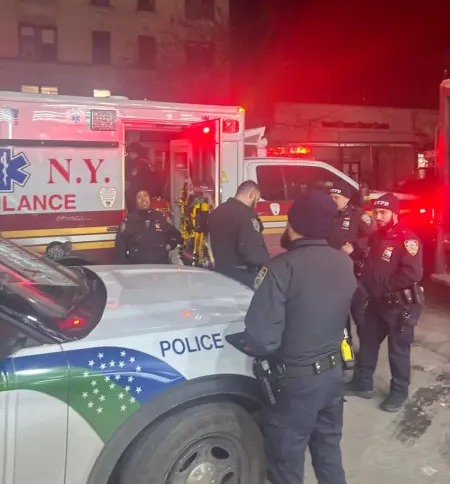
The injured student was transported to a nearby hospital, where he is receiving care. While details of his condition have not been publicly disclosed, the very fact of hospitalization underscores the seriousness of the attack. For Yeshiva University—a cornerstone institution within New York’s Jewish educational landscape—the incident has been a sobering reminder of the porous boundary between campus life and the surrounding urban environment. The daily commute, once perceived as a mundane ritual of academic life, has been abruptly recast as a site of potential peril.
In the hours following the assault, the Anti-Defamation League announced that it was working in concert with law enforcement, community partners, and Yeshiva University to gather additional information. VIN News relayed the organization’s public expression of solidarity with the victim and the broader university community, noting that such interventions, while essential, also signal the degree to which acts of violence reverberate beyond the immediate victim. The ADL’s involvement reflects a broader ecosystem of communal response that has emerged in recent years, one in which civil society organizations, educational institutions, and law enforcement agencies collaborate in the face of incidents that may carry the shadow of bias.
Yet the absence of an established motive leaves the incident suspended in an uneasy limbo. Authorities have not yet classified the attack as a hate crime, a determination that will hinge on evidence not yet available to the public. This ambiguity has generated a peculiar form of anxiety: the fear not only of violence itself, but of the uncertainty that attends its interpretation. In a city where Jewish communities have, at various moments, been the targets of ideologically motivated attacks, the question of motive is never merely academic. It shapes the communal narrative of vulnerability and resilience, influencing how institutions allocate resources and how individuals navigate public space.
The response within the Yeshiva University community has been marked by a mixture of shock and resolve. Students and faculty members, speaking to VIN News, described an atmosphere of heightened alertness, with informal advisories circulating about travel routes and evening schedules. While the university has not publicly announced new security measures in the immediate aftermath, the incident has inevitably prompted renewed scrutiny of how campus safety protocols intersect with the realities of urban transit. The notion that a student could be attacked in a space adjacent to a major subway station—a linchpin of the city’s transportation network—has unsettled assumptions about the protective halo often presumed to surround well-trafficked areas.
The broader implications of the assault for New York’s ongoing struggle to reconcile openness with security. The city’s public spaces, celebrated for their accessibility and vitality, are simultaneously vulnerable to exploitation by those who seek concealment within the urban crowd. Masked group assaults, particularly in infrastructural blind spots, expose the limitations of a security paradigm that relies heavily on visibility and deterrence. The incident near 181st Street thus becomes not only a localized tragedy but a case study in the challenges of safeguarding a sprawling, heterogeneous metropolis.
As investigators work to piece together the sequence of events, the staircase where the attack occurred stands as a stark testament to the consequences of urban neglect. VIN News reported that residents had previously raised concerns about the area’s lack of surveillance, concerns that now assume a tragic prescience. Whether this episode will catalyze concrete improvements—additional cameras, increased patrols, infrastructural redesign—remains to be seen. What is clear is that the violence has ruptured the quotidian rhythms of a neighborhood, injecting a note of dread into what was once a routine passageway.
In the meantime, the community’s attention remains fixed on the recovery of the injured student and on the unfolding investigation. In a city accustomed to absorbing and moving past episodes of violence with weary resilience, this assault has nevertheless struck a nerve. It has illuminated the precariousness of safety in the interstices of urban life and underscored the enduring need for vigilance in spaces too easily overlooked.
