



|
Getting your Trinity Audio player ready...
|
Workers Launch Anti-Israel Crusade in Bitter Union Battle at Iconic NYC Bakery
By: Fern Sidman
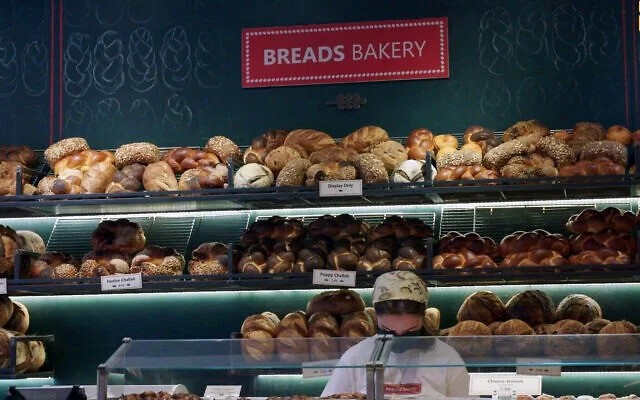
What began as a conventional labor-organizing campaign inside the flour-dusted kitchens of one of New York City’s most celebrated bakeries has erupted into a cultural and political confrontation that now reverberates far beyond the boroughs. Employees at Breads Bakery — the Manhattan-born chain famed for its chocolate babkas and Levantine-inflected pastries — say they are forming a union under the banner “Breaking Breads,” aligning themselves with United Auto Workers Local 2179. But their demands extend far past wages and scheduling. They strike at the heart of the bakery’s identity, its Israeli heritage, and the fraught politics of the Middle East.
According to a report on Thursday at VIN News, more than 30 percent of eligible workers had signed authorization cards as of Tuesday, surpassing the legal threshold required to petition for recognition. The proposed bargaining unit would include roughly 275 employees — bakers, kitchen staff, cashiers, baristas, delivery drivers, and porters — making it, union officials claim, one of the largest craft bakery organizing efforts in New York City in decades.
Yet, as the VIN News report documented, the campaign has ignited fierce backlash, in no small part because of the explicitly political tenor of the union’s demands.
In statements posted on Instagram, Breaking Breads framed its effort in the familiar language of workplace reform: higher wages, safer conditions, predictable schedules, and dignity on the job. Workers allege that despite what they estimate to be more than $30 million in annual revenue, many employees earn between minimum wage and roughly $20 per hour, with little stability in weekly hours. They point to a 2024 incident in which a locker reportedly fell in a staff area, leaving a worker with a concussion — an episode they cite as emblematic of management’s disregard for safety.
These claims, standing alone, would fit neatly into the long history of labor activism in New York’s food industry. But Breaking Breads has tied its campaign to a set of political demands that have set off alarm bells well beyond the bakery world.
As VIN News reported, the group says it will refuse to participate in what it calls “Zionist projects,” including baking cookies adorned with Israeli flags, participating in Jewish cultural festivals, or catering events it claims are connected to organizations that donate “millions each year to the IDF.” The union has further demanded that Breads Bakery end what it characterizes as the company’s support for Israeli causes, including its participation in last year’s Great Nosh, a citywide Jewish food festival held on Governors Island.
This politicization of a labor dispute has drawn blistering criticism from Jewish leaders and commentators. A screenshot circulating widely on social media — and reviewed by VIN News — shows a post by a prominent Jewish journalist who accused the workers of anti-Semitism and urged legal accountability, arguing that they are attempting to target a Jewish business owner “for his beliefs and religious identity.”
The post decries what it calls an effort to use unionization as a weapon to pressure a Jewish-owned company to sever ties with Israel and Jewish communal life. It calls on a major law firm to take up the case, framing the dispute not as labor activism but as discriminatory harassment masquerading as workplace reform.
This rhetoric spotlights the degree to which the campaign has transcended traditional labor lines. As the VIN News report noted, critics argue that refusing to bake items with Israeli symbols or to participate in Jewish cultural events is not protected labor advocacy but a form of ideological coercion aimed squarely at a company’s religious and national identity.
Breads Bakery is no anonymous corporate entity. It is a spinoff of a Tel Aviv-based brand, and its aesthetic and culinary sensibility have always been unapologetically Israeli-Jewish: challah braided to museum quality, tahini-inflected pastries, and the now-iconic babka that has become a shorthand for the chain itself.
That heritage, once a selling point in New York’s competitive food scene, has now become the fulcrum of a cultural struggle. To its employees in Breaking Breads, the bakery’s Israeli roots are no longer merely culinary but political. To its defenders, those same roots are being unfairly weaponized.
The company’s leadership has not yet issued a formal public response to the union announcement, and a spokesperson did not immediately reply to a request for comment, according to the VIN News report. That silence, however, has only intensified speculation.
From a legal standpoint, the workers appear to be following the established playbook. They are asking management to voluntarily recognize the union; if it declines, they say they will file a petition with the National Labor Relations Board seeking a formal election.
But the content of their demands raises complex questions. Labor law protects collective action over wages, hours, and working conditions. It does not clearly protect efforts to compel an employer to renounce religious or national affiliations. As one labor attorney told VIN News on background, a union campaign that veers into ideological territory may find itself on uncertain legal ground.
Jewish organizations across the city have reacted with palpable concern. The bakery’s participation in Jewish festivals, its baking of goods bearing Israeli symbols, and its ties to Jewish charities are not peripheral activities, they argue, but central expressions of cultural identity.
In this light, Breaking Breads’ insistence that it will boycott “Zionist projects” is seen not as workplace advocacy but as a demand for cultural erasure. As VIN News has reported, several community leaders fear that allowing such demands to stand would establish a precedent whereby employees could pressure Jewish-owned businesses to suppress their identity under threat of industrial action.
Union organizers reject that characterization. In their public statements, they frame their opposition to Israeli symbols and events not as hostility toward Judaism but as solidarity with Palestinians and resistance to what they describe as corporate complicity in violence abroad.
They insist that their campaign is rooted in conscience as much as in economics — a blending of labor and moral activism that they see as inseparable. “We are not just fighting for better wages,” one organizer told VIN News. “We are fighting to not be forced into participating in harm.”
The dispute at Breads Bakery has become, in the words of VIN News, a microcosm of America’s larger ideological rupture. It sits at the intersection of labor rights, identity politics, and the global reverberations of the Israel-Palestine conflict — all compressed into the cramped back rooms of a neighborhood bakery.
For management, the stakes are existential: not merely the prospect of unionization, but the prospect of being compelled to abandon the very cultural DNA on which the brand was built. For workers, the campaign represents both an attempt to rectify what they see as exploitative conditions and an assertion of moral agency in the workplace.
Whether Breads Bakery will voluntarily recognize Breaking Breads remains an open question. So, too, does how the National Labor Relations Board would view demands that straddle the line between workplace reform and political coercion.
What is certain is that this is no longer a parochial labor story. It is a test case for how far union activism can reach into the ideological and cultural life of an employer — and for how Jewish institutions in America navigate a climate in which their ties to Israel are increasingly contested, not by governments, but by their own employees.
In the meantime, customers continue to line up for babka, unaware that behind the gleaming pastry cases a profound battle is unfolding — not only over paychecks and lockers, but over identity, conscience, and the meaning of solidarity in a deeply divided age.
